Independent comparisons. We may earn from shop links. More info

Marine and automotive heat shrink wire connectors

Updated: 21 October 2026

Salt air, road spray and trailer vibration punish a joint that looked fine in the driveway. You are likely repairing a lamp feed, an instrument tail or an accessory circuit where a bulky junction block will not fit. Solder-seal heat-shrink butt splices from amazon.co.uk kits in the [solder connectors comparison](/hub/soldering-and-welding/solder-connectors) promise a waterproof inline join. The result still depends on gauge, heating and strain relief, not on an IP badge alone. This page stays with low-voltage vehicle and boat repairs. It is not a ranking of every kit, and it is not a licence to bury a sleeve in a mains wall.

Salt air, road spray and trailer vibration punish a joint that looked fine in the driveway. You are likely repairing a lamp feed, an instrument tail or an accessory circuit where a bulky junction block will not fit.

Our top picks

On this page

What you are joining

Automotive, caravan, trailer and leisure-marine wiring in this category is mostly low-voltage accessory work: lighting, pumps, sensors and audio feeds, where a compact inline splice beats a bulky block. A solder-seal sleeve integrates solder and adhesive so one heating pass can wet the copper and seal the insulation. That is attractive under a wheel arch or inside a transom panel where a crimp tool is awkward. These sleeves are not a shortcut for mains in a habitable space. On the road or on board, disconnect the battery before you heat near fuel vapour, support the loom so vibration does not flex the joint, and keep the cable off edges that can slice the shrink.

Humidity, vibration and IP claims

Listings shout waterproof, marine grade and sometimes IP67. In the captured set, the Feggizuli and greate rows include IP67 marketing. Many others cite dual-wall adhesive without a specific IP code. Treat those phrases as intent, not as a test certificate on your finished repair. Water follows failed adhesive flow, nicked insulation, or flex where the sleeve moves on the conductor. Vibration on trailers and road cars works the joint mechanically. If the copper can move inside a cold solder core, resistance rises and lamps flicker. Heat until the solder fully wets, then anchor the loom so the splice is not a hinge. Cable ties, conduit and grommets matter as much as the sleeve brand. Salt spray on an exposed butt splice still deserves a periodic look. Prefer a join inside a protected space, and keep spare sleeves in a dry case.

Choosing kits for vehicle and boat jobs

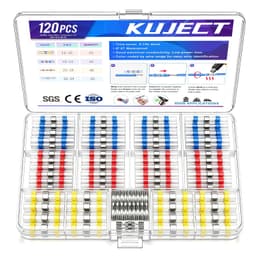
Match sleeve colour to the wire you actually run. Trailer lighting often sits in the red 22–18 AWG band. Fyntave's 200 red sleeves at about £8.98 can beat a rainbow box if the loom is one gauge, but only two UK reviews are on that capture. A mixed harness still wants an assorted kit, such as ELECTRAPICK's 180 pieces at about £7.99 or a Kuject row with the long review file. PERSENTU at about £5.59 for 100 pieces fits a trail-side fix, with only 14 UK reviews. ZIPCCI's 350 pieces at about £19.99 suit owners who rewire often. On a damp deck, compare an IP67 line (Feggizuli, or greate at about £11.99 with 4.6 from 223 reviews) with dual-wall adhesive only, then judge your heating honestly. Disconnect the battery before you cut, and call a professional if a safety-critical circuit misbehaves after the splice. Leave slack so the splice is not pulled sideways when a trailer flexes. Keep a shared car-and-boat case dry, and sort the colours after each job.

Tooling and heat profile

Work with ventilation. Shrink fumes are unpleasant in a closed cabin. greate's capture cites a 230 to 400 °C band. An under-powered gun leaves tight outer shrink and an unmelted solder ring, which fails under spray. If you have no gun, the 400-piece shengbowi kit with a mini 300 W gun at about £29.99 is the explicit tool-plus-consumable row, with five UK reviews on the capture. Otherwise budget a proper gun beside a connector-only kit. The heating order is on how to use solder-seal wire connectors. The method choice against crimps is on solder-seal versus crimp.

UK rules snapshot

Low-voltage vehicle and boat repairs still need sound workmanship. Part P and junction boxes dominate domestic mains, and they are less central here. Shore-power and onboard AC cross into qualified work quickly. Keep DC joins inspectable. A sleeve is not the enclosure if the circuit becomes fixed wiring in a habitable space.

Common questions

Do I need a crimp tool with solder-seal sleeves?
No for the captured solder-seal kits. Heat activates the joint. Many workshops still carry crimpers for other terminal types on the same vehicle. The sleeve itself is not a crimp barrel.
Which colour fits 1.5 mm² cable?
Use the kit chart. Metric sizes map to AWG bands on the packaging, and trailer feeds may differ from domestic lighting cable in the shed. Guessing red versus blue is how the wrong sleeve ends up on a lamp wire.
Can I use these on mains wiring in a wall?
Not as a standalone concealed mains joint. Accessory DC repairs are the focus here. Shore-power and onboard AC need the correct enclosure and, where the rules require it, a qualified installer.
What heat gun temperature do listings cite?
Expect several hundred degrees Celsius on the gun dial for larger sleeves. greate's capture cites about 230 to 400 °C. Judge by solder flow and adhesive rings, not by time alone, and allow for wind on a marina pontoon.
Are IP67 kits truly waterproof?
They are marketed for ingress resistance. Your heating and strain relief decide whether the joint survives a season of spray. Feggizuli and greate are the rows in this set that state IP67. The claim is not a lab result for your repair.
Solder seal or crimp for trailer lights?
Both can work on small gauges. Solder-seal saves a step if you heat correctly. Crimp-plus-shrink can be easier to rework at the roadside if you already practise crimps. Vibration still wants the loom anchored so the splice is not a hinge.
Is a kit with a mini heat gun worth it?
It is useful on a boat or a trailer when you lack workshop gear, provided you practise on scrap wire first. A 300 W mini gun may only shrink the outer wall on a large yellow sleeve.
Why did my solder not melt?
Increase heat at the centre, check the sleeve against the conductor, and avoid moving the gun too fast in a windy marina. If the ring stays dull, cut the sleeve off. A tight outer tube is not a finished join.

Related pages

Sources

Sources taken from the research digest. The digest also points at the stored amazon.co.uk listings. Those are the product rows, not an extra public article.

  1. IET Wiring Matters: terminal blocks (retrieved 21.10.2026)
  2. BuildWiz UK: heat-shrink and enclosures (retrieved 21.10.2026)
  3. Voltimum: termination of conductors (retrieved 21.10.2026)
  4. Professional Electrician: enclosing connections (retrieved 21.10.2026)
  5. HSE: electricity (retrieved 21.10.2026)
  6. Haisstronica: heat shrink and solder-seal connectors (retrieved 21.10.2026)