Independent comparisons. We may earn from shop links. More info

Solder seal wire connectors buying guide

Updated: 21 October 2026

You are about to order a kit from amazon.co.uk for a trailer lamp, a boat instrument feed or a run of garden lights, and the photos all look like coloured heat-shrink tubes with a grey solder ring inside. Before you pick a row in the [solder connectors comparison](/hub/soldering-and-welding/solder-connectors), it helps to know what you are buying: solder-seal butt splices that need a heat gun, not a crimp tool, and that still do not replace a junction box on fixed mains inside a wall. This guide covers gauge colour, kit size, heat tooling and the limits of waterproof claims so you spend once.

You are about to order a kit from amazon.co.uk for a trailer lamp, a boat instrument feed or a run of garden lights, and the photos all look like coloured heat-shrink tubes with a grey solder ring inside.

Our top picks

On this page

What you are joining

Solder-seal connectors join two stripped conductors inline, melt a preloaded solder ring through the strands, and shrink dual-wall tubing so hot-melt adhesive can seal the ends. That is attractive where space is tight and you want one step instead of crimp-then-shrink. Accessory circuits on cars, caravans, trailers, boats and outdoor lighting are the usual UK jobs in this category. Fixed wiring under floors or in walls is a different job. BS 7671 expects live parts in a suitable enclosure, and heat-shrink alone is insulation, not that box. If Part P or notification rules might apply, stop and use a registered electrician.

Gauge colours, kit counts and economics

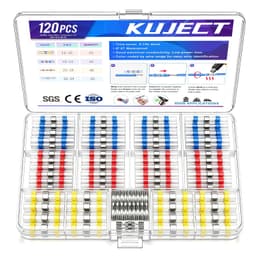
Most assorted kits use white, red, blue and yellow sleeves to map approximate AWG bands. A sleeve that is too large leaves loose metal that may not wet. One that is too small tears insulation or leaves copper exposed. The listing should state which colours ship. The comparison matrix flags mixed AWG sets where the capture recorded them, and single-colour bulk packs where only one band is supplied. Kit economics follow how many joins you will make this year. Captures run from about £5.59 for a hundred pieces to about £29.99 for four hundred pieces plus a mini heat gun. Fifty pieces can finish one lighting repair. A hundred to one hundred and eighty suits most home and garden jobs. Two hundred to three hundred and fifty fits trailer rewires and boat instruments. Four hundred sleeves for three joins wastes space, and a fifty-pack for a full caravan season often means a second order. On a damp boat or in a van, a case that keeps colours sorted beats a bag that mixes sizes. Several rows note a case. Others leave that cell blank.

Tooling and heat profile

Every solder-seal sleeve in this set is activated with heat, not with a crimp die. Listings commonly cite gun temperatures of roughly 230 to 450 °C, depending on sleeve size. Large yellow sizes need a capable two-stage heat gun with steady airflow. A weak mini gun can shrink the outer tube while the solder ring stays solid, which is a common failure in category reviews. Some kits bundle a mini 300 W gun. Most do not. One capture at about £29.99 pairs four hundred pieces with a mini gun in the title. Several kits around eight to twelve pounds assume you already own tooling. A naked flame risks charring the polyolefin and uneven adhesive, and it is a poor fit near fuel. Heat from the centre out, pause until solder flows around the strands, then finish so adhesive tracks out at both ends. If you have never done that sequence, read how to use solder-seal wire connectors before you open the case.

UK rules snapshot

Regulation 526 and related guidance require joints to be mechanically and electrically sound, and properly enclosed where conductors are buried or otherwise need an enclosure. Terminal blocks inside rated boxes, junction boxes with covers and factory-terminated leads sit inside that frame. A solder-seal sleeve on a 12 V lamp feed under a trailer floor is a different risk from a joint in a concealed mains cable. The trailer feed can be appropriate when the circuit is de-energised, the gauge matches and strain is managed. The mains joint still needs the correct box and method. Waterproof and IP67 wording on a listing is marketing intent, not a certificate for your repair. The result depends on strip length, overlap, heating time and whether the cable flexes. The method comparison against crimped splices is on the versus page linked below.

Common questions

Do I need a crimp tool with solder-seal sleeves?
No for the kits captured here. The workflow is strip, insert and heat. A crimp tool does not replace the heat gun, and pliers alone will not melt the internal solder ring.
Which colour fits 1.5 mm² cable?
Assorted kits map colours to AWG bands on the listing chart. 1.5 mm² house cable often sits in the blue or red band, depending on the manufacturer chart. Read the colour table shipped with your kit.
Can I use these on mains wiring in a wall?
Not as a standalone concealed joint. Mains work needs an appropriate enclosure and method under BS 7671. These sleeves are aimed at accessory, vehicle and outdoor lighting repairs unless a qualified installer specifies otherwise.
What heat gun temperature do listings cite?
Many captures mention roughly 230 to 450 °C for the gun setting, while tubing specs may list a lower continuous rating. Heat until the solder visibly wets. Do not stop because the label alone says the job is done.
Are IP67 kits truly waterproof?
IP67 on the box is a product claim, not proof that your joint passed a test. You need full adhesive flow, clean insulation and strain relief. Salt spray and trailer vibration still punish a lazy heat cycle.
Solder seal or crimp for trailer lights?
Solder-seal splices win on speed and compactness when you heat correctly. Crimp-plus-shrink can be easier to inspect and rework if you already own good crimpers. Trailer lighting often uses smaller gauges, where red or blue sleeves dominate either way.
Is a kit with a mini heat gun worth it?
It can be if you own no gun and you will use dozens of connectors. If you already have a workshop heat gun, connector-only kits around eight to thirteen pounds usually offer better value per sleeve.
Why did my solder not melt?
The usual causes are the wrong gun temperature, moving too fast, or a sleeve that is oversized for the wire. Heat the centre first, keep the airflow steady, and cut the sleeve out rather than leaving a cold joint under shrink.

Related pages

Sources

Sources taken from the research digest. The digest also points at the stored amazon.co.uk listings. Those are the product rows, not an extra public article.

  1. IET Wiring Matters: terminal blocks (retrieved 21.10.2026)
  2. BuildWiz UK: heat-shrink and enclosures (retrieved 21.10.2026)
  3. Voltimum: termination of conductors (retrieved 21.10.2026)
  4. Professional Electrician: enclosing connections (retrieved 21.10.2026)
  5. HSE: electricity (retrieved 21.10.2026)
  6. Haisstronica: heat shrink and solder-seal connectors (retrieved 21.10.2026)