Flux for electronics repair: boards, SMD and wires
You are under a magnifier lamp with a lifted pad on a laptop charging port, or swapping an HDMI socket on a console that failed after a power surge. The solder wire melts, but the replacement joint grains and pulls back unless the copper is actively fluxed. Electronics repair flux must wet fine pads without eating them, apply in tiny doses, and leave residue you can live with or wash before a conformal coat. The [flux comparison](/hub/soldering-and-welding/flux) holds five amazon.co.uk listings. This page stays on boards, SMD and rework, not solder-ring plumbing.
You are under a magnifier lamp with a lifted pad on a laptop charging port, or swapping an HDMI socket on a console that failed after a power surge.
You are under a magnifier lamp with a lifted pad on a laptop charging port, or swapping an HDMI socket on a console that failed after a power surge. The solder wire melts, but the replacement joint grains and pulls back unless the copper is actively fluxed. Electronics repair flux must wet fine pads without eating them, apply in tiny doses, and leave residue you can live with or wash before a conformal coat. The flux comparison holds five amazon.co.uk listings. This page stays on boards, SMD and rework, not solder-ring plumbing.
Our top picks
| Badge | Product | Form | Best for | Applicators | Note | Price | Offer |
|---|---|---|---|---|---|---|---|
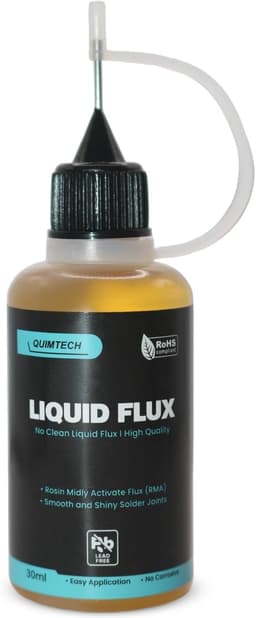
| Best overall |  Quimtech Quimtech RMA liquid flux 30 ml | Liquid bottle | Wires and through-hole | Bottle only | 9.2 | about £11.11 | View offer |
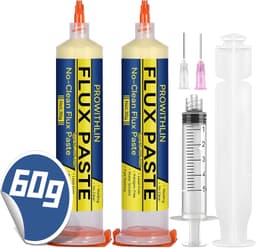
| Alternative |  prowithlin prowithlin syringe flux 2-pack | Syringe paste | Fine pitch and BGA | Needles and pusher | 9.2 | about £13.99 | View offer |
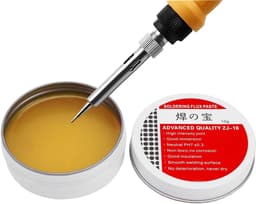
| Best value |  Yiapinn Yiapinn rosin paste 10 g tin | Paste tin | Through-hole and tips | Tin only | 9.0 | about £3.69 | View offer |
On this page
Why board repair needs different flux from the plumbing aisle
Syringe gel for SMD, BGA corners and spot rework
Tin paste for general bench and through-hole
Liquid RMA for wires, connectors and flow-heavy joints
Ventilation and residue on finished boards
Common questions
Do I need flux if my wire is rosin cored?
Is LA-CO OK on laptops?
Paste or liquid under a microscope?
Will no-clean flux ruin a conformal coat?
How much flux on a 0603?
Related pages
Sources
Sources taken from the research digest. Listings were checked on 20 October 2026.
- HSE — INDG249 Solder fume and you (retrieved 20.10.2026)
- HSE — SR20 Rosin-cored solder (retrieved 20.10.2026)
- HSE — Solderers and asthma (retrieved 20.10.2026)
- Water Regs UK — Solders and fluxes (retrieved 20.10.2026)
- WaterSafe — Lead-free solder (retrieved 20.10.2026)
- GOV.UK — General Product Safety Regulations 2005 (retrieved 20.10.2026)
- LA-CO UK (retrieved 20.10.2026)