Independent comparisons. We may earn from shop links. More info

Soldering flux buying guide: tin, syringe or liquid

Updated: 21 October 2026

You open amazon.co.uk for solder flux because the joint looks dull, the iron skates off the pad, or a repair video told you to add paste before the wire. The results mix £3 hobby tins, syringe kits with needles, and trade names that read like plumbing supplies. Before you pick a row in the [flux comparison](/hub/soldering-and-welding/flux), decide what metal you are joining, how you will apply flux, and whether you can ventilate rosin fumes. This guide is the decision order. The main table holds prices and specs once your direction is clear.

You open amazon.co.uk for solder flux because the joint looks dull, the iron skates off the pad, or a repair video told you to add paste before the wire.

Our top picks

On this page

What flux does on the bench

Flux is not solder. It strips oxides for a moment and helps molten alloy wet the surface, then burns off, leaves a film, or stays sticky, depending on chemistry and heat. Rosin comes from pine resin. No-clean aims for low residue after a normal hand-solder profile, and it still smokes. Separate flux matters when cored wire is not enough: old console pads, tarnished brass, or a second pass on a lifted trace. Grease defeats flux. Wipe with isopropyl where it is safe, tin a fresh tip, then add a thin film only where solder must flow. Too much paste on a phone board can wick under connectors.

Choose form and chemistry first

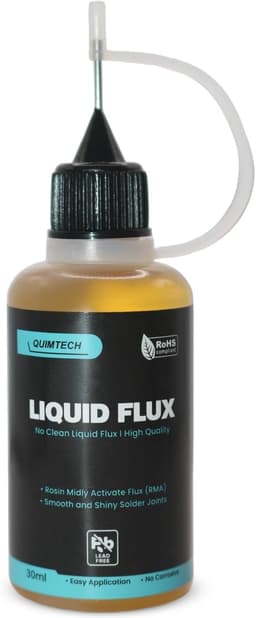
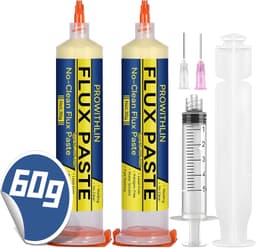
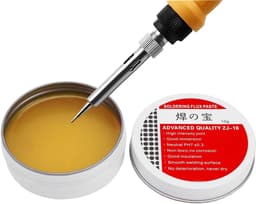
A metal tin suits tip tinning and larger pads, with a toothpick or a brush you supply. Yiapinn at about £3.69 is the budget electronics paste. LA-CO Regular at about £9.10 is the trade tin, with UK reviews about solder-ring plumbing, not fine SMD. Syringe gel meters flux onto a BGA corner or one through-hole. prowithlin at about £13.99 includes needles and a pusher. HELKOX at about £6.89 is cheaper per syringe and had one UK review at the October 2026 check. That is early evidence, not batch proof. Liquid flows into stranded wire and open joints. Quimtech’s 30 ml RMA at about £11.11 has 3,472 reviews at 4.6. The UK capture names a bottle only. Do not assume a needle ships. Chemistry sits on rosin or no-clean flux. Rosin fumes need airflow under HSE guidance, no-clean is not fume-free, and Regular paste is the wrong PCB default unless the supplier sheet says otherwise.

Ventilation, storage and water fittings

HSE treats rosin-based solder flux fume as a cause of occupational asthma in repeated work. At home, use a window or a small extractor, and keep your face out of the plume, even on a no-clean label. Store tins sealed and away from radiators. Dried flux is a common complaint. Syringes still dry if the needle stays on between sessions. A wholesome water joint in England, Wales or Scotland is regulated separately from hobby electronics. Read Water Regs UK and WaterSafe before LA-CO goes on potable copper. Flux for electronics repair sets out why plumbing paste and board paste are not interchangeable.

Map decisions to the comparison table

Filter the main comparison by tin, syringe or liquid once form and chemistry are settled. A small tin covers occasional phone fixes. A sealed 60 g syringe kit lasts years. Compare price per gram, not the rank line alone. A tight budget points to the rosin tin. Applicators in the box point to the twin syringe. Wire-heavy joins and a deep review file point to liquid RMA. Solder-ring copper, with the water rules in mind, points to Regular paste. Scored picks are on best solder flux.

Common questions

Do I need flux if my solder wire has a rosin core?
Often yes for rework. Core flux helps fresh wire on clean copper. Oxidised pads, a second heat, or a lead-free profile frequently need a thin extra film. Heat once the metal is clean. Extra paste will not rescue a greasy pad.
Is no-clean flux safe to breathe?
No. It still fumes, and it may leave a film. Ventilate, and wash your hands. No-clean means you usually skip a board wash. It does not mean the smoke is harmless. HSE links repeated rosin flux fume to occupational asthma.
Paste or liquid for fine stranded wire?
Liquid tends to wick along strands if you control the dose. Paste on a brush can work on tinned ends. Syringe paste wins when you must hit one pad without flooding the neighbours. Hold stranded ends so a run does not reach the insulation.
Can I use plumbing flux on a PCB?
Not as a default. Active plumbing paste can corrode fine copper or fight a conformal coat. Keep it on copper fittings, and check wholesome-water rules. Electronics rosin or no-clean is the board default unless the supplier sheet says otherwise.
Why did my flux paste dry out?
Air and heat. Close the tin, store it cool, and buy a size you will finish inside the seller’s stated shelf life. That date is a seller claim, not a lab check. Syringes dry too if the needle stays on.
What flux for solder-ring copper fittings?
UK buyers in the LA-CO review describe solder-ring work at 15 mm scale. Confirm lead-free solder and flux suitability for wholesome water before you heat a potable line. Otherwise treat the tin as a trade plumbing purchase, not a shortcut for board repair.
How much flux should I apply?
Enough for a thin shine on the joint. A rice-grain of paste on a through-hole pad is often enough. A puddle on SMD, or residue under a chip, means too much flux or an iron that never got hot.

Related pages

Sources

Sources taken from the research digest. Listings were checked on 20 October 2026.

  1. HSE — INDG249 Solder fume and you (retrieved 20.10.2026)
  2. HSE — SR20 Rosin-cored solder (retrieved 20.10.2026)
  3. HSE — Solderers and asthma (retrieved 20.10.2026)
  4. Water Regs UK — Solders and fluxes (retrieved 20.10.2026)
  5. WaterSafe — Lead-free solder (retrieved 20.10.2026)
  6. GOV.UK — General Product Safety Regulations 2005 (retrieved 20.10.2026)
  7. LA-CO UK (retrieved 20.10.2026)