Independent comparisons. We may earn from shop links. More info

Wall plugs: plasterboard or brick

Updated: October 2026

You tap the wall, it sounds hollow in one place and solid in another, and the packet says brick, plasterboard and timber in one breath. Wall plugs for plasterboard or brick are not the same object. A standard rawl plug expands against a solid hole. Plasterboard, and the gap behind dot and dab, do not give it that hole. This page is the fork. The listings are in the [wall plug comparison](/hub/sockets-and-extension-leads/wall-plug). DIY Doctor, a Corefix failure note, Dryline Pro and the five listings were used on 16 October 2026. No load was measured. A qualifying purchase can earn a commission at no extra cost to you.

You tap the wall, it sounds hollow in one place and solid in another, and the packet says brick, plasterboard and timber in one breath. Wall plugs for plasterboard or brick are not the same object.

Our top picks

On this page

Three walls that look the same

Under the paint you usually have one of three things. Solid brick or block, sometimes with plaster stuck to it. Plasterboard on a timber or metal stud, with a cavity behind the sheet. Or plasterboard stuck to masonry with dabs of adhesive, which leaves a gap. Dryline Pro's point is simple: a standard plug does not grip air. All three can look like a flat painted wall. A tap is a hint, not a survey. It fails at a stud, a noggin, or a dab under your knuckle. If you rent, drilling through the lining into the block can damage a finish you do not own. Timber takes a wood screw. A masonry sleeve in a stud is the wrong family.

What a standard plug does in each

In sound brick, block, stone or concrete, the screw spreads the plug against the hole. In plasterboard on studs, the same plug meets a thin sheet, often 12.5 mm, and then an empty bay. DIY Doctor says a normal plug widens the hole in soft board and works loose. Winged plugs for a picture or a coat hook clamp the sheet. They are not a red expansion plug with a new name. In dot and dab, the failure is the gap. Corefix describes the board and a short plug taking the load across the void, because the sleeve never reaches the block. Fischer's 0.15 kN on 12.5 mm plasterboard is a cell for a stated 6 × 30 mm DuoPower. It is not a rating for a PVC sprig or for PlasPlugs. A stud may take a wood screw with no plug. An expansion assortment in that gap is a guess.

What the five listings actually say

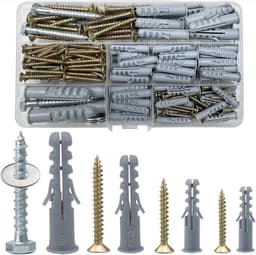
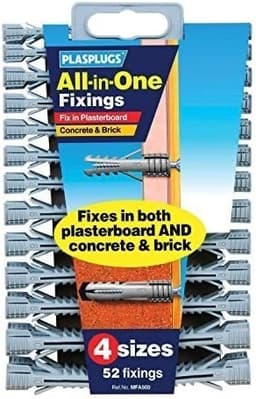
Merriway does not claim plasterboard. The use bullet names solid brick, concrete, stone and masonry. Lemiyoo's title says plasterboard and the use bullet does not. A 4.6 from 736 reviews does not resolve that. Yibaijia names solid and perforated brick and concrete, and drywall only in a highlight. PlasPlugs' title lists hollow cavity, partition and drywall, with no millimetre sizes and no load. DODIYDO's bullet says yes to plasterboard. Reviews limit that yes: smaller plugs are weak in drywall. Universal, on these titles, is a sentence. On Rawlplug UNO it is a geometry and a table. Screwfix lists a red UNO 6 × 28 mm for concrete, brick, stone, block and plasterboard, with screws of 3.5–5 mm. That is not a synonym for PlasPlugs or DODIYDO.

When a different fixing is the buy

If you are in solid brick or block, leave this page and follow the masonry steps on how to fit a wall plug. If you are on plasterboard over a stud, a light picture can use a board fixing that clamps the sheet. A wood screw into a stud needs no plug. Do not continue the masonry sequence on the face of the board. On dot and dab, a short expansion plug is the failure Corefix describes. Reaching the block means a product that states the cavity and the load, and it means a hole in the lining. Renters should assume that hole is damage. Heavy items leave this comparison: television, radiator, cabinet, boiler. None of the five publishes an ETA for a dab gap.

Common questions

How do I tell dot and dab from a stud wall?
A stud wall has timber or metal at regular centres and a hollow bay between them. Dot and dab is board stuck to masonry, with a gap, and a hard spot where a dab sits. A tap can hint and can mislead you. If a drill breaks through into open space and then, deeper, into block, you are likely in a dab gap. Stop and change fixing rather than leaving a short plug in the board.
Will a universal plug hold a shelf on board?
Only if that plug's own table says so for that board and that screw, and a shelf is often already too much for the sheet. Rawlplug UNO publishes substrate lines for named sizes. Fischer's plasterboard cell belongs to DuoPower, not to these assortments. PlasPlugs and DODIYDO use universal language without that table. Do not transfer 0.15 kN onto a grey plug.
What should I use for a light picture on board?
A fixing that clamps plasterboard, or a screw into a stud, for a light frame. DIY Doctor treats winged plastic board plugs as the light end, a picture or a coat hook. Keep the masonry assortment for brick. On dot and dab, a clamp on the sheet still only holds the sheet. The gap behind it is unchanged.
What should I use for a television?
The bracket manufacturer's fixing, into a stud or into masonry with a stated anchor, not one of these five packs. No listing here shows an ETA for that job. One DODIYDO reviewer already refused a flat screen.
Does a hollow sound always mean I must not use a rawl plug?
It means you must not assume the plug will meet solid material. A hollow bay can hide a stud you can screw into, with no plug. A dab gap can hide block you could reach with a long specified fixing. A standard rawl plug in the board, or floating in the gap, is the case to avoid.

Related pages

Sources

Public UK sources on masonry plugs, plasterboard fixings, and drilling near cables. Listings checked 16 October 2026. Prices on amazon.co.uk move.

  1. DIY Doctor, fixing to masonry (retrieved 16 October 2026)
  2. DIY Doctor, fixing to plasterboard (retrieved 16 October 2026)
  3. Rawlplug UNO data sheet (retrieved 16 October 2026)
  4. Fischer DuoPower ETA (retrieved 16 October 2026)
  5. EOTA EAD 330284-00-0604 (retrieved 16 October 2026)
  6. HSE, work near electricity (retrieved 16 October 2026)
  7. HSE CIS65 (retrieved 16 October 2026)
  8. BSI, BS EN 14566 (retrieved 16 October 2026)