Independent comparisons. We may earn from shop links. More info

Socket cube with USB: about 12 W, not a 65 W brick

Updated: 23 October 2026

You want the phone beside the lamp without a second plug in the bedside socket. A socket cube with USB in this set offers about 12 W, shared. That tops up a phone or a small tablet. It does not replace a laptop charger. A rocker may kill the 13 A faces and leave the USB live, which one Status review describes. The table is the [socket cube comparison](/hub/sockets-and-extension-leads/socket-cube). Peter F., editor for DIY & tools, did not time any charges. Watts are the amazon.co.uk figures, read on 21 October 2026. A qualifying purchase can earn a commission at no extra cost to you.

You want the phone beside the lamp without a second plug in the bedside socket. A socket cube with USB in this set offers about 12 W, shared. That tops up a phone or a small tablet. It does not replace a laptop charger.

Our top picks

LENCENT LENCENT 3-way cube

Best overall

LENCENT LENCENT 3-way cube
8.7/10about £14.99
Aodeng Aodeng 3-way adaptor

Alternative

Aodeng Aodeng 3-way adaptor
8.0/10about £17.99
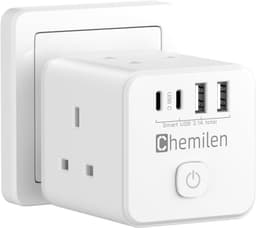
Chemilen Chemilen 3-way cube

Alternative

Chemilen Chemilen 3-way cube
8.3/10about £13.99
On this page

12 W is phone charging

Five volts at about 2.4 A is 12 W, the JSVER and LENCENT budget, and the size of a basic phone plug. A laptop at 45 W or 65 W needs Power Delivery named on its charger. USB-C in this set is still a 5 V hole. Aodeng prints a combined 5 V / 3.4 A for four ports. Chemilen says USB-C up to 15.5 W. None of that is a 65 W brick. Which?, quoting Tim Benham, warns that several USB ports on one adaptor can be overloaded, and he advises against overnight charging on a piled block. The mains path is still 13 A, covered on how to use a socket cube. A 65 W UGREEN lead showed up in search and is not in this table.

What each cube in this set prints

LENCENT B09GLQRR5W, about £14.99, has three AC outlets and two USB ports at 12 W. JSVER, about £12.99, prints a 12 W total and a named 13 A fuse, and also says 2.4 A per port. Aodeng, about £17.99, combines four ports at 5 V / 3.4 A. Chemilen, about £13.99, prints USB-C up to 15.5 W at 4.1 from 20 reviews. Status, about £13.98, has three USB ports on a 1.4 m lead and prints no watts. The Masterplug table mentions USB the bullets never describe, so it is not a USB cube. Which body to buy is on best socket cube UK.
LENCENT LENCENT 3-way cube

Testsieger

LENCENT LENCENT 3-way cube
8.7/10about £14.99

Per port is not the total

When both a per-port figure and a total appear, use the total. Aodeng’s 2.4 A and 3.0 A ports share 5 V / 3.4 A. Chemilen says up to 15.5 W and 12 W, and a reviewer says the four ports share about 3.1 A. At 5 V that is about 15 W for the bank. JSVER prints 2.4 A per port and a total of 12 W. Two phones split 12 W. LENCENT prints one 12 W maximum for two ports. Status prints nothing, so you cannot plan a rate. A Kemelo lead at 20 W USB-C was dropped from this category as an extension lead. Do not borrow that wattage for these wall cubes.

The switch and a dead USB port

The Status bullets do not mention a switch. A UK review does: the switch cuts the 13 A sockets, the USB stays on, and the USB plugs get hot. If you wanted chargers off at night, unplug at the wall. Aodeng claims one switch for mains and USB. Chemilen claims a switch and an LED. Those are claims. USB can die while the mains faces work. Another Status review found the ports dead on arrival. JSVER reviews describe melting and blown fuses within about three months with the USB unused. If a charger stays warm with the switch off, pull the cube.

A USB cube is a charger as well as an adaptor

Schedule 1 of the Plugs and Sockets etc. (Safety) Regulations 1994 puts an adaptor that contains another device, other than a fuse, a switch or an indicator, outside the plain-adaptor rules. A built-in USB charger is that device. That classifies the object. It does not make it illegal to own. JSVER and Chemilen name a 13 A fuse. LENCENT prints 3,250 W and does not name a fuse as a fuse. Status names neither, and the plug field says Type B. Pins and shutters are on the socket cube buying guide. Use these cubes for one or two phones in a dry room. For 65 W, leave the table.

Common questions

Is 2.4 A per port the same as 2.4 A for every port at once?
Only when the total says so. JSVER’s total is 5 V / 2.4 A, 12 W, so the ports share it. Aodeng’s combined line is 5 V / 3.4 A. A Chemilen reviewer describes about 3.1 A across four ports. LENCENT prints one 12 W maximum. Two devices split that total.
What does USB 3.0 on the LENCENT table mean?
It is the connector field. The charge bullet says 12 W, 5 V / 2.4 A. USB 3.0 there does not mean a faster rate or Power Delivery. One review found phone charging fine, which matches 12 W. Quote the watt line when you compare.
Does the switch turn the USB off?
On the Status, a review says the switch cuts only the 13 A sockets and the USB plugs get hot. Aodeng claims one switch for both. Chemilen claims a switch and an LED. The Masterplug switches mains faces and does not describe USB. For a dark night, unplug at the wall unless you have seen the ports go off.
Why did the USB ports fail while the mains sockets worked?
They are a separate circuit. A Status review found USB dead on arrival while the 13 A sockets worked. Working mains faces do not prove the charger. JSVER reviews describe melt and blown fuses with the USB unused. Try a known phone on day one, and stop if the plastic smells.
Where do I go if I need 65 W?
Out of this category. The Aodeng at about £17.99 still prints 5 V and 3.4 A combined. A 65 W search hit such as the UGREEN lead is not in the table. The Kemelo 20 W USB-C cube was an extension lead and was removed. Buy a charger labelled with the watts you need.

Related pages

Sources

Sources taken from the research digest. Listings were scored from stored amazon.co.uk rows. This page did not run a lab test.

  1. Electrical Safety First — block adaptors (retrieved 22.10.2026)
  2. Electrical Safety First — appliance ratings (retrieved 22.10.2026)
  3. Electrical Safety First — plugs and fuses (retrieved 22.10.2026)
  4. Plugs and Sockets etc. (Safety) Regulations 1994 (retrieved 22.10.2026)
  5. BSI, BS 1363-3:2023 (retrieved 22.10.2026)
  6. IET Wiring Matters — BS 7671 FAQ (retrieved 22.10.2026)
  7. NICEIC — bathrooms and electrics (retrieved 22.10.2026)