Independent comparisons. We may earn from shop links. More info

How to fit a TV aerial socket on an existing cable

Updated: 22 October 2026

The downlead is already in the back box, and you want to know how to fit a TV aerial socket without losing Freeview. By the end you should be able to remake one joint, test it, and know when to stop. This is not a loft install and not a dish. The cable needs a little spare. Product rows stay on the [aerial socket comparison](/hub/sockets-and-extension-leads/aerial-socket). Which plate belongs on that cable is on the [TV aerial wall socket buying guide](/hub/sockets-and-extension-leads/aerial-socket/sub/aerial-socket-buying-guide). Peter F. used maker leaflets and the fitting faults in these listings, not a bench test. A qualifying purchase can earn a commission at no extra cost to you.

The downlead is already in the back box, and you want to know how to fit a TV aerial socket without losing Freeview. By the end you should be able to remake one joint, test it, and know when to stop.

Our top picks

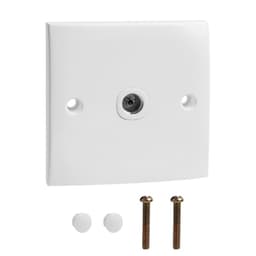
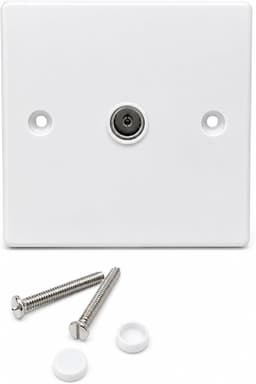
DRUT DRUT metal faceplate

Alternative

DRUT DRUT metal faceplate
7.2/10about £8.99
On this page

Before you unscrew the old plate

If the box might contain mains, switch that circuit off and prove it is dead. The MK leaflet says not to install this outlet with mains above 50 V. Earth a metal plate where BS 7671 requires it. If you cannot see an earth path, stop. Do not work on the aerial in a thunderstorm. Keep spare sheath past the clamp. If the end is green or already short, stop cutting. A screwdriver in the pack only turns the face screws. Follow the leaflet if one is there. If it is not, the lengths below are the usual UK range.

Braid, core, and the clamp

Strip about 15 to 25 mm of outer sheath. Smart Aerials uses about 20 mm. SatCure uses about 25 mm. Fold the braid back as a collar and keep every strand off the centre. Expose about 5 to 8 mm of the inner conductor. One braid strand on the core shorts the aerial, and DIY Doctor’s note is that the set then sees little or nothing. The braid goes under the clamp and the core goes in the centre terminal. Tighten until the copper is held, then stop. An over-tight screw can shear the conductor, which SatCure warns about and a DRUT review reports. A TIANXUAN reviewer stripped a clamp screw and found the screws were not M3. A deeper screened body is a different fit, on the screened or unscreened TV socket page.

Back in the box

Offer the plate up before you tighten the face screws. A 25 mm box, the minimum BG states for the 960-0J, is only just deep enough. Push the cable in as a loop. If the plate sits flush only when the sheath folds sharply, the box is too shallow. A kinked dielectric breaks the picture even when the joint looked neat. Screened euro modules often need 35 mm. The Knightsbridge module Screwfix sells at £4.49 including VAT will not curl into a shallow plaster box.

Then the fly-lead

On a normal house aerial both sockets are female, so the lead is male-to-male IEC. An F-lead belongs on an F-socket. A Voltrique review says the socket broke off the face as the lead went in. Power the set only after the plate is screwed back, and look for a picture before you retune. If this room died as you tightened the plate, stay with the joint. If every room died, or the fault started in wet weather, the plate is the wrong suspect. Call a CAI-registered fitter for the loft, the roof, or a core too short to remake. That order is on the Freeview aerial socket no signal page.

Common questions

How far do I strip the sheath and the core?
UK fitting guides cluster around 15 to 25 mm of outer sheath and about 5 to 8 mm of bare centre conductor. Smart Aerials uses about 20 mm of sheath and about 5 mm of core. SatCure uses about 25 mm and 5 mm. Use the leaflet in the pack if it prints a figure. Leave enough spare for one remake.
What happens if one braid strand touches the core?
The downlead is shorted and the television loses the aerial, even though the plate looks fitted. Fold the braid back as a collar and check the centre hole for whiskers before you tighten the clamp. A new faceplate will not cure a strand you left in place. Pull the plate off and look, rather than retuning a short.
How tight should the centre screw be?
Tight enough to grip the copper, and no tighter. An over-driven screw can shear the conductor, which SatCure warns about and which a DRUT buyer reported. The MK leaflet also says the braid clamp must not squash the dielectric flat. If the screw has already cut the core, you need spare cable for a fresh end, not another turn of the screwdriver.
Do I need to isolate the mains?
Yes, if the box might contain power, and you should prove the circuit is dead before you strip anything. The MK instruction is not to install this outlet in an enclosure with mains above 50 V. Earth a metal plate where BS 7671 requires it. A plastic coax plate is still not a reason to work in a live box.
What fly-lead do I use afterwards?
For a female wall plate and a female television input, use a male-to-male IEC lead and seat both plugs fully. That is the usual house TV point. An F-lead is for a threaded satellite socket. If the new plate is male, a standard male-to-male lead will not fit, and you bought the wrong gender. The buying guide covers that choice before you strip the cable.
When do I stop and call an aerial fitter?
Stop if the cable is too short, the core is severed, the box contains mains you cannot separate, or the run continues into a loft, a roof or a communal riser. Water-stained cable and a picture that a sound joint and a new fly-lead do not restore are fitter jobs too. Do not keep fitting cheaper plates into a damaged end. A CAI member is the usual route BBC Reception points to for an installer.

Related pages

Sources

Sources taken from the research digest. Listings were scored on 22 October 2026. This page did not run a lab test. No plate here is claimed as EN 50083-2 Class A.

  1. Planning Portal — aerials and dishes (retrieved 22.10.2026)
  2. BG Electrical — 960-0J coaxial socket (retrieved 22.10.2026)
  3. MK — TV/FM outlet instructions (retrieved 22.10.2026)
  4. Hager — UKCA declaration (retrieved 22.10.2026)
  5. EN 50083-2:2012 foreword (retrieved 22.10.2026)
  6. Schneider Electric UK — isolated outlets (retrieved 22.10.2026)
  7. Ofcom — 700 MHz coexistence (retrieved 22.10.2026)
  8. Freeview — avoiding interference (retrieved 22.10.2026)