Oxeye daisy or English daisy
You want a white daisy with a yellow eye, and the two native plants that match that photo are not interchangeable. Oxeye daisy or English daisy is a height decision before it is a brand decision. Oxeye, Leucanthemum vulgare, is a meadow perennial the RHS lists at up to 90 cm. English daisy, Bellis perennis, is a rosette to about 10 cm. In the nine packets on the [Daisy seeds](/hub/seeds-and-plants/daisy-seeds) comparison, three listings are oxeye and one is Pomponette, a double bedding strain of Bellis, not the wild lawn single. If you wanted a frost-tender carpet, use the [daisy seeds buying guide](/hub/seeds-and-plants/daisy-seeds/sub/daisy-seeds-buying-guide). Links to Amazon are affiliate links.
You want a white daisy with a yellow eye, and the two native plants that match that photo are not interchangeable. Oxeye daisy or English daisy is a height decision before it is a brand decision.
You want a white daisy with a yellow eye, and the two native plants that match that photo are not interchangeable. Oxeye daisy or English daisy is a height decision before it is a brand decision. Oxeye, Leucanthemum vulgare, is a meadow perennial the RHS lists at up to 90 cm. English daisy, Bellis perennis, is a rosette to about 10 cm. In the nine packets on the Daisy seeds comparison, three listings are oxeye and one is Pomponette, a double bedding strain of Bellis, not the wild lawn single. If you wanted a frost-tender carpet, use the daisy seeds buying guide. Links to Amazon are affiliate links.
Our top picks
| Badge | Product | Species | Stated height | Life cycle | Note | Price | Offer |
|---|---|---|---|---|---|---|---|
| Best overall |  JustSeed JustSeed oxeye daisy, 3 g | Leucanthemum vulgare | 65 cm | Not stated on the listing | 7.4 | about £4.25 | View offer |
 Mr Fothergill's Mr Fothergill's oxeye daisy | Oxeye daisy, Latin name not in the file | 60 cm | Hardy perennial, flowers next year | 6.4 | about £3.79 | View offer | |
 Generic Nika English daisy Pomponette | Bellis perennis Pomponette | 15 cm | Biennial, double bedding strain | 3.6 | about £2.95 | View offer |

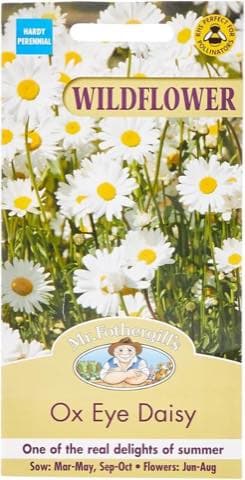

The tall meadow daisy
The low lawn daisy
When to pick which
Common questions
Which one belongs in a lawn?
How tall is oxeye compared with the lawn daisy?
Will Pomponette look like the wild lawn daisy?
Can I put oxeye in a small formal border?
Is oxeye invasive in the UK?
Related pages
Sources
Sources taken from the research digest. Listings were checked in October 2026.
- RHS — Leucanthemum vulgare (retrieved 21.10.2026)
- RHS — How to sow a wildflower patch (retrieved 21.10.2026)
- RHS — Bellis perennis (retrieved 21.10.2026)
- RHS — Cleretum bellidiforme (retrieved 21.10.2026)
- RHS — Gerberas growing guide (retrieved 21.10.2026)
- RHS — How to grow erigeron (retrieved 21.10.2026)
- Seed Marketing Regulations 2011, regulation 4 (retrieved 21.10.2026)
- The Marketing of Ornamental Plant Propagating Material Regulations 1999 (retrieved 21.10.2026)
- Woodland Trust — Oxeye daisy (retrieved 21.10.2026)
- Wildlife and Countryside Act 1981, Schedule 9 (retrieved 21.10.2026)
- RHS — Brachyscome iberidifolia (retrieved 21.10.2026)