Independent comparisons. We may earn from shop links. More info

How to use wood screws

Updated: October 2026

A sharp point on the packet is not a promise that the timber will not split. This is how to use wood screws without chewing the head or bursting the edge: match the bit the packet names, decide whether this joint needs a pilot, and let the clutch stop the head flush. A bullet that says no pilot is about that maker’s point in ordinary softwood. It is not a rule for hardwood, an edge, or the edge of an MDF board. Products Compared read the amazon.co.uk listings in the [wood screws comparison](/hub/screws-and-accessories/wood-screws). There is no lab test here. A qualifying purchase can earn a commission at no extra cost to you.

A sharp point on the packet is not a promise that the timber will not split.

Our top picks

On this page

Bit before trigger

PZ means a Pozidriv bit, PH means Phillips, and a hex flange means a socket. BuildWiz puts PZ2 on about 3.5 mm to 5.0 mm, and PZ3 from about 6.0 mm. The Index screw is 6.7 mm external hex, and reviewers use an 8 mm socket. Drywall screws are often PH2, which is how a Phillips bit ends up in a wood screw. A Phillips bit in a Pozidriv screw cams out. A Pozidriv bit in a Phillips screw does not seat. Gorffy reviews describe a shallow recess that skips on a powered driver. The tick marks are on the Pozidriv and Phillips page. If ForgeFast says Pozi in the bullet and Torx in the spec, look at the screw. Seat the bit square and start slowly.

Length and the second piece

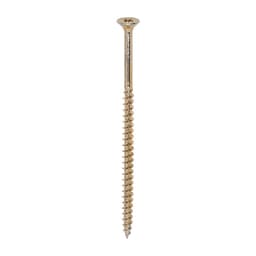
On a countersunk screw, length includes the head. bolts.co.uk measures from the point to the flush surface. A workshop habit is to leave at least as much screw in the second piece as the top is thick. That is a rule of thumb, not a line on these packets. Through 18 mm chipboard, a 30 mm screw leaves about 12 mm in the stud. A 50 mm or 60 mm screw leaves a clearer grip if the point stays inside. Solo is 100 mm with 70 mm of thread from 80 mm up, so the plain shank can pull the top tight. A fully threaded 40 mm screw can jack the joint apart. Diameter sits on the buying guide.

Pilot and clearance

Pine will often take a sharp screw without a pilot, away from the edge. You still pilot in hardwood, within about 25 mm of an edge or about 30 mm of end grain, and for stainless or brass. Those distances are BuildWiz’s rule of thumb, and they are not printed on these boxes. For a 5.0 mm screw, BuildWiz suggests a softwood pilot around 3.5 mm, a hardwood pilot around 4.0 mm, and a 5.0 mm clearance through the top piece only. The European Panel Federation suggests MDF face screws at least 12 mm from an edge and a pilot about 85 to 95 percent of the core diameter. Drill that pilot in the edge of an 18 mm shelf. A ForgeFast review still used a short pilot on a fence.

When to stop

Set the clutch so it slips as the head reaches flush. In chipboard, one extra second pulls the head through the face. Stop when the head is flush. A Brackit review says the head snaps off with an impact driver, and another buyer broke seven screws in ten. Index hex heads survive impact in sleeper reviews and they also ruin 8 mm sockets. Use the combi drill and the clutch on a countersunk Pozi box. Use a socket on the green hex timber screw, and stop before the flange crushes the timber. A joist, a stair, a guard or a connection on a drawing is a professional job. Outdoor coatings are on the decking and sleepers page.

Common questions

Do I need a pilot in pine?
Away from edges and end grain, a sharp chipboard screw often starts in pine without a pilot. Reviewers say that about Solo and about ForgeFast in softwood. Near an edge, in a thin strip, or where a previous screw has already split the grain, drill a pilot smaller than the thread. One buyer in the Solo reviews heats each screw to protect small pine. A pilot is the calmer version of that trick.
What bit size is PZ2 for?
PZ2 is the usual Pozidriv bit for wood screws around 3.5 mm to 5.0 mm. PZ3 starts to matter from about 6.0 mm. A 4.0 x 30 mm or 5.0 x 40 mm Pozi box in this set is a PZ2 job. The 6.7 mm Index screw is external hex, and reviews name an 8 mm socket. PH2 is the Phillips size, and it is not a substitute for PZ2.
How do I stop before the head pulls through chipboard?
Use a clutch that slips as the head meets the face, and stop when the head is flush. Chipboard has a hard skin over a softer core, so the head punches through if you keep driving. If the clutch is already at its highest setting and the screw will not finish, the pilot is too tight or the bit is the wrong cross.
What is a clearance hole for?
A clearance hole is the full shank diameter through the top piece only. The thread then bites the second piece and the head pulls the top piece down. Without it, a fully threaded screw can hold a gap open. BuildWiz’s rule of thumb for a 5.0 mm screw is a 5.0 mm clearance in the top and a smaller pilot in the bottom.
Can I use an impact driver on these boxes?
On the Pozi assortments, the Brackit reviews are a warning: heads snap, and one buyer broke most of the screws they tried. A combi drill with a clutch is the better match for countersunk wood screws. The Index hex timber screws are the listing reviewers drive hard into sleepers. Even there, sockets wear out. If the screw is for a carcass, leave the impact driver in the bag.

Related pages

Sources

Public UK sources on timber fasteners, UKCA, recess types, gauges and stainless grades. Listing prices and star counts are from the amazon.co.uk extracts kept for this comparison on 15 October 2026. Prices move.

  1. BSI, BS EN 14592:2022 (retrieved 15 October 2026)
  2. GOV.UK, designated standards for construction products (retrieved 15 October 2026)
  3. Fastener + Fixing, structural timber fasteners and UKCA (retrieved 15 October 2026)
  4. BS 1210:1963, withdrawn 1 July 2014 (retrieved 15 October 2026)
  5. bolts.co.uk, guide to common recess styles (retrieved 15 October 2026)
  6. B&Q, nails, screws and wall plugs (retrieved 15 October 2026)
  7. Screwsline, metric or imperial (retrieved 15 October 2026)
  8. TIMCO, stainless steel FAQ (retrieved 15 October 2026)