Independent comparisons. We may earn from shop links. More info

How to use a hollow wall anchor setting tool safely

Updated: 22 October 2026

You have the pliers and one metal cavity anchor, and the plasterboard is a stud wall with a void behind it. How to use a hollow wall anchor setting tool is a short order of work: drill the hole the packet names, seat the anti-rotation lugs, leave the screw proud, and squeeze until you feel resistance. Then stop. A harder second squeeze punches thin board. The ten cards are on the [hollow wall anchor setting tool comparison](/hub/screws-and-accessories/hollow-wall-anchor-setting-tool). Peter F. followed Rapid and Rawlplug's guides, not a lab test.

You have the pliers and one metal cavity anchor, and the plasterboard is a stud wall with a void behind it.

Our top picks

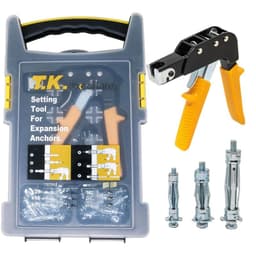
TOPWAY TOPWAY molly gun

Best overall

TOPWAY TOPWAY molly gun
9.2/10about £9.79
On this page

Before you drill

You need a real void and the drill size printed on the sleeve in your hand. Tap the board, or use a stud finder, so the hole lands in the bay. Bare UK plasterboard is often 12.5 mm. If you cannot find a void, or the load is a television or a basin, fix into a stud. Whether this wall should get a sleeve at all is on plasterboard cavity fixing gun. Use the diameter on your packet. Rawlplug's Interset chart is 8 mm, 10 mm and 12 mm for M4, M5 and M6 in that range only. Drill square and clear the dust so the lugs sit flush. The screw stays in the anchor.

Set the anchor

Push the sleeve in until the flange meets the face. Unscrew until a section of thread still holds and the head stands proud enough for the jaws. Rapid's guide is to leave that section, then tap the teeth so they bite the plaster and stop the body turning. Keep the tool square. If you cock it, the nose slips off a small head and the lugs tear the paper. Squeeze until you feel resistance. On a ratchet tool, press the release, let the handles open, and pull again. A non-ratchet tool is one stroke, under about 20 mm, aimed at board around 12.5 mm or less. A Timco merchant guide says stop when the set feels firm. Resistance means the legs have met the back of the board, not that you should keep going. If the handles meet and you feel nothing, wind the screw in and squeeze once more, then stop.
TOPWAY TOPWAY molly gun

Testsieger

TOPWAY TOPWAY molly gun
9.2/10about £9.79

Hang the item

Once the sleeve has set, take the screw out. Pass it through the bracket, mirror plate or rail, and refit it by hand before you use a driver. The anchor is already expanded. You are only clamping the fitting against the flange. Stop when the item is snug. Extra turns pull the flange into the face and crush the gypsum. A screwdriver can turn the lugs instead of pulling the head. That choice is molly setting tool vs screwdriver. Here the driver comes out only for the refit. If the flange sank below the paper, do not hang the item on that hole.

When the tool does nothing

If the handles shut easily when empty, then lock once a sleeve is in the nose, that is a bad tool. T.K.Excellent reviews include handles that are hard to start or that lock. Philoch reviews include missing E-clips, and without that clip the pivot cannot hold the pull. Return the tool. TOPWAY states a 14 mm stroke. One review found that pull too short for a long M5, including a long TIMco sleeve. Another squeeze will not add stroke the pliers do not have. Reviews on Brackit and TOPWAY describe a washer under a small head. That is a workaround buyers tried, not a maker step, and it can stop the flange sitting flat. A qualifying amazon.co.uk purchase can earn a commission at no extra cost to you.

Common questions

Do I take the screw out before I drill?
No. Drill the bare hole to the diameter on the sleeve packet. The screw stays in the anchor while you insert the sleeve and tap the lugs. You remove the screw only after the sleeve has set, so you can pass it through the fitting and wind it back in. Taking it out first leaves you with a sleeve that will not draw up when you squeeze.
How far do I leave the screw proud?
Leave a section of screw, in Rapid's wording: still threaded in the sleeve, with the head far enough out for the jaws to hook it. There is no single millimetre that suits every nose. If the handles close and you feel nothing, wind the screw in and squeeze again. If you leave so little thread that the head is buried against the flange, the jaws never get a purchase.
What if the handles close and nothing happened?
The sleeve did not collapse. Wind the screw in and pull again, with the tool square and the lugs still biting the face. If that second squeeze is also empty, stop. The hole may already be enlarged. Do not reuse it for another anchor, and do not keep pulling until the handles bottom out. An empty close with no resistance is a missed set, not a finished one.
Which drill bit, 8 mm, 10 mm or 12 mm?
Use the bit your packet prints. Rawlplug's Interset chart uses 8 mm, 10 mm and 12 mm for M4, M5 and M6 in that range. Another maker's chart does not copy those holes, so an M5 from a different packet may not be 10 mm. One universal bit is how a sleeve either rattles or splits the face. If the packet has no diameter, do not guess from the M number on the tool title.
Can I keep squeezing until the flange looks perfect?
No. Stop at the first firm resistance. Timco's merchant guidance is to stop when the set is firm and not to over-pull. A further squeeze on thin board can punch the sleeve through and leave a hole larger than the flange. The flange should sit on the face, not disappear into it. If it already has, that fixing is finished in the wrong way, and the item should not hang there.

Related pages

Sources

Public UK sources from the research digest, used for this page in October 2026. Prices, stars and review counts are from the ten amazon.co.uk listings captured on 19 October 2026. There is no laboratory test. A 65 lb listing line is not a safe working load.

  1. Fischer UK, metal cavity fixing HM (retrieved 19 October 2026)
  2. Fischer UK, cavity fixing DuoHM (retrieved 19 October 2026)
  3. Rawlplug, SM Interset (retrieved 19 October 2026)
  4. Rawlplug, AT-88 setting tool (retrieved 19 October 2026)
  5. British Gypsum Site Book (retrieved 19 October 2026)
  6. Wonkee Donkee, metal anchor expansion tools (retrieved 19 October 2026)
  7. Rapid, how hollow wall anchors work (retrieved 19 October 2026)
  8. Consumer Rights Act 2015, section 9 (retrieved 19 October 2026)