Independent comparisons. We may earn from shop links. More info

How to screw down decking boards so they stay flat

Updated: October 2026

The joists are level and you are about to drive one screw into the middle of each crossing. Stop there. One screw is the usual reason boards cup and split later. The TDCA method is two screws at every joist, set in from the ends, with a pilot where the timber can split and a head that finishes flush. This page is the method. Packs are in the [decking screws comparison](/hub/screws-and-accessories/decking-screws). Figures are from October 2026 listings, not a lab test. A qualifying purchase through our links can earn a commission at no extra cost to you.

The joists are level and you are about to drive one screw into the middle of each crossing. Stop there. One screw is the usual reason boards cup and split later.

Our top picks

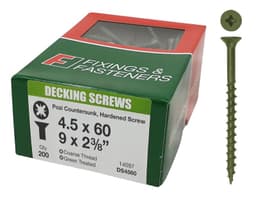
Forgefix ForgeFix 4.5 x 60 mm

Best overall

Forgefix ForgeFix 4.5 x 60 mm
9.2/10about £5.84
TIMCO TIMCO Classic 4.5 x 70 mm

Best value

TIMCO TIMCO Classic 4.5 x 70 mm
8.9/10about £8.50
On this page

Where the screws sit

Use two screws wherever a board crosses a joist, at the quarter points of the width. On a 145 mm board that is about 36 mm in from each edge. Two fixings stop the board twisting as it wets and dries. Keep screws 25 mm in from each cut end, or the end grain splits. Where two boards meet, each end gets its own pair, so that joist takes four screws. A 3 x 3 m deck with 145 mm boards and joists at 400 mm centres needs about 320 screws, which is two boxes of 200.

Length and pilots before the driver

The TDCA wants a screw at least 2.5 times the board thickness: 50 mm for 20 mm boards and 75 mm for 30 mm boards. A 28 mm board wants about 70 mm. In softwood, many screws start without a pilot in the middle of the board. Drill one within 25 mm of the ends. In hardwood, pilot every fixing about 2 mm larger than the shank. A type-17 claim, such as on the Zynthor 4.8 x 75 mm pack, does not replace that advice.
Forgefix ForgeFix 4.5 x 60 mm

Testsieger

Forgefix ForgeFix 4.5 x 60 mm
9.2/10about £5.84

Head depth and a driver that stays in the recess

Drive each head flush, neither proud nor sunk into a cup. A proud head catches bare feet. A deep cup holds water against the coating, and the TDCA says a damaged coating is where corrosion starts. Wear eye protection. HSE guidance covers eye protection with power tools, and splinters and broken bits come up at face height when you kneel. UK reviews of ForgeFix Pozi screws, and of TIMCO Classic, describe stripped heads under an impact driver. Keep the bit straight and slow down as the head meets the board. When a Torx drive is worth it is in the decking screws buying guide.

When fixing it yourself should stop

A sound, low deck is a reasonable DIY job. Soft or rotten joists will not hold new screws, so replace the frame first. Ask a builder if the deck needs a guard, or if it meets the house in a way that could affect a damp-proof course. GOV.UK says garden decking is no longer permitted development under Class E once it is a raised platform over 0.3 m. Planning permission and Building Regulations can apply above that. Check with your local authority. Oak and the coast need the grades in stainless or coated decking screws. Hollow boards are covered in composite decking screws or clips.

Common questions

How many screws per decking board at each joist?
Use two screws wherever a decking board crosses a joist, placed at the quarter points of the board's width. The TDCA recommends this because two fixings stop the board twisting and cupping around a single pivot. Where two board ends meet over the same joist, each end gets its own pair, so that joist takes four screws.
How far from the end of a deck board should screws go?
Keep decking screws about 25 mm in from the cut end of each board, as the TDCA recommends. Screws closer to the end act as wedges in the end grain and split the board, often weeks after fixing. Drill a pilot hole at the ends even in softwood, because that is where splits start.
Do you need to pre-drill decking boards?
In treated softwood, you can usually drive decking screws without a pilot hole in the middle of a board, but you should pre-drill within 25 mm of the ends. In hardwood, the TDCA recommends a pilot on every fixing, about 2 mm larger than the screw shank. A type-17 or no-pilot claim on a listing does not replace that advice.
Should decking screw heads be flush or countersunk below the surface?
Decking screw heads should finish flush with the board surface. A head left proud is a trip hazard and catches bare feet. A head driven deep below the surface leaves a cup that holds water against the coating and timber, which encourages corrosion and rot. Slow the driver as the head nears the surface and stop when it is level.
Why do decking screws strip and what should I do?
Decking screws usually strip when the bit is worn, the driver is at an angle, or an impact driver hits a knot at full speed. UK reviews of Pozi decking screws describe exactly this. Use a fresh bit that matches the recess, keep the driver straight and slow down near the surface. Remove a stripped screw with an extractor before refixing.
Can I screw down decking boards over rotten joists?
No. New screws will not hold in soft or rotten joists, and the boards will loosen again quickly. One UK review of a budget decking screw describes exactly that disappointment on a repair over rotten timber. Replace the affected joists, or ask a professional to assess the frame, before you fix any boards on top.
Do I need planning permission for a raised deck?
According to GOV.UK permitted development guidance, garden decking is no longer permitted development under Class E once it forms a raised platform over 0.3 m. Above that height, you may need planning permission, and Building Regulations can apply. Check with your local planning authority before you build, and treat a raised deck as more than a board-fixing job.

Related pages

Sources

Public UK sources on deck fixings, stainless grades, salt spray, permitted development and eye protection. Listing prices and star counts are from the amazon.co.uk extracts kept for this comparison on 15 and 16 October 2026. Prices move.

  1. TDCA, Deck fixings FAQ (retrieved 16 October 2026)
  2. TDCA, Metal fixings (retrieved 16 October 2026)
  3. GOV.UK, Permitted development technical guidance (retrieved 16 October 2026)
  4. BSSA, Stainless steel fasteners (retrieved 16 October 2026)
  5. ISO 9227:2017 (retrieved 16 October 2026)
  6. TIMCO, Salt-spray test reports (retrieved 16 October 2026)
  7. Ecodek, Composite screws and clips (retrieved 16 October 2026)
  8. HSE, Using the right type of PPE (retrieved 16 October 2026)