Independent comparisons. We may earn from shop links. More info

Decking screws buying guide: length, metal and drive

Updated: October 2026

You have treated softwood boards in the garden, joists already level, and an amazon.co.uk search that mixes 50 mm green screws, 75 mm packs and 200 mm hex bolts. This decking screws buying guide puts the choice in order: the job first, then the length for your board, then the metal for your garden, and only then the drive and the price. Named packs are ranked in the [decking screws comparison](/hub/screws-and-accessories/decking-screws). Prices and stars below are from those listings in October 2026, not a lab test. A qualifying purchase through our links can earn a commission at no extra cost to you.

You have treated softwood boards in the garden, joists already level, and an amazon.co.uk search that mixes 50 mm green screws, 75 mm packs and 200 mm hex bolts.

Our top picks

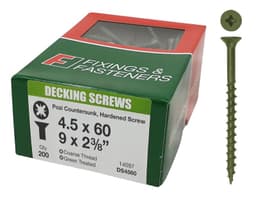
Forgefix ForgeFix 4.5 x 60 mm

Best overall

Forgefix ForgeFix 4.5 x 60 mm
9.2/10about £5.84
TIMCO TIMCO Classic 4.5 x 70 mm

Best value

TIMCO TIMCO Classic 4.5 x 70 mm
8.9/10about £8.50
On this page

Board screw or frame screw

A deck-board screw fixes a board of roughly 20 to 32 mm onto a joist, with a countersunk head that sits flush. A frame screw holds joists to posts or sleepers and needs a long hex head and washer. The AJ Timber 200 mm hex coach screws have strong UK reviews for sleeper beds, but an 8 mm head will not sit flush in a board. The Zynthor 6.7 x 63 mm pack is a frame fixing even where the listing mentions decking. If you see a hex head, a washer or the words coach screw, keep it for the frame.

Length against board thickness

The TDCA says a deck screw should be at least 2.5 times the board thickness: 50 mm for 20 mm boards and 75 mm for 30 mm boards. A 50 mm screw therefore suits fence slats, trellis and thin boards, not a typical 28 mm deck. Egertons is slightly more relaxed for 32 mm softwood: 4.5 x 60 mm or 5 x 65 mm, if at least 25 mm ends in the joist. Measure one board, because planed timber is often thinner than the sawn size.
Forgefix ForgeFix 4.5 x 60 mm

Testsieger

Forgefix ForgeFix 4.5 x 60 mm
9.2/10about £5.84

Metal for this timber and this garden

Green organic-coated carbon steel is reasonable for an inland deck on treated softwood. BSSA names A2 (304-type) as general outdoor stainless and A4 (316-type) for coastal, estuarine or road-salt sites, under BS EN ISO 3506. Oak needs stainless whatever the postcode. ISO 9227 does not turn a salt-spray hour figure into years outdoors, and TIMCO's 1,008-hour result is for its In-Dex range only. The split is on stainless or coated decking screws.

Drive, point, and how many to buy

ForgeFix uses Pozi, and UK reviews describe heads that strip when an impact driver hits a knot. Torx T25, on the METALLIXITY and Zynthor 4.8 x 75 mm packs, holds the bit better, and HOME IT A4 uses TX20. Pozi is usually fine on a drill-driver with a gentle clutch. Type-17 tips often start in softwood away from the ends, but the TDCA still wants pilots at board ends and a larger pilot in hardwood. Spacing is in how to screw down decking boards. Named picks are on best decking screws.

Common questions

How long should a decking screw be for a 28 mm board?
By the TDCA rule of at least 2.5 times the board thickness, a 28 mm deck board needs a screw of about 70 mm. A 60 mm screw still leaves around 32 mm in the joist, which meets a 25 mm minimum embedment some timber merchants use, but it falls short of the 2.5 times rule. If you can buy 70 or 75 mm at a similar price, take the longer screw.
Is a 50 mm decking screw enough?
A 50 mm decking screw is enough for boards of about 20 mm, which is the TDCA worked example. For the 28 to 32 mm softwood boards most UK garden decks use, 50 mm leaves too little thread in the joist. Keep 50 mm boxes for fence slats, trellis, thin boards and light repairs rather than a new deck.
Can I use green coated decking screws in oak?
You should not use green coated carbon-steel screws in oak. Oak and other tannin-rich timbers react with ordinary steel, staining the wood and attacking the screw. Use stainless steel instead, and A4 (316-type) if the deck is also near the coast. Pre-drill every hardwood fixing with a pilot about 2 mm larger than the screw shank, as the TDCA advises.
Pozi or Torx decking screws for an impact driver?
Torx, a star drive, is the safer choice with an impact driver, because the bit sits deeper and is less likely to cam out and strip the head. UK reviews of Pozi decking screws describe stripped heads when the driver hits a knot. Pozi works well enough with a drill-driver on a low clutch setting, especially when the board is pre-drilled.
Do self-drilling decking screws need a pilot hole?
Type-17 or cutter-point decking screws often start in softwood without a pilot hole away from the board ends. The TDCA still recommends a pilot at board ends, where splits begin, and on every hardwood fixing. A listing that says no pre-drilling is needed is a product claim, not a fixing standard, so pre-drill the ends anyway.
How many decking screws do I need per joist?
Use two screws at each point where a board crosses a joist, placed at the quarter points of the board width and about 25 mm in from the board ends. A 3 x 3 m deck with 145 mm boards and joists at 400 mm centres needs around 320 screws, so plan for two boxes of 200.
What is the difference between decking screws and coach screws?
Decking screws are countersunk, around 4.5 to 5 mm thick and 50 to 75 mm long, and they fix boards flush to joists. Coach screws have a hex head and often a washer, and they are much longer, up to 200 mm, for posts, sleepers and frames. Do not use coach screws on deck boards, because the heads stand proud and trip people.

Related pages

Sources

Public UK sources on deck fixings, stainless grades, salt spray, permitted development and eye protection. Listing prices and star counts are from the amazon.co.uk extracts kept for this comparison on 15 and 16 October 2026. Prices move.

  1. TDCA, Deck fixings FAQ (retrieved 16 October 2026)
  2. TDCA, Metal fixings (retrieved 16 October 2026)
  3. GOV.UK, Permitted development technical guidance (retrieved 16 October 2026)
  4. BSSA, Stainless steel fasteners (retrieved 16 October 2026)
  5. ISO 9227:2017 (retrieved 16 October 2026)
  6. TIMCO, Salt-spray test reports (retrieved 16 October 2026)
  7. Ecodek, Composite screws and clips (retrieved 16 October 2026)
  8. HSE, Using the right type of PPE (retrieved 16 October 2026)