Stop screwdriver cam out: pressure, size and speed

Stop a screwdriver bit camming out by matching the recess, standing square and slowing the drill. A harder tip still slips if the drive or size is wrong.
On this page

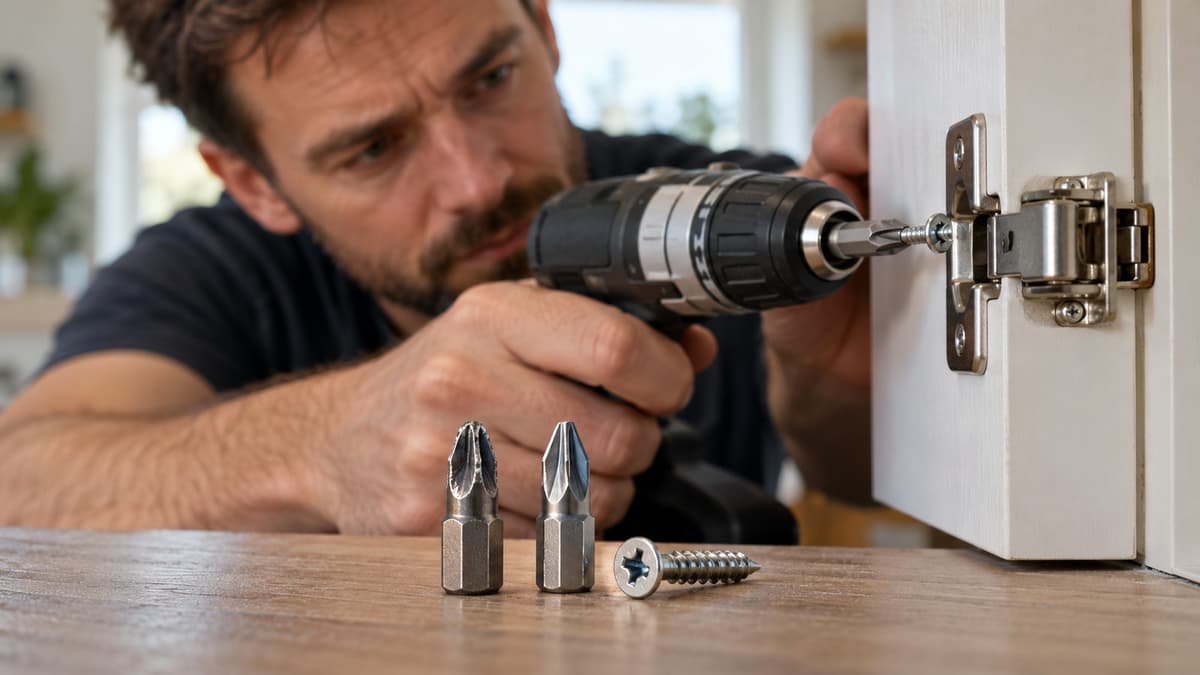
The hinge is half on, the cross has gone bright, and the drill squeaks as the bit jumps. Leaning harder turns a head you could still save into a round coin. Accu groups the usual causes as the wrong type or size, no push along the screw, an angle off square, and speed that is too high. Check those four before a new set becomes the repair.
In short
Stop screwdriver cam out by matching the recess, keeping the bit square, pushing along the screw, and dropping the speed before you buy a harder tip. Cam-out is the bit climbing out of the head while you are still turning. A fresh bit, including one sold as S2, still slips in the wrong drive. If the recess is already a shining dish, more lean makes the next attempt worse.
Cam-out is the bit climbing out
Cam-out is the bit leaving the recess while the chuck is still turning. On a Phillips screw the flanks slope, so turning force pushes the tip out as well as around. When your push along the screw is lighter than that lift, the bit climbs, spins on the rim, and polishes the metal. You hear a chirp and see a bright ring. A bit slipping out of the screw is that climb, a second too late.
Pozidriv adds small ribs between the arms of the cross, and a PZ bit is cut to fill them. A Phillips bit sits on the cross, misses the ribs, and walks out. An angle does the same to a correct PZ2, because one rib takes the load and the others stay empty. The Pozidriv and Phillips comparison separates the two crosses before you blame the drill.
Wiha’s note on conical drives is plain about the aftermath. The bit can leave the screw, mark the paint, and injure you on the way. Wear glasses, because that jump throws chips. Torx and hex resist the climb because their walls sit nearer to parallel. They still spin when the size is wrong or the tip is worn. A T20 in a T25 rounds the star. A clean recess can still be saved by fit, angle, push and speed. A smooth dish has lost the walls that locate a bit. Stop while a corner is still there.
Four checks before you add force
Run these checks with the drill switched off, and take the battery off before you swap the bit. A spinning chuck is how a slip becomes a cut.
- Match the family the recess was cut for: Pozidriv where you can see ticks between the arms, Phillips where the cross is a plain X, and Torx only in a star.
- Choose the largest size that sits in the recess and does not rock on the rim, then confirm the fit by feel.
- Hold the bit square to the screw so the shank, the holder and the fastener are one line.
- Push along the screw until the tip stays seated, turn slowly, and stop at the first rise.
A PZ1 rattles in a hinge cut for PZ2, and a PZ3 sits on the rim and never enters. Many UK cabinet hinges are PZ2, so start there until the bit feels seated. If the drill is cocked around a carcass, move your feet so the chuck, the bit and the screw are one line. Push when screwing is the check people skip, then overdo. Keep enough force along the shank for the whole turn. Your full weight on a 25 mm bit, until the timber splits, is past that. One slow turn with your spare hand clear is the test. A chirp means stop.
A lone PH2 fails the first check on a Pozidriv screw. The bit set comparison is whether you own both families in this size. The top pick, the Bosch 32-piece extra-hard set, was listed at about £8.36 on amazon.co.uk on 15 October 2026, with two PH2 and two PZ2 at 25 mm on a 1/4 inch shank, a magnetic holder, and 4.7 from 26,022 reviews. S2 is not named on that listing.
Speed, clutch and the moment you stop
Drill speed and cam out travel together. High rpm shortens the time the tip spends in the flanks, on the first turns and again when the head seats. Use the low gear if the combi has one, and feather the trigger. A clutch set for a long screw keeps turning after a hinge screw has seated, and it keeps turning while the bit is climbing. Toolstation pairs that torque with size. Start lower than on the last heavy screw. If the clutch clicks and the screw has barely moved, step up one number and keep the same square push. If the bit rises, leave the clutch alone. No single number suits every hinge and decking screw, so this page prints none.
Stop at the first climb. One chirp, caught at once, can leave a mark you can still drive after you reseat the bit and go slower. Three more seconds on the trigger make a dish. Seat the bit until the hex is home. If the bit falls out when you point the drill at the floor, it is loose, and a loose bit will cam out of a sound screw. Clutch habit and seating sit on the how to use a bit set page.
What a new bit will not fix
A worn bit tip is the cause a new bit actually cures. Hold it to a lamp. The corners should be crisp. A rounded, chipped or polished end no longer fills the recess, so it cams out of a screw a fresh tip of the same size and family would drive. Replace that bit. A fresh S2 bit still cams out of the wrong recess. S2 names a steel. It says something about how soon the corners round, and nothing about the pattern on the end.
The Bosch 43-piece extra-hard set in the same comparison is listed at £14.50 and does name S2, with PH, PZ, slotted, Torx and tamper Torx in the set name. Open it when your tips are genuinely worn. It is a weak buy if the hinge screw is Pozidriv and the only bit you own is Phillips. Impact on a packet is a torsion zone for an impact driver. It adds no ribs to a Phillips tip, and it rebuilds no rounded recess. If the right tip, held square and slow, still climbs out of a clean recess, look at wear or a bent holder. A dish means any new steel is late. Buy the bit for the next screw.
When you abandon the screw
Abandon the screw when a matched bit will no longer locate. Fit the right family and the largest size that seats, stand square, push, and turn slowly through a quarter turn. If the bit climbs at once and the centre is smooth, stop. Further attempts eat the rim. Cam-out can cut your hand. The chuck keeps turning after the bit leaves, and the holder can skate into the hand steadying the work. Keep that hand off the line of the screw, and wear glasses. A chip from the head is a real eye risk on a single hinge.
These bits are not insulated screwdrivers. The shank is 1/4 inch steel in a metal holder. Leave any screw in a live fitting until the circuit is isolated. Leave the screw as well when it is the only thing holding a door or a cupboard, or when you suspect it runs towards a cable. A sharp PZ2 does not buy you another thirty seconds of trigger on a head that has already let go.
This page follows Accu’s usual causes, Wiha’s note on conical drives, and the Bosch listings in the bit set comparison on amazon.co.uk as of 15 October 2026. We have not lab-tested how hard you should push, and we do not print a clutch number. A qualifying purchase through our links may earn us a commission at no extra cost to you.
Common questions
Why does the bit climb out of the screw?
Does more pressure always help?
Should I slow the drill down?
Is a worn tip the cause?
Do Torx screws cam out less?
Can cam-out cut my hand?
Will a new set fix a Phillips bit in a Pozidriv screw?
When do I abandon the screw?

Peter F. is the editor for DIY & tools at productscompared.co.uk. Comparisons in this category are checked against amazon.co.uk listings, review evidence and public UK sources.
Related articles

Pozidriv and Phillips mix-up: which bit to use
The ticks between the cross mean Pozidriv. A Phillips bit in that recess cams out even when the tip is new.

Stripped screw when to stop: the shine is the limit
A shining recess will not take another hard lean. Stop before the next attempt turns the head into a dish.
How often to replace PZ2 bit: when the tip is done
No screw count tells you a PZ2 is finished. Rounded corners on the tip are the sign to swap it.