Independent comparisons. We may earn from shop links. More info

Wood or metal circular saw blade for the right job

Updated: 22 October 2026

You own a wood circular saw, a 165 mm cordless perhaps, and a length of aluminium trim or a piece of angle iron is on the bench. The temptation is to fit the same 80-tooth Saxton you use on MDF and feed slowly. That path dulls carbide quickly, grabs on ferrous stock, and ignores speed marks written for a different tool class. In this amazon.co.uk comparison, wood ATB discs, one large Evolution aluminium blade, and one BRSCHNITT ferrous blade are three separate families. Tooth count does not cross those lines. Start from the [circular saw blade comparison](/hub/saw-accessories/circular-saw-blade), then keep each family on its own job.

You own a wood circular saw, a 165 mm cordless perhaps, and a length of aluminium trim or a piece of angle iron is on the bench. The temptation is to fit the same 80-tooth Saxton you use on MDF and feed slowly.

Our top picks

On this page

A wood ATB blade stays on timber and board

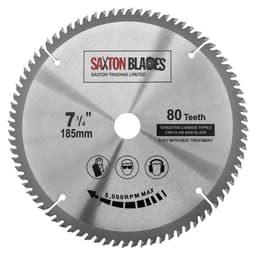
The Saxton wood listings, 165 mm 60- and 80-tooth and 185 mm 80-tooth, describe timber, board, laminates, and plastic. They use an ATB grind for wood fibres, not the triple-chip geometry shops use on non-ferrous metal. Reviewers put them on worktops, oak flooring, and plywood. That does not make them aluminium blades. Steel risks kickback and ruins the edge. More teeth improve a visible wood edge and do not licence metal. Diameter, bore, and speed still come first, in the circular saw blade buying guide. Aluminium extrusion or ferrous angle means you leave this family.

Aluminium in this set is one Evolution blade

Evolution B0173J4FFG is sold as an aluminium blade: 255 mm, 80 teeth, 25.4 mm bore, about £87.98, 4.5 from 36 reviews. It targets Evolution saws and other machines that accept that size and bore, not a 165 mm handheld upgrade. The material field describes the work, not a claim that the plate is aluminium. The UK review in the file mentions cleaner cuts than a standard blade and questions whether about three times the price is worth it on small jobs. Evolution’s 185 mm multi-material advert is a different SKU. Other UK shops stock separate 165 mm aluminium blades, which is the trade treating non-ferrous as its own shelf. Match diameter and bore before stars.

Ferrous metal is the BRSCHNITT blade, and not for wood

The BRSCHNITT listing, B0CSBVP2XX, is a 165 mm, 48-tooth ferrous metal blade at about £20.99, 4.3 from 214 reviews. Bullets state iron, angle, sheet, pipe, and rebar, with a recommended 3,000 rpm and a maximum 5,000 rpm. They also state never use on wood. The arbor is described as 20 mm and 15.875 mm, with no ring listed in the components held for this comparison. UK reviews split: clean cuts in tube and roofing sheet for some buyers, early failure after roughly seven to ten cuts in heavier box section for others. Cutting oil appears in user comments but not in included components. A handheld wood saw often exceeds 5,000 rpm on no load, so matching 165 mm is insufficient if the speed mark is wrong. This is not a blade to mount for mostly wood with one steel bracket.

A multi-material title is not a test

DeWalt’s DT10640-QZ can appear under language that suggests wider materials, yet the amazon.co.uk bullets in this snapshot describe ripping and cross-cutting timber, plywood, MDF, and chipboard. That is not structural steel, and not the ferrous bullet line of the BRSCHNITT disc. Kerf remains unstated in the raw fields. You cannot infer metal capacity from a thin-kerf claim alone. Spark-free lines on other Evolution products are not test results for these ASINs. Structural steel, repeated ferrous cuts, or a site where PUWER applies to guarding and speed need the rated saw, or a fabricator. Among wood blades only, tooth bands are on circular saw blade tooth count.

Common questions

Can I cut aluminium with the Saxton wood blade if I go slowly?
You should not plan on it. Wood ATB teeth are not designed for aluminium swarf and heat. Shops sell separate non-ferrous blades for that reason. A slow feed does not turn an alternating top bevel into a triple-chip grind, and it does not change the material bullet on the Saxton wood listings.
Will more teeth turn a wood blade into a metal blade?
No. An 80-tooth wood blade remains a wood blade. Tooth count changes finish on timber, not material class. The Saxton 185 mm 80-tooth top pick is still a timber and board disc. Aluminium in this set is the Evolution 255 mm blade, and ferrous work is the BRSCHNITT listing.
What saw does the Evolution blade in this set actually fit?
One that accepts 255 mm discs with a 25.4 mm bore and rpm within the blade mark, typically an Evolution mitre saw or a dedicated aluminium setup. It is not a general 165 mm cordless blade. The listing is about £87.98, 80 teeth, 4.5 from 36 reviews, and the material field names the work, not the plate.
Can the BRSCHNITT blade go on my cordless wood saw?
Only if you verify the arbor, the 165 mm diameter, and that the saw’s speed stays within the 5,000 rpm maximum. The listing recommends 3,000 rpm for iron and angle. Many cordless wood saws exceed 5,000 rpm on no load, which makes the pairing unsafe despite the shared diameter. No reducing ring is listed.
The DeWalt title says multi-material. Does that include steel?
Not according to the wood-focused bullets in this snapshot. DT10640-QZ describes ripping and cross-cutting timber, plywood, MDF, and chipboard. For ferrous work, use the BRSCHNITT listing on a suitable saw, not the DeWalt framing disc. A thin-kerf claim with no millimetre figure is not a metal rating.
Can I cut steel and then cut timber with the same blade?
The BRSCHNITT blade explicitly excludes wood. Even on ferrous-only jobs, mixed DIY use tends to contaminate workpieces and guards. Treat ferrous and wood as separate setups, with the speed mark checked on the metal blade and the wood ATB disc kept for timber and board.

Related pages

Sources

Public UK sources and the amazon.co.uk listings stored for this comparison on 19 October 2026. Page updated 22.10.2026.

  1. HSE WIS16: Circular saw benches — Safe working practices (retrieved 19 October 2026)
  2. HSE: Circular saw benches used for ripping (retrieved 19 October 2026)
  3. HSE: Woodworking machinery standards (retrieved 19 October 2026)
  4. HSE L114: Safe use of woodworking machinery (retrieved 19 October 2026)
  5. BSI: BS EN 847-1:2017 (retrieved 19 October 2026)
  6. Trend: Saw blade safety sheet (retrieved 19 October 2026)
  7. DeWalt DCS391 instruction manual (retrieved 19 October 2026)