Independent comparisons. We may earn from shop links. More info

How to change a circular saw blade in the right order

Updated: 22 October 2026

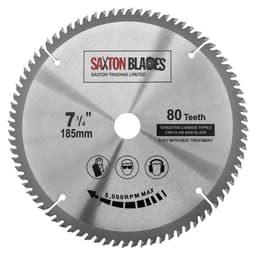
You have a new disc in hand, perhaps a 165 mm Saxton with a 16 mm ring or a DeWalt framing blade, and the saw is still on the bench with the cable plugged in or the battery seated. The injury cases HSE cites around woodworking saws often start with someone reaching for the arbor while the machine can still start. This page is the sequence for a handheld circular saw: isolate power, match the rotation arrow, turn the screw the way that manual specifies, seat any reducing ring, and restore the lower guard. It does not rank blades. Diameter and tooth count are on the [circular saw blade comparison](/hub/saw-accessories/circular-saw-blade).

You have a new disc in hand, perhaps a 165 mm Saxton with a 16 mm ring or a DeWalt framing blade, and the saw is still on the bench with the cable plugged in or the battery seated.

Our top picks

On this page

Isolate the saw before the wrench

Remove the battery from a cordless saw or unplug a corded one before you touch the blade or guard. Check the trigger cannot be pressed accidentally. A still trigger with power removed is the baseline. Retract the lower guard by hand and confirm it springs back. A guard that sticks open after a blade change is not ready for work. If resin or dust binds the guard, stop and clean with the machine isolated. HSE WIS16 warns never to clean a running blade. Only after isolation should you look for the rotation marks. Which disc you bought is a separate decision, covered in the circular saw blade buying guide.

Match the arrow, not the printing

Blades carry an arrow. The saw body or lower guard carries a matching arrow. The teeth must point in the direction of travel when the motor spins, which is what the guard arrow shows, not necessarily the side where the brand name prints. DeWalt’s DCS391 manual is explicit: align the blade arrow with the lower-guard arrow, and do not assume the label faces you when that alignment is correct. A blade fitted backwards still spins, but it burns timber and throws dust the wrong way. One reviewer of the DeWalt 40-tooth reported that until the disc was turned over.

The screw direction is on that saw

This is where generic web guides fail UK owners. DeWalt’s cordless DCS391 uses a left-hand thread on the clamping screw: you turn clockwise to loosen and anticlockwise to tighten, opposite to many bench tools. DeWalt’s corded DWE550 and DWE560 manual states a right-hand thread: clockwise to tighten, anticlockwise to loosen. Both are DeWalt. The thread direction is model-specific. Use the blade-lock button or block the blade only while the saw is stopped. Never wedge a tooth against wood with power connected. Remove the outer clamping screw and outer washer as your manual shows. On the DCS391 you do not remove the inner flange. Do not lubricate the washer area unless the manual asks for it. If the screw will not move and the head is rounding, stop.

Seat the ring, then restore the guard

If the new blade matches the arbor, place the disc on the inner flange with the arrow aligned. When the bore is 20 mm and the spindle is 16 mm, or the box includes a ring as the Saxton wood blades often do, fit the ring first. Trend’s sheet says to trial-fit it, tap it flush, and reject it if loose. It must be thinner than the plate and covered by the flange. Reinstall the outer washer and screw the way your saw turns, by hand plus a short wrench movement. Do not hammer the screw. The guard should cover the teeth at rest and move freely. Cracks or missing carbide tips mean scrap. If the guard, riving knife, or arbor will not settle, that is a workshop job. HSE rip-saw guidance expects the knife thicker than the plate and thinner than the kerf. After the thin-kerf Saxton 60-tooth, confirm the knife still fills the gap: one review said a very thin plate missed it. Tooth bands are on circular saw blade tooth count.

Common questions

Do I remove the battery or unplug before touching the blade?
Yes. Isolation first, every time, on cordless and corded saws. Take the battery out or pull the plug before you retract the guard or put a wrench on the arbor. A trigger that cannot fire because the power is gone is the baseline, not an optional extra.
Which way do the teeth face?
Follow the arrow on the blade matched to the arrow on the saw or lower guard. Printing orientation is misleading. DeWalt’s DCS391 manual says to align those two arrows and not to assume the label faces you. A disc fitted backwards still spins, but it burns timber and throws dust the wrong way.
Is every DeWalt blade screw left-hand thread?
No. The cordless DCS391 is left-hand: clockwise loosens, anticlockwise tightens. The corded DWE550 and DWE560 manual specifies right-hand thread, clockwise to tighten. Read the sheet for your exact model. Both are DeWalt, and the thread is not shared across the range.
How do I loosen the DCS391 screw?
Clockwise to loosen, anticlockwise to tighten, with the battery removed and the blade locked as the manual describes. You remove the clamping screw and the outer washer. On the DCS391 the inner flange stays on. If the head starts to round, stop rather than forcing a longer lever.
What if the reducing ring rattles in the bore?
Do not use it. Trend’s fitting sheet treats a loose ring as unacceptable even when the outer flange feels tight. Obtain a correct ring or a blade with the native bore for your arbor. The ring must sit flush, stay thinner than the plate, and be covered by the flange.
When should I stop and call someone instead of forcing the screw?
Rounded screw heads, a guard that will not seat, a riving knife that no longer aligns with the stated kerf, or a bent arbor are all stop points. PUWER duties on site equipment may require documented maintenance rather than improvisation. A longer lever on a rounding screw turns a blade swap into an arbor repair.

Related pages

Sources

Public UK sources and the amazon.co.uk listings stored for this comparison on 19 October 2026. Page updated 22.10.2026.

  1. HSE WIS16: Circular saw benches — Safe working practices (retrieved 19 October 2026)
  2. HSE: Circular saw benches used for ripping (retrieved 19 October 2026)
  3. HSE: Woodworking machinery standards (retrieved 19 October 2026)
  4. HSE L114: Safe use of woodworking machinery (retrieved 19 October 2026)
  5. BSI: BS EN 847-1:2017 (retrieved 19 October 2026)
  6. Trend: Saw blade safety sheet (retrieved 19 October 2026)
  7. DeWalt DCS391 instruction manual (retrieved 19 October 2026)