Independent comparisons. We may earn from shop links. More info

Aluminium saw blade vs steel cutting blade

Updated: October 2026

You already own a wood blade, or a carbide blade that says it will cut steel, and you want to know whether it is the aluminium tool. An aluminium saw blade vs a steel cutting blade is a comparison of two jobs, even when both plates say carbide. A blade that names steel is a different tool from a blade that names aluminium and plastic. The [circular saw blade for aluminium comparison](/hub/saw-accessories/circular-saw-blade-for-aluminium) holds the eleven amazon.co.uk listings we checked on 16 October 2026. This is the Products Compared editorial team. We used those listings and public UK maker pages, not a lab, and a qualifying purchase can earn a commission at no extra cost to you.

You already own a wood blade, or a carbide blade that says it will cut steel, and you want to know whether it is the aluminium tool.

Our top picks

On this page

A wood blade is not a shortcut

A wood blade pulls the work in. That hook is the wrong action on aluminium, which is soft and quick to grab a thin wall. Key Blades states that a wood hook which draws the piece toward the teeth is the wrong action, and that ferrous metal belongs on a low-rpm cold saw. They sell that geometry, so keep the distinction and treat the page as a merchant argument. Putting a steel-cutting blade on a wood mitre saw with the guard tied up does not meet the EIS12 note on a linked guard. The 165 mm BRSCHNITT says never to use the blade on wood. EXFEIN’s bullet names wood as well as metal. Quote the bullet on the blade you bought. BAUBECK’s UK reviews are timber and skirting, not an aluminium edge. Size and bore stay on the buying guide.

What the steel-capable listings actually show

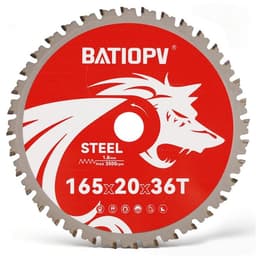
Four 160–165 mm listings name steel as well as aluminium. Saxton’s UK titles include a metal shed and cutting ali, and one review says it lost half its teeth. Those titles are not a measurement of the edge. The 165 mm BRSCHNITT’s UK reviews are iron tube, box and roofing sheet. Aluminium is a question on that page, not the theme. EXFEIN’s reviews mention sheet, steel and ally. BATIOPV names low-carbon steel, and tips looked blue after rebar. These four will remove some aluminium. Their reviews are mostly tube, sheet and bar.

Negative hook and positive rake are both in print

Trend’s highlights print a −6° hook. Reisser UK sells a −5° TCG for aluminium and plastic, in a 216 mm example that is not one of these ASINs. Knotwood’s UK cladding guide, June 2025, asks for a negative rake and at least 60 teeth. Key Blades makes the same case. That is one published school. Addison Saws publishes the other: a positive rake and deeper gullets, because a fine steel pitch loads as the chip sticks. Both accounts are in print. This page will not call a negative hook always safer. If you are docking fascia or soffit, the extrusions page is the scenario.

When to use which

If the cut is aluminium or plastic on a mitre saw or a table saw, prefer a listing that states that job and prints a hook or TCG. In this set that is Trend’s −6° highlights, if you accept no rpm and no ring, and the two 305 mm TCG blades. FOCSTOL has a UK review about aluminium skirting. The 305 mm BRSCHNITT’s review lines are German. Both are the wrong diameter for a 165 mm saw. If the cut is mild steel tube and the saw can stay under the marked rpm, Saxton states a ceiling and includes a 16 mm ring. Skip a ferrous-capable blade for a fine extrusion if all you have is a steel-tube review. The wax and the clamp are on the how to cut aluminium page.

Common questions

Can you use a wood blade on aluminium?
You should not. A wood hook pulls the work in, and aluminium grabs. Key Blades states that action as the wrong one for non-ferrous metal. The 165 mm BRSCHNITT says never to use that metal blade on wood. Keep the families apart.
Will a steel-cutting TCT make a clean aluminium edge?
It may remove metal. It is not, on these files, a clean-edge guarantee. Saxton’s UK titles include aluminium and ali, and also a report of lost teeth. The 165 mm BRSCHNITT’s UK reviews are tube, box and sheet. Addison’s account is that a fine steel pitch loads up as the aluminium chip sticks. If you need a stated aluminium geometry, use a listing that prints it.
Why do UK sellers disagree about negative and positive rake?
Because they are solving different snatch and chip problems, and they say so. Trend, Reisser, Knotwood and Key Blades print a negative hook or rake for aluminium and plastic. Addison specifies a positive rake and deeper gullets so the chip clears on their non-ferrous saws. Neither page is a test of these eleven ASINs. Read the hook your listing actually prints, and leave the other school as a stated disagreement.
Which listings in this set are the steel-capable ones?
Saxton, EXFEIN, the 165 mm BRSCHNITT and BATIOPV. They are 160–165 mm plates with 36 to 48 teeth, and they name steel or iron as well as aluminium or other non-ferrous metal. Saxton prints 3,800 rpm. BATIOPV’s bullet prints 2,800 rpm. EXFEIN and the 165 mm BRSCHNITT print a 5,000 rpm maximum and a lower recommended speed. BAUBECK names both wood and metal with 28 teeth, and its UK reviews are timber.
What speed problem comes with BATIOPV and Saxton?
Saxton’s ceiling is 3,800 rpm, and running above that can shorten blade life. BATIOPV’s specification says 2,800 rpm, while a UK review says the blade is marked 1,300 rpm. Do not average those two readings. If the saw is faster than the figure on the plate, that blade is the wrong pairing.
When should you buy a separate aluminium blade instead?
When the cut is aluminium or plastic on a mitre or table saw, and the blade you own names steel, lacks a hook or TCG line, or cannot be kept under its marked rpm. Trend’s −6° plates and the 305 mm TCG pair are the listings in this set that state the non-ferrous job. A trade blade such as Bosch’s 165 mm EXPERT, at £103.48 on Bosch’s UK page, is the step up if you want that geometry and it is not in this table.

Related pages

Sources

Public UK sources used for this comparison. Listing prices, stars, and review counts are from amazon.co.uk extracts dated 16 October 2026.

  1. PUWER 1998, regulation 11 — guarding duty for employers (retrieved 16 October 2026)
  2. HSE EIS12 — pivoting-head metal-cutting circular saws (retrieved 16 October 2026)
  3. HSE WIS16 — circular saw benches (retrieved 16 October 2026)
  4. BS EN 847-1:2017 — tools for woodworking, circular saw blades (retrieved 16 October 2026)
  5. Knotwood UK cutting, storage and handling guide (June 2025) (retrieved 16 October 2026)
  6. Trend aluminium and plastic blade range (retrieved 16 October 2026)
  7. Addison Saws — why aluminium loads a blade (retrieved 16 October 2026)
  8. Electrical Safety First — circular saws (retrieved 16 October 2026)