How to cut aluminium with a circular saw
The blade is already chosen, or it is already on the saw. You are about to dock aluminium fascia or a window profile, and the cut goes wrong when the piece moves, the teeth load, or the saw is faster than the blade allows. How to cut aluminium with a circular saw is a sequence: confirm the guard and the speed, clamp the work, wax a stopped blade, then feed without forcing it. The [circular saw blade for aluminium comparison](/hub/saw-accessories/circular-saw-blade-for-aluminium) is the table. This is the Products Compared editorial team. We used those listings rather than a lab cut, and a qualifying purchase can earn a commission at no extra cost to you.
The blade is already chosen, or it is already on the saw.
The blade is already chosen, or it is already on the saw. You are about to dock aluminium fascia or a window profile, and the cut goes wrong when the piece moves, the teeth load, or the saw is faster than the blade allows. How to cut aluminium with a circular saw is a sequence: confirm the guard and the speed, clamp the work, wax a stopped blade, then feed without forcing it. The circular saw blade for aluminium comparison is the table. This is the Products Compared editorial team. We used those listings rather than a lab cut, and a qualifying purchase can earn a commission at no extra cost to you.
Our top picks
| Badge | Product | Maximum speed | Bore | Stated materials | Note | Price | Offer |
|---|---|---|---|---|---|---|---|
| Best overall |  Trend Trend CSB/AP21072 210 mm 72T | Not printed | 30 mm, no ring listed | Aluminium and plastic | 6.7 | about £21.75 | View offer |
 Saxton Saxton TCT16048TMB 160 mm 48T | 3,800 rpm | 20 mm, 16 mm ring | Steel, copper, aluminium | 8.8 | about £18.99 | View offer | |
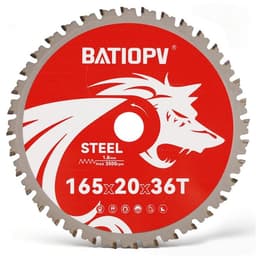
| Preis-Tipp |  BATIOPV BATIOPV 165 mm 36T metal blade | 2,800 rpm bullet | 20 mm, no ring listed | Aluminium and steel | 8.0 | about £17.99 | View offer |


On this page
Set the saw before you plug it in
Clamp, support, then wax
Let the teeth cut
When to stop
Common questions
Do you wax a running blade?
How should a thin extrusion be supported?
Is a hand-held circular saw a good idea?
What if the blade’s maximum is 2,800 rpm and the saw is faster?
When do you stop and call someone else?
Related pages
Sources
Public UK sources used for this comparison. Listing prices, stars, and review counts are from amazon.co.uk extracts dated 16 October 2026.
- PUWER 1998, regulation 11 — guarding duty for employers (retrieved 16 October 2026)
- HSE EIS12 — pivoting-head metal-cutting circular saws (retrieved 16 October 2026)
- HSE WIS16 — circular saw benches (retrieved 16 October 2026)
- BS EN 847-1:2017 — tools for woodworking, circular saw blades (retrieved 16 October 2026)
- Knotwood UK cutting, storage and handling guide (June 2025) (retrieved 16 October 2026)
- Trend aluminium and plastic blade range (retrieved 16 October 2026)
- Addison Saws — why aluminium loads a blade (retrieved 16 October 2026)
- Electrical Safety First — circular saws (retrieved 16 October 2026)