Independent comparisons. We may earn from shop links. More info

Circular saw blade tooth count: 24, 30, 48, 72, 96

Updated: 22 October 2026

You already know the saw wants a 315 mm disc and a 30 mm bore. The next decision is how many teeth sit on that plate. A circular saw blade tooth count is not a quality score. More teeth can leave a cleaner edge and can load the motor harder, and a chart for a 185 mm to 250 mm blade is not a rule for this size. In this amazon.co.uk set the counts are 24, 30, 48, 72, and 96. This page is one variable only. Prices stay on the [315mm x 30mm circular saw blade comparison](/hub/saw-accessories/315mm-x-30mm-circular-saw-blade). A qualifying purchase can earn us a commission at no extra cost to you.

You already know the saw wants a 315 mm disc and a 30 mm bore. The next decision is how many teeth sit on that plate. A circular saw blade tooth count is not a quality score.

Our top picks

On this page

What the tooth count changes

Fewer teeth take a larger bite, clear chips faster, and leave a rougher face. More teeth take a smaller bite, leave a smoother edge, and ask more of the motor if you force the feed. Compel's UK chart, for blades from 185 mm to 250 mm, puts about 18 to 24 teeth on ripping and 60 to 80 on a clean crosscut. Those bands are a direction, not a rule for a 315 mm plate. Bore, plate, kerf, and marked speed still outrank tooth count. A 96-tooth disc on the wrong arbor is still the wrong disc.

24, 30, and 48 teeth

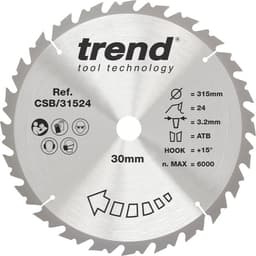
Trend's CSB/31524 is labelled a coarse rip: 24 teeth, a 3.2 mm kerf, and a +15° hook. UK reviews describe reclaimed rafters, pallets, and about two years of hard table-saw use. One nail strike with no reported tip loss is one incident, not a rating. A UK Workshop rule of thumb puts about 24 teeth on ripping and about 48 on plywood or MDF. That is a forum rule of thumb, not a British Standard. The BGS 3957 is 30 teeth, a 3.0 mm cutting width, a 2.2 mm plate, and no finish label. One UK review used it for firewood about two hours a week for about four months. The Trend CSB/31548 is the combination pick: 48 teeth, the same kerf and hook, with UK notes of a 50 mm oak rip and window ledges. Who should skip a thin sample is on the best 315mm blade page.

72 and 96 teeth

Trend's CSB/31572 is a fine finish at 72 teeth with a 3.2 mm kerf. The amazon title prints +10°. Some UK shop pages for the same code print 15°, and at least one page has shown both. Leave that until you hold the plate. Draper's 25782 is also 72 teeth. Draper's 25873 is 96 teeth. The manufacturer page states a 3.2 mm kerf, a 10° rake, and 4,200 rpm. The amazon raw does not print the kerf or the rake. Naming plywood is a materials list, not a tear-out test. Forcing a 96-tooth disc through thick hardwood like a 24-tooth rip blade can scorch the cut.

What a finer blade will not fix

Tooth count will not repair a bore that is not 30 mm, a plate the manual rejects, a kerf that leaves the riving knife nowhere to sit, or a marked speed below the spindle. In this set the Trend and BGS plate fields are 2.2 mm. The Makita 2712 manual limits body thickness to 2 mm or less, so a bullet that names that saw is a separate check. That conflict is on the saw fit page. Diameter, bore, knife, and rpm are on the buying guide. More teeth are a finish choice inside a matched diameter and bore.

Common questions

Is 96 teeth always better than 24?
No. Ninety-six teeth aim at a finer face and a heavier cut load. Twenty-four teeth in this set are labelled for a coarse rip. Better depends on the job. A furniture edge and a pallet breakdown are different cuts, and a higher count does not fix a wrong bore or a plate the manual rejects.
What is the 48-tooth blade for if you only buy one?
In this set the 48-tooth Trend is the combination label: mixed ripping and crosscutting, including sheet goods named in the bullets. A UK Workshop rule of thumb also puts about 48 teeth on general plywood and MDF work. If your saw is already 315 mm x 30 mm and you want one everyday disc, that count is the usual compromise. It is still a compromise, not a blade that rips like 24 teeth and finishes like 96.
What is the 30-tooth BGS for, given it has no finish label?
The BGS 3957 states 30 teeth, a 3.0 mm cutting width, and a 2.2 mm plate, without calling the job a rip or a crosscut. One UK review used it for weekly firewood for about four months. Treat it as a budget rough blade in this set, not as a labelled combination or a fine crosscut. The details field that says Metal is a separate warning, not a tooth-count answer.
Will 72 or 96 teeth stop tear-out in plywood?
They can help when the feed is controlled and the blade is sharp, because more teeth take a smaller bite. They do not eliminate tear-out on their own. Draper names plywood on the 96-tooth manufacturer page. That is a materials list, not a tear-out score from a lab or from a UK cut test in this file.
Why do the 24-tooth and 48-tooth blades say +15° while the 72-tooth title says +10°?
The 24-tooth and 48-tooth amazon titles in this set both print +15°. The 72-tooth amazon title prints +10°, while some UK shop pages for the same code print 15° or both. The conflict stays unresolved until you read the figure on the plate in your hand. Do not average the shop pages.

Related pages

Sources

Public UK sources and the amazon.co.uk listings compared on this page. Updated 22.10.2026.

  1. HSE: circular saw benches (retrieved 21 October 2026)
  2. HSE WIS16: circular saw benches (retrieved 21 October 2026)
  3. HSE: wood dust (retrieved 21 October 2026)
  4. HSE: woodworking standards, including BS EN 847-1 (retrieved 21 October 2026)
  5. Makita 2712 manual (retrieved 21 October 2026)
  6. Trend CSB/31524, CSB/31548 and CSB/31572 (retrieved 21 October 2026)
  7. Draper 24969 TCT circular saw blade (retrieved 21 October 2026)
  8. amazon.co.uk Trend CSB/31548 (retrieved 21 October 2026)