Independent comparisons. We may earn from shop links. More info

Wet and dry sandpaper

Updated: 21 October 2026

You are about to dip a brown decorating sheet in a mug of water because the label said silicon carbide. Wet and dry sandpaper is silicon carbide on a backing the listing calls waterproof, used on a cured film, plastic or a suitable metal repair. In the six packs in our [sandpaper comparison](/hub/sanders/sandpaper), only one listing says that. This page is that distinction, then the size limit on the pack that qualifies. Bare-wood grit paths stay on the [sandpaper for wood](/hub/sanders/sandpaper/sub/sandpaper-for-wood) page. A qualifying amazon.co.uk purchase can earn us a commission, at no extra cost to you. We did not wet-sand a panel.

You are about to dip a brown decorating sheet in a mug of water because the label said silicon carbide.

Our top picks

On this page

What wet and dry actually is

Wet and dry means the sheet can meet water without the backing falling apart, and the abrasive on that sort of sheet is silicon carbide. CFS Fibreglass describes that pairing for gelcoat and topcoat, used with water to limit heat and clogging. BuildWiz says the same: silicon carbide on a waterproof backing. The water carries dust off the cut. It is not a claim you can borrow from the mineral alone. Fit For The Job, AbraGoren and LowMux also name silicon carbide, and none says waterproof. Harris and G4GADGET are emery. CXS Tools’ warning is the one to keep: only paper labelled wet and dry should meet water. A dry silicon carbide sheet will soften and tear if you soak it. If the listing is silent, keep the sheet dry.

When water helps, and when it ruins the job

Water helps when a film has cured and you are levelling dust nibs, a run, or the edge of a small repair. The slurry shows the cut and keeps the fine sheet from clogging as fast. Follow the tin for how long the coat must cure. A 48-hour figure in a tool blog is that writer’s practice, not a rule for every product on a UK shelf. Water ruins bare wood. It raises the grain, and it does not belong on MDF. Bare steel is the other surface to leave dry: water invites flash rust. If the metal still has a cured coating and you are only nibbing that film, you are back on a sheet that says waterproof. If you are cutting back to bright metal, stay dry. Used dry, a waterproof sheet is still sandpaper. You do not gain a dust-free job by wetting it. The how to use sandpaper page covers the dry sequence and the block. Add water only after the film exists and only on the pack that claims it.

The pack in this set that is wet and dry

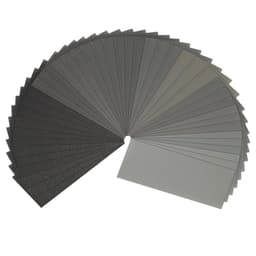
STEBRUAM is 42 sheets at £6.99, three of each grit from 120, 150, 180, 240, 320, 400, 600, 800, 1000, 1200, 1500, 2000, 2500 and 3000. The listing says waterproof silicon carbide on water-resistant paper, with the grit printed on the back. Amazon.co.uk shows 4.6 from 2,368 reviews, and this capture ranks the listing 1 in Sanding Paper. Each sheet is 9 × 3.6 inches, about 229 × 91 mm. Reviewers used the upper grits for small car-paint repairs, models, French polishing and carbon fibre. Those reviewers said the sheets are too small for a large flat panel. A 230 × 280 mm wet-and-dry sheet is not what this listing sells. You can cut 229 × 91 mm smaller for a block. You cannot tile a door with it. One buyer reported about a month’s wait for delivery, a single report, not a promise about the next order. If the repair is a stone chip, a model or a small plastic edge, the range is why this pack is the top pick. A wardrobe door wants a full-size sheet in the two or three grits you will use.

Grits past 400

Past 400 you are refining a film or a small hard surface, not preparing timber for its first coat. STEBRUAM’s 1500, 2000, 2500 and 3000 sheets are what reviewers reached for on a touch-up. LowMux’s finest sheet is 220. AbraGoren stops at 120. G4GADGET’s fine sheet is 150. None of those is a stand-in for 2000 grit. A door you are rubbing down before a fresh coat rarely needs that ladder. A key around 120–220, on a dry sheet you can hold, does the work. On a whole panel, the 229 × 91 mm sheet fails before the grit number does. Silicon carbide on Fit For The Job, AbraGoren or LowMux is a grain, not a waterproof badge. Emery on Harris and G4GADGET is a different grain again. Take STEBRUAM when the job is a small cured repair. Take a numbered dry pack when the job is wood, filler or a first coat.

Common questions

Is wet and dry the same as ordinary sandpaper?
No. Ordinary sheets here are emery or silicon carbide for dry hand sanding. Wet and dry adds a waterproof backing so you can use water. STEBRUAM is the only pack that says that, from 120 to 3000 grit. Treat the other listings as dry paper.
Can I add water to any sheet?
Only if the listing says the sheet is wet and dry or waterproof. Fit For The Job, AbraGoren and LowMux name silicon carbide and do not say waterproof. Harris and G4GADGET are emery. If the page is silent, sand dry.
Which pack in this set is actually wet and dry?
STEBRUAM, at £6.99. The listing says waterproof silicon carbide, 42 sheets, three of each grit from 120 to 3000, each sheet 9 × 3.6 inches, with 4.6 from 2,368 reviews. Harris, Fit For The Job, AbraGoren, G4GADGET and LowMux do not make that claim.
Are the sheets big enough for a panel?
The STEBRUAM sheets are about 229 × 91 mm. Reviewers said that is too small for a large flat panel. They are large enough for a stone chip, a model or a small plastic edge. A door wants a full 230 × 280 mm wet-and-dry sheet instead.
Does silicon carbide on its own mean waterproof?
No. Silicon carbide is the grain. Waterproof is the backing. AbraGoren, LowMux and Fit For The Job list silicon carbide and leave waterproof use unstated. Only STEBRUAM pairs the grain with a water-resistant paper claim. Emery, on Harris and G4GADGET, is not described as wet and dry.

Related pages

Sources

Sources taken from the research digest. Prices, stars and review counts are the stored amazon.co.uk listing figures.

  1. HSE — wood dust (retrieved 21.10.2026)
  2. HSE — cutting and sanding wood (retrieved 21.10.2026)
  3. HSE — sanding plasterboard joints (retrieved 21.10.2026)
  4. HSE INDG463 — silica dust (retrieved 21.10.2026)
  5. Consumer Rights Act 2015, section 9 (retrieved 21.10.2026)
  6. ISO 6344-2:2021 — macrogrits (retrieved 21.10.2026)
  7. ISO 6344-3:2021 — microgrits (retrieved 21.10.2026)
  8. Norton — choosing sandpaper (retrieved 21.10.2026)
  9. Toolstation — sandpaper buying guide (retrieved 21.10.2026)
  10. Homebuilding — sandpaper grades (retrieved 21.10.2026)