Independent comparisons. We may earn from shop links. More info

How to use sandpaper

Updated: 21 October 2026

The sheets are already on the bench, and the first mistake is usually the grade you pick up. How to use sandpaper by hand means starting at the scratch you can see, moving up in small steps, and throwing the sheet away when it stops cutting or the backing splits. This page is that method for the mixed packs in our [sandpaper comparison](/hub/sanders/sandpaper). If you still need a grit or a sheet size, use the [sandpaper buying guide](/hub/sanders/sandpaper/sub/sandpaper-buying-guide) first. A qualifying purchase can earn us a commission, at no extra cost to you. We did not time a sanding test.

The sheets are already on the bench, and the first mistake is usually the grade you pick up.

Our top picks

On this page

Start at the grit that matches the damage

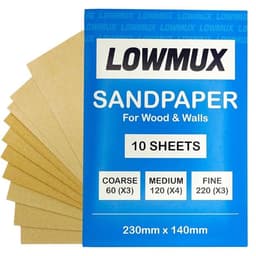
Look at the surface before you look at the finest sheet. A deep scratch, flaking paint or a proud lump of filler needs a coarse cut. A sound film that only needs a key does not. Norton’s UK guidance puts coarse paper around 40–60 for stripping, about 80–180 for smoothing, and 240–400 for a fine finish. Axminster starts many wood jobs around 80–120 and tells you not to jump straight to 220. Those are rules of thumb. They are not printed on every pack in this set. If you start at 220, you polish the high spots and leave the coarse scratch underneath. LowMux contains 60, 120 and 220, so the 120 sheet is the step in the middle. AbraGoren contains 40, 80 and 120, and it stops there. G4GADGET contains 60, 100 and 150. Harris and Fit For The Job only say coarse, medium and fine, so you keep that order by feel and you cannot claim you used P120. Bare wood has its own stop, which the sandpaper for wood page sets out.

How to hold the sheet

Your fingers follow the hollows. A block keeps the abrasive flat, which is what makes the next grit honest. Norton’s advice is to sand with the grain on wood, and to fold the sheet so the abrasive faces do not rub each other. Fit For The Job’s buyers cut or fold a large sheet onto a block. AbraGoren and LowMux are 230 × 140 mm, a strip you can wrap. STEBRUAM’s sheets are 9 × 3.6 inches, so the block is a small one. AbraGoren, G4GADGET and LowMux buyers report tearing when the sheet is worked hard. One G4GADGET buyer said a sheet disintegrated on contact, and another added masking tape before an orbital sander. That tape is a workaround a reviewer described, not a fitting the listing specifies. The bullets do not name a pad size. If the paper splits in the hand, stay on a block and replace the sheet. Harris buyers more often report grit rubbing off. Loose abrasive on the work is a reason to change paper.

When the sheet is finished

A sheet is finished when it stops cutting, when the grit has glazed into a shiny clog, or when the backing has split. You can knock loose dust out of a dry sheet. You cannot restore a surface that has shed its grit. Harris reviews describe that shedding. Wipe or vacuum loose grit off before the next grade, or you will drag a coarse particle through a finer scratch. Do not soak a sheet because it is clogged unless the listing says it is wet and dry. In this set only STEBRUAM says that. Ordinary paper falls apart when it is wet. If you are finishing a cured paint spot and you meant to add water, move to the wet and dry sandpaper page. On a dry decorating sheet, clogging means you change the piece. A finer sheet will not remove the scratch the coarse sheet had not finished.

Dust and the point where you stop

Hand sanding makes less dust than a belt sander. You should not sweep a closed room so the dust hangs in the air. HSE figures for wood dust, as an 8-hour workplace limit, are 3 mg/m³ for hardwood and 5 mg/m³ for softwood, with mixtures using 3 mg/m³. Hardwood dust can cause nasal cancer, and wood dust can cause asthma. Power-tool sanding is where HSE expects H or M class extraction and, in enclosed work, respiratory protection at APF 20, such as FFP3. A short hand job on a skirting does not automatically need that setup. If dust sets off breathing problems, stop. Stop when the scratch from the previous grit has gone. On bare wood that is often around 180–220 before primer or stain. On sound paint it is a key, unless the film is peeling. Call someone in for suspected lead paint, for floors, and for large hardwood or MDF jobs. A sub-£7 mixed pack is the wrong tool for stripping a floor. Check the last grit with a low-angle light, wipe the dust off, and only then open the tin.

Common questions

Do I have to sand with the grain?
On wood, yes. Norton’s UK guidance is to sand with the grain so the scratches lie the way the timber already runs. Across the grain, a coarse sheet leaves lines that a stain will show. On painted joinery where you cannot see the grain, follow the length of the moulding.
Can I skip from 60 grit to 220?
You can, and the coarse scratches usually remain. Axminster’s advice is not to skip to 220 from a much coarser start. LowMux includes 120 between 60 and 220, so use it. AbraGoren never reaches 220. Move up when the previous scratch has gone.
Should I use a block or my hand?
Use a block on flat surfaces. Your hand is for a tight moulding where a block will not sit. Fold so abrasive does not rub abrasive. AbraGoren, G4GADGET and LowMux sheets tear when worked hard, so the block also stops you creasing a weak backing.
When do I throw the sheet away?
Throw it away when it glazes, when the grit sheds, or when the backing splits. A dusty sheet may still cut after you knock the dust out. A sheet that leaves loose abrasive on the work, which Harris buyers report, is finished even if the paper looks intact.
Do I need a mask for a small hand-sanding job?
A short hand pass on a skirting is not belt-sanding a floor. HSE’s extraction and FFP3-style guidance is written for power-tool wood dust. Stop if the dust affects your breathing. Suspected lead paint, a floor, or a large hardwood or MDF job belongs with someone who can control the dust.

Related pages

Sources

Sources taken from the research digest. Prices, stars and review counts are the stored amazon.co.uk listing figures.

  1. HSE — wood dust (retrieved 21.10.2026)
  2. HSE — cutting and sanding wood (retrieved 21.10.2026)
  3. HSE — sanding plasterboard joints (retrieved 21.10.2026)
  4. HSE INDG463 — silica dust (retrieved 21.10.2026)
  5. Consumer Rights Act 2015, section 9 (retrieved 21.10.2026)
  6. ISO 6344-2:2021 — macrogrits (retrieved 21.10.2026)
  7. ISO 6344-3:2021 — microgrits (retrieved 21.10.2026)
  8. Norton — choosing sandpaper (retrieved 21.10.2026)
  9. Toolstation — sandpaper buying guide (retrieved 21.10.2026)
  10. Homebuilding — sandpaper grades (retrieved 21.10.2026)