Independent comparisons. We may earn from shop links. More info

Sandpaper for wood

Updated: 21 October 2026

You have a painted door, bare softwood, or a filler patch, and the pack in your hand runs to 3000 grit. Sandpaper for wood fails in two ways: starting so coarse that you carve sound paint, or polishing bare timber until primer or stain has nothing to grip. This page keeps those jobs apart and matches them to the packs in our [sandpaper comparison](/hub/sanders/sandpaper). The steps for holding the sheet are on the [how to use sandpaper](/hub/sanders/sandpaper/sub/sandpaper-how-to-use) page. A qualifying purchase can earn us a commission, at no extra cost to you. We did not sand a sample board.

You have a painted door, bare softwood, or a filler patch, and the pack in your hand runs to 3000 grit.

Our top picks

On this page

Bare wood before paint or stain

Bare timber wants a mid grit that levels mill marks and a fine stop before the surface turns polished. Norton’s UK guide puts about 80 on the sanding stage, 120 on a finish, and 180 for a smoother wood surface, after about 40 if you are stripping. BuildWiz puts bare softwood around P120–P220. A working ceiling used across these notes is to stop bare wood around 180–220 before primer or stain. Toolstation’s finishing band runs wider, towards 400. Treat anything finer as a choice only if the tin asks for it. A 3000 grit sheet is the wrong next piece on a new pine door. You will burnish the grain. Sand with the grain. If the timber is already smooth, you may start at 120 rather than 40. If you can see saw tear-out, 40 or 60 is the honest start, and you still walk back up. AbraGoren contains 40, 80 and 120. It does not contain 180 or 220.

Sound paint, tired varnish, and filler

Sound paint is a key, not a strip. Maker UK’s cabinet note keys intact paint around P120 then P180, and only drops towards P80 when the finish is peeling. Best at Hire’s chart runs skirting P80 then P120. Attacking a sound gloss door with 40 grit digs through the film into timber you did not mean to expose. Fit For The Job’s bullets describe the medium grade for varnish and bare wood, and the coarse grade for rough timber and old coatings. The pack does not print a number. Filler on wood is sanded after it has gone off, level with the surrounding surface, then blended. BuildWiz’s path is about P120, then P180, then P220. The closest numbered sheets here are AbraGoren’s 120, G4GADGET’s 150, and LowMux’s 120 and 220. None prints 180. If the tin says 180, buy that sheet separately. Between coats, BuildWiz mentions around P240, a nibbing pass, not a re-cut of the door.

Which sheet pack matches that path

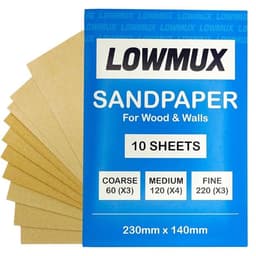
AbraGoren, at £4.79, is the 40/80/120 pack, ten silicon carbide sheets at 230 × 140 mm, with 4.4 from 3,096 reviews. It matches a path that starts coarse and stops at 120. It does not match a stop at 180 or 220. Buyers say the sheets tear when worked hard. The bullets claim the kraft backing does not rip easily. The review notes do not confirm that claim. G4GADGET, at £4.99, prints 60, 100 and 150 on emery sheets about 290 × 210 mm, short of the 180–220 ceiling, and the reviews are the hardest on tearing. LowMux, at £5.99, prints 60, 120 and 220. It reaches the bare-wood stop and skips 80 and 180. Choose LowMux when 220 is the last sheet. Choose AbraGoren when you need 40 and 80. Harris, at £3.25, and Fit For The Job, at £3.95, can only be described as coarse, medium and fine. Harris buyers report grit rubbing off. Fit For The Job’s catalogue field of 280 conflicts with the mixed grades. They suit a small job if you do not need to tell a tin you used P120. The sandpaper buying guide unpacks that unnamed label.

Sheets that are a poor fit for a door

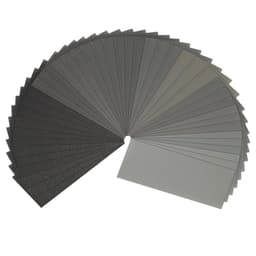
STEBRUAM is 42 sheets from 120 to 3000, waterproof silicon carbide, each one about 229 × 91 mm, at £6.99 with 4.6 from 2,368 reviews. It has no 40, 60 or 80 grit sheet for failed paint or rough timber. Reviewers used it for small car-paint repairs and said the pieces were too small for a large flat. A panel door is that large flat. That pack belongs on the wet and dry sandpaper page. Do not wet bare wood. Water raises the grain, and it does not belong on MDF. Wet sanding is for a cured film, with paper the listing calls waterproof. Five of these packs do not say that. HSE’s 8-hour wood-dust limits are 3 mg/m³ for hardwood and 5 mg/m³ for softwood, and mixtures use 3 mg/m³. Do not sweep that dust through a closed room. Large hardwood or MDF jobs, floors, and suspected lead paint belong with someone who can control the dust.

Common questions

What grit should I use on bare wood before paint?
Start at the damage you can see, often 80 or 120 if the timber is already fair, and coarser for tear-out or a failed coat. Stop around 180–220 before primer or stain. The charts do not draw that line in the same place. LowMux includes 220. AbraGoren includes 80 and 120 and stops at 120.
What grit for a door that is already painted and sound?
Key it. Maker UK’s cabinet guidance is about P120 then P180 on intact paint, and nearer P80 only when the finish is peeling. A 40 grit sheet will cut through sound paint. None of the numbered packs here prints 180, so add that sheet separately if the tin asks for it.
Should I sand wood to 400 grit?
Not before a normal primer or stain. Around 180–220 is the usual stop so the coat can grip. Grits from 400 into the thousands are for a cured film on a small sheet. Taking bare pine to 3000 fights the first coat.
Which pack in this set includes 80 and 120?
AbraGoren does: three sheets of 40, four of 80 and three of 120. LowMux has 120 beside 60 and 220, and it does not have 80. G4GADGET has 100 and 150. Harris and Fit For The Job do not print either number.
Can I wet-sand bare wood?
No. Water raises the grain, and MDF and water are a worse mix. Wet sanding belongs on a cured film, with a sheet the listing calls waterproof. In this set that claim is on STEBRUAM only. Sand bare wood dry, with the grain.

Related pages

Sources

Sources taken from the research digest. Prices, stars and review counts are the stored amazon.co.uk listing figures.

  1. HSE — wood dust (retrieved 21.10.2026)
  2. HSE — cutting and sanding wood (retrieved 21.10.2026)
  3. HSE — sanding plasterboard joints (retrieved 21.10.2026)
  4. HSE INDG463 — silica dust (retrieved 21.10.2026)
  5. Consumer Rights Act 2015, section 9 (retrieved 21.10.2026)
  6. ISO 6344-2:2021 — macrogrits (retrieved 21.10.2026)
  7. ISO 6344-3:2021 — microgrits (retrieved 21.10.2026)
  8. Norton — choosing sandpaper (retrieved 21.10.2026)
  9. Toolstation — sandpaper buying guide (retrieved 21.10.2026)
  10. Homebuilding — sandpaper grades (retrieved 21.10.2026)