Independent comparisons. We may earn from shop links. More info

How to use sandpaper on an orbital sander

Updated: 21 October 2026

You have a new pack of discs, and the first pass leaves swirls, dust, or a pad that sheds grit halfway across the board. That is usually pressure, misaligned holes, or a hook pad that has lost its bite, not a sign you bought the wrong grit first. How to use sandpaper on an orbital sander means matching the disc to the pad, letting the orbit cut, and fixing the mark before you step finer. The [sandpaper orbital sander comparison](/hub/sanders/sandpaper-orbital-sander) lists eleven amazon.co.uk packs from 19 October 2026. Peter F. did not run a lab test. A qualifying purchase can earn a commission at no extra cost to you.

You have a new pack of discs, and the first pass leaves swirls, dust, or a pad that sheds grit halfway across the board.

Our top picks

On this page

Fit the disc and the dust path

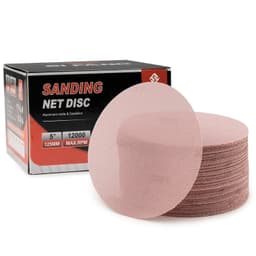
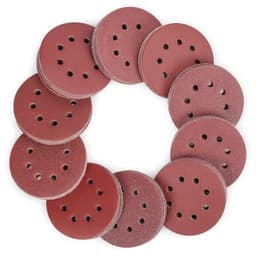
Measure the backing pad. A disc larger than the pad overhangs the foam and can dig into a corner, and the wrong diameter throws hole alignment off. Clean the hooks and pull off old abrasive. If the hooks feel smooth, a fresh disc may peel off after a few swaps. WORKPRO and Aucenix reviews often mention early detachment when the pad is worn. Line punched holes up with the pad openings and the extraction port. WD7 expects the pad flat on the work and air passing through the abrasive. Blocked holes load the grit in minutes. Mesh discs such as SI FANG or Ruidawin use an open face instead. You still need a hook pad and airflow. See mesh versus paper. SI FANG mesh in this category states 12,000 rpm. Stay at or below that figure and never mount these discs on an angle grinder. UK wood-dust limits are 3 mg/m³ for hardwood and 5 mg/m³ for softwood over eight hours.

How to make the pass

Place the pad flat on the work before you apply power. Starting at an edge with the pad tilted invites the half-moon scratches people call pigtails or swirls. Move steadily, overlap each pass by about a third of the pad width, and do not bear down. Heavy pressure collapses the foam, slows the orbit, and heats the abrasive so varnish or wax loads it instead of letting it cut. Let the weight of the sander do most of the work. If progress stalls, use a coarser grit or a second light pass. Vacuum before the next grit so coarse grains do not ride into the finer step.

One grit step, then stop jumping

You do not need a ten-step ladder on every job. As a rule of thumb for a scuffed tabletop or a door with old clear coat, use the coarsest grit that removes the damage in reasonable time, often 80 or 100, then about 120 to erase those scratches, then 180–240 before a finish. Jumping from 40 to 240 saves minutes and costs an afternoon of swirl chasing. Change the disc once it loads or glazes. Do not mix grits on one sheet. The full ladder lives on sandpaper orbital sander grit. Clean the pad hooks between grits. Loaded filler needs cure time or a more open abrasive, not a finer number on the same glazed disc.

When the surface or the disc goes wrong

Swirls and pigtails usually mean a tilted pad, edge pressure, or grit too fine for the previous scratch. Step back one grit before you blame the brand. Clogging in minutes points to wax or soft resin, heat from heavy pressure, or holes that are not aligned. Stop and get advice, instead of finer grit, when you suspect lead paint on pre-1970s woodwork, when a workplace has no wood-dust controls, when asthma flares as soon as dust rises, or when you cannot confirm pad size and speed. Diameter and hole count are on the sandpaper orbital sander buying guide.

Common questions

How do I put a hook-and-loop disc on?
Centre the disc and press from the middle outward so the hooks engage. Do not trap grit under the centre. If the edge lifts at once, the hook face may be worn.
Do punched holes have to meet the pad?
Yes, for standard eight-hole 125 mm or 150 mm discs on matching pads. Misalignment blocks airflow, loads the grit, and defeats built-in extraction. Mesh discs follow different rules but still need airflow around the pad.
How hard should I press?
Light enough to keep the pad flat and the orbit moving. If you must push hard to cut, use a coarser grit or check for loading and blocked holes. Random orbital sanders are not belt sanders. Force mostly creates heat and swirls.
Why do I get swirls or pigtails?
Tilted pad, sanding on an edge, grit too fine for the previous scratch pattern, or contamination on the work. Correct the cause, step back one grit if needed, and overlap passes evenly before you change brands.
What do I do when the disc clogs in minutes?
Reduce pressure, improve dust extraction, align holes, and remove wax or soft coatings first. Swap to a fresh disc once the mineral is glazed. Continuing on a loaded sheet only polishes and smears.
Why did mesh fray at the edge?
Overhang past the pad, aggressive edge work, or a diameter mismatch. Match disc to pad and keep full pad contact on flat areas. Ease into corners without riding the rim.
Do I need a mask for a short sanding job at home?
For a few minutes on one small item, many DIYers still choose a well-fitting FFP3, because wood dust is a known sensitiser. Longer runs, MDF, or no extraction need the stricter HSE controls, because exposure adds up.

Related pages

Sources

Sources taken from the research digest. Listings were checked on 19 October 2026.

  1. HSE — Wood dust (retrieved 19 October 2026)
  2. HSE — WD7 Hand-held powered sanders (retrieved 19 October 2026)
  3. HSE — Cutting and sanding wood (retrieved 19 October 2026)
  4. ISO 6344-3:2021 coated abrasives (retrieved 19 October 2026)
  5. Klingspor — How abrasive grains wear (retrieved 19 October 2026)
  6. Mirka — Abranet net abrasive (retrieved 19 October 2026)
  7. FEPA — P12 to P220 grains (retrieved 19 October 2026)
  8. amazon.co.uk hook-and-loop disc listings (retrieved 19 October 2026)