Independent comparisons. We may earn from shop links. More info

Orbital sander grit guide

Updated: 21 October 2026

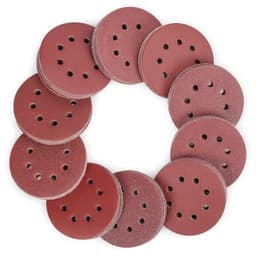
The mixed pack on the bench shows numbers from 40 to 600, and the wrong orbital sander grit either barely cuts or leaves pigtails under raking light after a jump to 240. This guide owns the numbers: what a P-grade means, how to step bare wood, strip-back, filler, and paint, and which discs in the [sandpaper orbital sander comparison](/hub/sanders/sandpaper-orbital-sander) cover that ladder. Peter F. read the eleven listings on 19 October 2026. There was no lab cut test. A qualifying purchase can earn a commission at no extra cost to you.

The mixed pack on the bench shows numbers from 40 to 600, and the wrong orbital sander grit either barely cuts or leaves pigtails under raking light after a jump to 240.

Our top picks

On this page

What the number means

UK packs usually show FEPA P numbers, such as P80, P120, and P240, or a bare figure such as 80 grit. They are not the same micrometre size. Published charts for coated abrasives put P80 near 201 µm, P120 near 125 µm, and P240 around 58 µm. A bare 220 often follows a CAMI-style scale, so it is not the same particle as P220. P is a controlled FEPA scale (P12–P220 on coated abrasives), not a marketing word. Listing grit fields often store only one end of a mixed box. VKMKM shows 40 while the title runs to 600. WORKPRO can show 600 while 60-grit discs are still in the bag. Read the title and the labels inside. Grain is not grit. Aluminium oxide dulls on wood. Silicon carbide suits glass or stone at light pressure. Ceramic wants more push than a palm sander gives. Technique stays on how to use sandpaper on an orbital sander.

A step for bare wood

For flat bare wood, start around P80 or P100 to remove mill marks, raised grain, or stain in the surface. Use P120 to erase those scratches, then P180 to P240 before varnish, oil, or a water-based finish. Soft pine may look ready at P180. Open-grained oak or ash often benefits from P220. Do not jump from 80 to 240. Fine grit follows the texture it is given and will not excavate an 80-grit pigtail. Drop back to the grit that made the mark, sand it flat, then climb again. Vacuum between steps. When the board is dull and even at P180–P240, you are ready for finish.

Strip, filler, and paint

Stripping old finish usually starts at P60–P80, sometimes P40 for a thick film, then the bare-wood ladder. AMFUN P40 in this set is coarse wall stock removal, not a furniture finish grit. Filler commonly runs P120–P180 once the repair is hard. Loading in seconds usually means soft filler or heat, not a grit that is too fine. Between paint coats, a light P240–P320 pass knocks nibs. Stop when the sheen is even. If latex loads paper, an open mesh disc helps clogging. See mesh versus paper. Grades from 800 to 2000 are for burnishing. KONGMING (80–2000) is the only pack here that spans that far.

Which packs actually contain that range

A furniture mixed pack, roughly 60–320 or 40–400, covers most bare-wood and paint-prep sequences. NOOKEYA (60–320), Goysen (40–400), and TPmax (60–320 on the 150 mm row) sit there. WORKPRO and VKMKM stretch to 60–600 or 40–600. Check holes and diameter on the sandpaper orbital sander buying guide. Mesh here is mostly 80–400 (SI FANG, Ruidawin) and does not start at P40. SI FANG’s title emphasises 80 grit while some UK review text describes a mixed run up to 400. KONGMING (80–2000) is the ultra-fine row, and its mineral fields disagree on silicon carbide versus aluminium oxide.

Common questions

What grit do I start with on bare wood?
Start with the coarsest grade that removes the defect, often P80 or P100, then P120, then P180–P240 before finish. P240 will not finesse away deep scratches on its own.
What is the difference between P80 and 80?
P80 is a FEPA grade with a defined grain size. A bare 80 grit label may follow a different scale. Prefer P-labelled discs from the same pack when the step has to match.
Can I jump from 80 to 240?
You can, but you usually should not if 80 left visible scratches. Work 120, or the next step in your box, until raking light shows an even scratch pattern, then move to 180 and 240. Fine grit polishes. It does not excavate pigtails.
What grit strips old finish?
Many strip-back jobs start at P60–P80, sometimes P40 for thick film, then repeat the bare-wood ladder. If the abrasive loads into a shiny belt of varnish, coarser grit, lighter pressure, or better dust extraction beats switching to a finer number.
What grit between coats of paint?
A light P240–P320 pass is typical to knock nibs and dull the sheen before the next coat. You are not sanding to bare wood. Stop as soon as the surface is uniformly scuffed. If the disc clogs, consider mesh or hand scuff pads rather than a coarser grit.
Does a finer grit remove swirls from a coarse grit?
Only if the swirls are shallow enough for that step to blend them. Deep pigtails need to be sanded out at the grit that created them, or one step coarser, then stepped up again. P240 does not erase 80-grit grooves.
Why does the listing grit field say only 40 when the title lists ten grades?
Grit fields often store one value, the coarsest or finest grade in a variety pack, not every disc in the bag. Trust the title, bullets, and what you unpack.
When do I need 800 to 2000?
After P240–P320 prep, for burnishing, not structural removal. Most furniture jobs stop before 400. KONGMING is the only comparison listing that reaches 2000.

Related pages

Sources

Sources taken from the research digest. Listings were checked on 19 October 2026.

  1. HSE — Wood dust (retrieved 19 October 2026)
  2. HSE — WD7 Hand-held powered sanders (retrieved 19 October 2026)
  3. HSE — Cutting and sanding wood (retrieved 19 October 2026)
  4. ISO 6344-3:2021 coated abrasives (retrieved 19 October 2026)
  5. Klingspor — How abrasive grains wear (retrieved 19 October 2026)
  6. Mirka — Abranet net abrasive (retrieved 19 October 2026)
  7. FEPA — P12 to P220 grains (retrieved 19 October 2026)
  8. amazon.co.uk hook-and-loop disc listings (retrieved 19 October 2026)