Independent comparisons. We may earn from shop links. More info

How to use a random orbital sander

Updated: 21 October 2026

You have a flat panel, a door or a tabletop, and the last time you stained it the swirls showed in the light from the window. Knowing how to use a random orbital sander is mostly about pressure, grit order and when you lift the pad. The random action reduces rings compared with a spinning disc. It does not cancel a clogged sheet, a heavy hand, or a grit you skipped. Prices stay on the [150 mm orbital sander comparison](/hub/sanders/150mm-orbital-sander). Peter F. followed UK workshop guides and a manufacturer sanding note on 19 October 2026. There was no filmed test. Links to amazon.co.uk may earn a commission at no extra cost to you.

You have a flat panel, a door or a tabletop, and the last time you stained it the swirls showed in the light from the window.

Our top picks

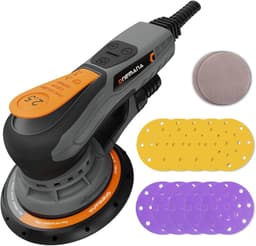
ONEMANA ONEMANA R7303-4 5.0 mm

Best overall

ONEMANA ONEMANA R7303-4 5.0 mm
9.6/10about £139.99
TEENO TEENO T-PSC911

Best value

TEENO TEENO T-PSC911
8.4/10about £36.09
On this page

Set the pad up before you touch the job

Fit a hook-and-loop disc that matches the pad, 150 mm or 125 mm, and line the dust holes up with the holes in the pad. A disc that almost fits will still cut, and the dust will stay under it and load the grit. Connect the hose if you have an extractor. Why tape is a bad adaptor, and which class of vacuum to use, is orbital sander dust extraction. For indoor wood, treat the hose as part of the setup. Set the speed down when the surface is already smooth, when you are sanding filler, or when a film finish is in the way.

Move across the flat

Place the pad on the wood, then switch on. Homebuilding and 3M’s random-orbit guide both want the pad started on the surface, with light pressure, rather than dropped onto the timber from the air. Keep the pad flat. Overlap each pass by about a third of the disc. On a 150 mm pad that overlap is roughly 50 mm. Keep moving. A pause in one spot, especially on softwood or veneer, digs a hollow you will chase with the next grit. If you press until the motor note drops, you have stalled the orbit. Near the edge, a 150 mm disc wants to roll the arris. Stay a few millimetres in, or switch to the 125 mm pad if the kit has one.
ONEMANA ONEMANA R7303-4 5.0 mm

Testsieger

ONEMANA ONEMANA R7303-4 5.0 mm
9.6/10about £139.99

Climb the grits

A common workshop ladder for bare wood is P80, P120, P150 and P180. Fosseway Tapes tells people not to skip more than one step. That is a workshop rule of thumb, not a British Standard. Mark the panel with a pencil grid before each grit and sand until the lines have gone. On veneer, do not start coarser than P80. What to buy is the buying guide.

Read the surface, then stop

A damp cloth on bare wood raises the grain, which is useful before the last grit and a surprise if you stain immediately. Before a clear finish, a short hand pass with the grain, using the same final grit, knocks down the orbital scratch that stain can still pick up. Stop and get help when the coating might be lead paint or an unknown industrial finish, when the job is a floor or a whole house, or when you employ people and the question is their vibration dose. HSE’s initial figure for random-orbit sanders, if you have no better measurement, is 12 m/s², and the daily exposure action value for employers is 2.5 m/s² A(8). Those are employer duties.

Common questions

Where do I start the grit on bare wood?
On bare wood with machine marks or old varnish, a common start is about P80, then you climb. If the surface is already smooth, start finer, often around P120 or P150. On veneer, do not begin coarser than P80. The right start is the coarsest grit that still removes the defect you can see, not the coarsest disc in the box.
Can I jump from P80 to P180?
You can, and the P80 scratches usually remain. Workshop guidance is not to skip more than one step, so P80 to P120, then onward, is the safer ladder. Treat that as a rule of thumb from abrasive sellers, not as a legal sequence. If the stain already looks striped, go back to the missing grit and remove those lines before you continue.
How hard should I press?
Press only enough to keep the pad flat and moving. If the motor slows, you are pushing too hard and the orbit is no longer random. A 150 mm pad on a door does the work with the tool’s own weight, around 2 to 3 kg on the item weights in this set. Extra pressure also rounds edges and heats the disc.
Should the sander be switched on before it touches the wood?
Set the pad down flat, then start it, and keep it on the wood until you move onto an area you have already sanded. Starting in the air and landing the disc writes a swirl. The same applies at the end of the pass if the pad is still spinning and the tool has no brake.
Why do circles appear under stain?
They are usually the previous grit, a clogged disc, or a moment where you paused or tilted. Stain and oil show orbital scratches that paint can hide. Check with a pencil grid and a raking light before you colour the wood. A light hand pass with the grain at the final grit removes a lot of what stain would draw as a ring.
What if the tool shocks me mid-job?
Stop, switch off, and unplug it. Do not keep sanding to see if it happens again, and do not open the case. UK reviews on some MAXXT listings in this comparison describe shocks through the body or the lead. Your route is the seller and the Consumer Rights Act 2015. The same stop applies if the tool keeps cutting out or smells of burning.

Related pages

Sources

Sources taken from the research digest. Listings were checked on 19.10.2026.

  1. HSE — Vibration regulations (retrieved 19.10.2026)
  2. HSE — Vibration assessment (retrieved 19.10.2026)
  3. HSE — Noise for employers (retrieved 19.10.2026)
  4. HSE — WD7 Hand-held sanders (retrieved 19.10.2026)
  5. HSE — Cutting and sanding wood (retrieved 19.10.2026)
  6. legislation.gov.uk — Electrical Equipment (Safety) Regulations 2016, regulation 35 (retrieved 19.10.2026)
  7. Bosch Professional GB — GET 75-150 (retrieved 19.10.2026)
  8. Howe Tools — 150 mm orbital sander pads (retrieved 19.10.2026)
  9. MioTools — MENZER random orbital sanders (retrieved 19.10.2026)