Independent comparisons. We may earn from shop links. More info

5mm vs 2.5mm orbit sander

Updated: 21 October 2026

You are looking at two 150 mm sanders that seem identical until one title says 5 mm and the other says 2.5 mm. A 5mm vs 2.5mm orbit sander choice is about the stroke, the distance the pad swings off centre, not about the disc diameter. If you buy one corded machine for mixed furniture and doors, the 5 mm stroke is the more useful one. The full table is on the [150 mm orbital sander comparison](/hub/sanders/150mm-orbital-sander). Peter F. used maker guides and the amazon.co.uk pages on 19 October 2026. A purchase through our links can earn a commission at no extra cost to you.

You are looking at two 150 mm sanders that seem identical until one title says 5 mm and the other says 2.5 mm.

Our top picks

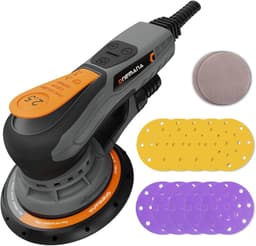
ONEMANA ONEMANA R7303-4 5.0 mm

Best overall

ONEMANA ONEMANA R7303-4 5.0 mm
9.6/10about £139.99
TEENO TEENO T-PSC911

Best value

TEENO TEENO T-PSC911
8.4/10about £36.09
On this page

The two millimetres

On a random-orbit sander the pad spins and, at the same time, orbits. The orbit figure is the size of that swing. 3M’s sanding guide puts about 2.5 mm with fine finishing and about 5 mm with general-purpose sanding. A 2.5 mm stroke makes a smaller scratch for a given grit, and it levels more slowly. A 150 mm disc can be a 5 mm orbit or a 2.5 mm orbit. If a listing never prints an orbit, you cannot place it on either side of this page. Voltage and the dust port sit in the buying guide.

When 5 mm is the one to switch on

Switch on a 5 mm orbit when you need to level. On amazon.co.uk the ONEMANA R7303-4 at £139.99 states 5.0 mm and 230 V. The RAYBAO and the TurboVolt also state 5 mm. The TurboVolt’s voltage is not in the table. A 5 mm pad with P240, at a lower speed, can finish, and the scratch is still a 5 mm scratch. How you move the pad is in how to use a random orbital sander. UK reviews on the MAXXT 5 mm pages include electric shocks. That is a reason to read those listings, not a property of a 5 mm orbit.
ONEMANA ONEMANA R7303-4 5.0 mm

Testsieger

ONEMANA ONEMANA R7303-4 5.0 mm
9.6/10about £139.99

When 2.5 mm earns its keep

Use 2.5 mm when the scratch size is the point: between coats, on a surface that is already flat, or on a small moulding where a deep scratch is hard to chase. You will wait longer if you ask it to strip a door. The ONEMANA R7303-5 at £124.99 states 2.5 mm and does not print a voltage, unlike the 5.0 mm ONEMANA’s 230 V line. The MAXXT R7303-M2.5-UK at £139.99 states 2.5 mm and 230 V, and one UK review says the tool shocked them and stopped after four uses. Those faults belong to that listing. They are not what 2.5 mm means.

Pairs, and listings that never say

The pair you can compare on the printed stroke is R7303-4 at £139.99 with 5.0 mm and 230 V, and R7303-5 at £124.99 with 2.5 mm and no voltage in the table. Because the review text is duplicated, pick them on the printed orbit and then check the plate. No orbit is printed for the TEENO, the Ezzylife, the R7308, the air Anesty or the VeftBltrem. The R7308 table also says 110 V.

Common questions

Which orbit removes old varnish faster?
The 5 mm orbit, with a coarse grit such as P80 or P120, is the one makers describe for general stock removal. A 2.5 mm orbit will eventually cut the same varnish, and you will spend longer on the door. Grit still does most of the cutting. A fine disc on a 5 mm pad will not strip a thick film quickly.
Which leaves a smaller scratch before stain?
The 2.5 mm orbit is the one described for a finer scratch at a given grit. Stain shows orbital marks that paint can hide, so the smaller stroke helps on the last grit if the surface is already level. It does not remove deep lines you left with P80. You still climb the grits, whichever orbit you own.
Can one 5 mm sander do fine work if I drop the speed?
It can do careful fine work, and the orbit length does not change when you turn the dial down. Lower speed reduces heat and gives you time to see the scratch. People who finish often still keep a 2.5 mm machine for the last grits. If you only own the 5 mm tool, use a fresh fine disc, light pressure and a raking light, then a short hand pass with the grain.
Should I own both?
Own both if you sand most weeks and you can see the difference under a clear finish. For a table or a door a few times a year, one stated 5 mm sander plus a sensible grit ladder is the better spend. Two tools also mean two hoses and two chances to buy the wrong voltage. The ONEMANA 2.5 mm listing does not print volts.
Is 4.5 mm the same as 5 mm?
It is the same class of general-purpose stroke, and it is not the same number. Bosch prints 4.5 mm for the GET 75-150. Treat a printed 4.5 mm as closer to 5 mm than to 2.5 mm when you are choosing one DIY machine. Do not round a missing figure up to 5 mm because the pad happens to be 150 mm.
What if the listing does not state the orbit?
Then you do not know which side of this comparison you are buying. Wattage, a 150 mm pad and a high star line do not answer it. In this set that silence covers the TEENO, the Ezzylife, the MAXXT R7308, the Anesty and the VeftBltrem. Choose a listing that prints 5.0 mm or 2.5 mm, or get the figure from the seller before you pay.

Related pages

Sources

Sources taken from the research digest. Listings were checked on 19.10.2026.

  1. HSE — Vibration regulations (retrieved 19.10.2026)
  2. HSE — Vibration assessment (retrieved 19.10.2026)
  3. HSE — Noise for employers (retrieved 19.10.2026)
  4. HSE — WD7 Hand-held sanders (retrieved 19.10.2026)
  5. HSE — Cutting and sanding wood (retrieved 19.10.2026)
  6. legislation.gov.uk — Electrical Equipment (Safety) Regulations 2016, regulation 35 (retrieved 19.10.2026)
  7. Bosch Professional GB — GET 75-150 (retrieved 19.10.2026)
  8. Howe Tools — 150 mm orbital sander pads (retrieved 19.10.2026)
  9. MioTools — MENZER random orbital sanders (retrieved 19.10.2026)