Independent comparisons. We may earn from shop links. More info

How to install a gun cabinet on brick, joists or floor

Updated: 17 October 2026

How to install a gun cabinet starts with the structure, not the first hole through the plasterboard. You need a fixing into brick, concrete, or joists, a place out of casual view, and keys that are not left inside. If the wall or the floor is unknown, stop before the bolts go in. We have not visited your house. This follows the Firearms security handbook and the fixing points in our [gun cabinet comparison](/hub/safes-and-secure-storage/gun-cabinet). Which model to buy is on [best gun cabinet](/hub/safes-and-secure-storage/gun-cabinet/sub/gun-cabinet-best). A qualifying purchase can earn a commission at no extra cost to you.

How to install a gun cabinet starts with the structure, not the first hole through the plasterboard. You need a fixing into brick, concrete, or joists, a place out of casual view, and keys that are not left inside.

Our top picks

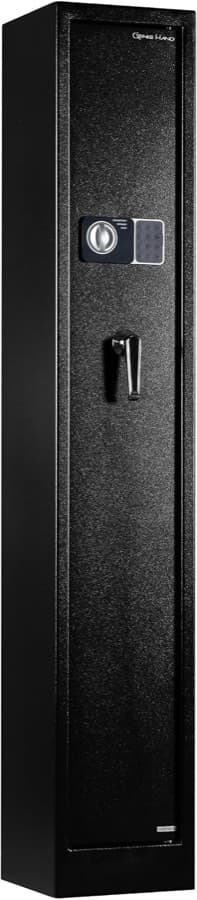
Genie Hand Genie Hand rifle safe

Best overall

Genie Hand Genie Hand rifle safe
8.6/10about £373.21
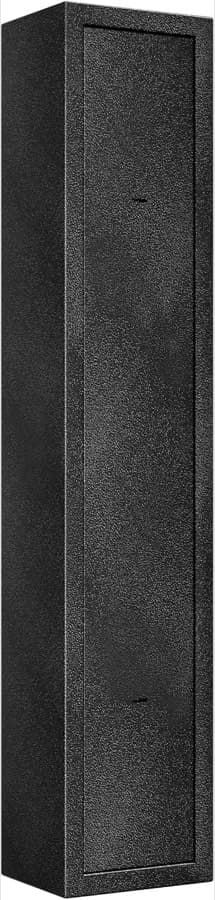
Sealey Sealey SGS3

Rank 2

Sealey Sealey SGS3
4.0/10about £181.02
GDK GDK 10GA

Rank 3

GDK GDK 10GA
4.0/10about £439.99
On this page

Where the cabinet can sit

Put the cabinet in an occupied, dry part of the home, out of casual view. A corner is harder to attack than a long open wall, which is the practical point BASC makes. An outhouse or a shed is a poor default. A damp loft or a damp cellar is a poor default as well. The handbook notes that damp can corrode fixings. The Genie Hand cabinet states that it is not water resistant. Loft joists are not a spare floor. The handbook says they can be about 40 per cent smaller than floor joists. If the only candidate room is damp, unoccupied, or on show, change the room before you change the bolts.

What you bolt into

Brick, concrete, or sound masonry is the fixing the handbook prefers. Joists are acceptable. Mark the holes through the cabinet so the bolts land on that structure. The coach-screw size for joists is at least 8 mm in diameter and not less than 63 mm long, into the joists, not the floorboards. That size is not a universal bolt for brick. We are not giving a torque setting. Plasterboard on its own is not the structure. In this set the Sealey SGS3 is wall or floor with fixings included, the Genie Hand has four wall holes, and the GDK 10-gun cabinet states four wall points. Those are listing points, not proof the wall will hold. If you hit studs, thermal block, or a wall you cannot identify, stop. The same stop applies if you rent and cannot drill.
Genie Hand Genie Hand rifle safe

Testsieger

Genie Hand Genie Hand rifle safe
8.6/10about £373.21

Weight, suspended floors, and lofts

The handbook’s example for a suspended timber floor is about 56 lb per square foot. Its 9-gun illustration is about 24 by 12 inches and about 126 lb, placed towards the joist ends rather than the middle of the span. Wall fixing reduces the floor load. If you are in doubt, take structural advice. Weights here run from about 18 kg to about 48 kg, and one cabinet states no weight. Do not turn those figures into a pass against 56 lb per square foot. A very heavy safe may not need fixing if it cannot realistically be carried off. That sentence does not apply to these 18–48 kg cabinets. Bolt them.

Keys, overrides, and when to stop

A bolted cabinet fails if the keys are in it. The handbook limits keys for firearms and for section 1 ammunition to authorised people, and it wants the primary key and the spare stored apart. The Genie Hand, the unbranded biometric cabinet, and the KAER still have an override or emergency key. That override stays outside. A code does not retire the key. Stop if the wall is stud, thermal block, or unknown, if the floor or loft is doubtful, if you rent and cannot drill, or if the officer has refused the plan. Never store a gun loaded. If the guns are stolen, report that to the police. For a long absence, the Police Service of Northern Ireland points holders towards a dealer. The certificate condition is on gun cabinet firearm certificate storage.

Common questions

Can I bolt a gun cabinet only to plasterboard?
No. Plasterboard is a lining, not the structure the handbook expects you to fix to. A cavity plug can pull out with the cabinet. You need brick, concrete, masonry, or joists behind that board. If the only material you can reach is the board itself, do not install the cabinet there.
Is a brick wall better than a stud wall?
For ordinary fixings, yes. The handbook prefers brick, concrete, or masonry, and it treats stud walls as something to avoid unless you anchor into a solid structure. Thermal block and breeze block take ordinary plugs poorly. A brick wall you can identify is a straightforward fix. A stud wall is a stop for advice, not a longer screw.
What does the handbook say about a suspended timber floor?
It gives an example of about 56 lb per square foot, and it prefers the joist ends to the middle of the span. A worked example is a 9-gun cabinet of about 24 by 12 inches and about 126 lb. Wall fixing reduces the floor load. If you are unsure the floor can take the cabinet, get structural advice rather than standing it in the middle of the room.
Where do the keys and the keypad override go?
Outside the cabinet, limited to authorised people, with the spare kept apart from the key you use. On a keypad cabinet the override is still a key. Leave it outside. The handbook does not treat a code as a reason to store the emergency key inside the door.
Do I need a professional for thermal block or a rental?
Yes, if you cannot say what the wall is made of, or if it is thermal block or studwork without a solid anchorage. Yes, as well, if the tenancy forbids drilling. Those are not problems a larger bolt from the kit solves. Ask a structural professional, or ask the enquiry officer, before you drill.

Related pages

Sources

Public UK sources on firearm and shotgun storage, BS 7558:1992, and air weapons. Listing prices and star counts are from the amazon.co.uk extracts kept for this comparison, dated 15 October 2026. Prices move.

  1. The Firearms Rules 1998 (retrieved 15 October 2026)
  2. Firearms security handbook 2020 (retrieved 15 October 2026)
  3. Statutory guidance for firearms licensing, August 2025 (retrieved 15 October 2026)
  4. BS 7558:1992 listing (retrieved 15 October 2026)
  5. Circular 005/2023, storage of air weapons (retrieved 15 October 2026)
  6. Air weapons: a brief guide to safety (retrieved 15 October 2026)
  7. PSNI firearms and explosives branch (retrieved 15 October 2026)
  8. Scottish Government, air weapon licensing (retrieved 15 October 2026)