Independent comparisons. We may earn from shop links. More info

How to use an end mill on the first pass

Updated: October 2026

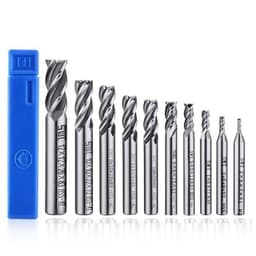
You have a new end mill and you want the first pass to cut rather than snap the flute. An end mill is not a drill. This is how to use an end mill: confirm the tip, seat the plain shank in a matching collet, take a shallow pass that throws a chip, and treat smoke as a stop. The [milling cutter set comparison](/hub/routers/milling-cutter-set) lays out the sets. Peter F. updated this on 21 October 2026 from these listings and public UK notes. If the collet is damaged, hand it to a machinist before you start the spindle. A qualifying purchase can earn a commission at no extra cost to you.

You have a new end mill and you want the first pass to cut rather than snap the flute. An end mill is not a drill.

Our top picks

On this page

Look at the end before you plunge

Check the tip with the spindle off. A centre-cutting end mill has edges that meet over the centre, so it can enter on the axis. A mill with a gap in the middle must come in from the side. Ashdown Tooling says not to plunge a cutter that is not centre cutting. A traditional UK slot drill is two-flute and over centre, yet model engineers disagree about modern four-flute tools, so the listing and the tip decide. ASNOMY and Oudtinz state centre cutting. QWORK, AFUNTA, and HSEAMALL do not. If the bullet is silent, stay with a side entry until you see edges that cross the centre. Plunge a four-flute only when that tool is centre cutting. If it is not stated, meet an edge, feed across, then add depth. A closed pocket needs a drilled hole or a centre-cutting tip. Alloy choice is on the HSS or carbide end mill page.

Grip the shank, not the flute

Match the collet to the shank and close the jaws on plain steel, not on the flute. A 6 mm shank needs a 6 mm collet. A 3.175 mm bit will not clamp in that collet, and a 1/4 inch shank is 6.35 mm so it will not enter it either. Shank families are on the milling cutter set buying guide. Keep the flute outside the jaws. If the flute goes in, the cutter walks out under side load. Tighten, then twist the cutter by hand with the machine unplugged. It should not move. An AFUNTA review on amazon.co.uk described a drill-press Morse taper that loosened under side load. Keep the stick-out short. If the collet is cracked or packed with chips, stop and call a machinist before you chase the first chip.

Make a chip, not dust

Rubbing makes dust and a welded flute. Cutting throws a chip out of the groove. Start at a fraction of the diameter on a hobby mill, with a feed that keeps the edge biting. There is no rpm chart for a £15 HSS set. Aluminium welds to the flute when the edge rubs. Model engineers use paraffin or a light WD-40-type spray, and they prefer two or three flutes so the gullet stays open. Clear the flute with the spindle stopped. A squeal means you are rubbing, so take less depth rather than pushing harder. Do not copy that pass into mild steel. Steel wants a slower, more rigid cut than paraffin on aluminium. How a downcut packs a groove is on the CNC router bit set page.

Downcuts and wood dust

A downcut pushes chips into the cut. It can tidy a top edge, and it packs the groove if the pass is too deep. Slow the feed, as the Hozly note in this comparison says, because a downcut packs chips. A UK review of maple on that listing reported smoke once the chips packed. Clear the slot, take a lighter pass, and stop if the hardwood still smokes. At work, follow HSE guidance WD5 on wood dust rather than treating a household vacuum as the control. At home, keep dust out of your breathing zone, clamp the board, and do not freehand the bit. Stop if the collet slips, the work moves, or you cannot clamp the part.

Common questions

Can I plunge a four-flute end mill?
Plunge a four-flute end mill only when the edges meet over the centre. Flute count does not decide it. Ashdown Tooling treats a traditional UK slot drill as a two-flute tool that cuts over centre, and modern four-flute mills are not all alike. If the listing is silent and the tip has a gap in the middle, enter from the side or from a drilled hole.
How do I know if this end mill is centre cutting?
Read the listing, then look at the tip. ASNOMY and Oudtinz state centre cutting. QWORK, AFUNTA, and HSEAMALL do not, so treat those as side-cutting until the edges visibly cross the centre. Edges that meet in the middle can enter on the axis. A web or a flat in the middle means you start from an edge.
Why does aluminium stick in the flutes?
Aluminium welds to the flute when the edge rubs or the chip cannot leave the gullet. The cutter then skates and the next pass runs hotter. Model engineers on UK hobby mills keep a real chip, prefer two or three flutes, and use paraffin or a light WD-40-type spray. If the flute is already packed, stop the spindle and clear it before you feed again.
How far should the shank go into the collet?
Close the collet on the plain shank, with the flute entirely outside the jaws and the jaws filled rather than biting the tip of a barely inserted shank. No single millimetre depth fits every collet in these sets. After you tighten it, the cutter must not twist by hand with the machine unplugged. If it turns, the size is wrong or the collet is worn.
Should I use an end mill in a pistol drill?
Keep an end mill out of a pistol drill. It needs a milling machine, a mill-drill with a sound holder, or a CNC router with the matching collet, because the cut pushes sideways. An AFUNTA review on amazon.co.uk described a drill-press Morse taper that loosened under that side load. A pistol drill leaves the feed in your hand.
Why did the downcut smoke in hardwood?
A downcut packs chips down into the groove. In maple, a UK review of a Hozly downcut reported smoke when those chips packed and the bit rubbed. Slow the feed, shorten the depth, and clear the slot before the next pass. If it still smokes, stop.

Related pages

Sources

Public UK and manufacturer sources from the research digest, October 2026.

  1. HSE — Wood dust (retrieved 21.10.2026)
  2. HSE — WD5 Routers (retrieved 21.10.2026)
  3. HSE — WIS22 (retrieved 21.10.2026)
  4. HSE — High-speed router (retrieved 21.10.2026)
  5. BSI — BS EN 847-1:2017 (retrieved 21.10.2026)
  6. BSI — BS EN 847-2:2017 (retrieved 21.10.2026)
  7. Trend — Routing FAQ (retrieved 21.10.2026)
  8. Model Engineer — End mill versus slot drill (retrieved 21.10.2026)
  9. Machine Mart — Clarke ET163 (retrieved 21.10.2026)