Independent comparisons. We may earn from shop links. More info

How to fill a metal raised bed

Updated: October 2026

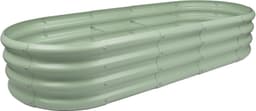
The kit arrives as a flat parcel. The compost bill is the surprise. A 180 × 90 × 30 cm metal bed holds 486 litres to the rim, about eight or nine 60-litre bags, and a two-pack doubles that. This is how to fill a metal raised bed that is an open-bottom galvanised frame: where it sits, when cardboard helps, and how the title becomes litres. The kits are on the [metal raised bed comparison](/hub/raised-beds-greenhouses-and-compost/raised-bed-metal). Peter F. used listing dimensions and public UK growing notes. This is not a fill trial. A qualifying purchase can earn a commission at no extra cost to you.

The kit arrives as a flat parcel. The compost bill is the surprise. A 180 × 90 × 30 cm metal bed holds 486 litres to the rim, about eight or nine 60-litre bags, and a two-pack doubles that.

Our top picks

On this page

Site, weeds, and the path

Assemble the frame where it will stay. A filled bed is not something you drag. Clear couch grass and bindweed while you can still see the roots. Annual weed loses to cardboard or to a summer of crops. Leave a kneeling path. The RHS wants beds under about 1.5 m, and Which? often cites about 1.2 m. A 90 cm frame works from both sides. A 60 cm frame works from one side. Sit the bottom edge down all the way round so compost does not leak at the first watering.

Open bottom on soil, and on hard standing

On lawn or bare soil, leave the bottom open. Roots and worms continue downwards and water leaves. A solid plate is not a missing part. Use cardboard only to smother turf for a season, and do not turn it into a sealed sheet. On paving or tarmac, the wall is the entire root depth. The RHS schools sheet asks for at least 50 cm there, and a 30 cm kit does not meet that. Read raised bed height for vegetables before you buy more compost for a hard site.

Cardboard, or nothing at all

On clean cultivated soil, add compost straight onto the open bottom. Cardboard earns its place on grass and annual weeds. Wet the sheets, overlap them by a hand’s width, and keep them inside the wall. It rots. It will not stop bindweed you left in the ground. Skip cardboard on tarmac and on turf you have already stripped. Woody sticks in the base shrink and leave a hollow. If you use them, calculate the remaining depth as the root zone.

Litres, bags, and the lines to ignore

A 180 × 90 × 30 cm bed is 486 litres. Nine 60-litre bags is 540 litres, which covers a little settlement. A UK reviewer on the KING BIRD bed allowed about nine bags for that soil box. The listing’s 2,916 litres uses the trellis height. Which line to trust is on the galvanised raised bed buying guide. A 120 × 60 × 30 cm bed is 216 litres, about four 60-litre bags. The same footprint at 43 cm is about 310 litres. A twin pack doubles the count. Leave the fill a centimetre or two under the rim.

Filling without hurting the bed or your back

Tip the bags in from the path. Do not stand in the middle. These frames feel flimsy until compost is against them, so fill evenly while the bolts are still slack. If a brace is missing or too short, stop. HSE employer guidance uses about 25 kg as an illustration of a lower-risk lift. That is not a legal maximum at home. Keep gloves on for the metal edge, water slowly, and expect a small top-up after the first soak.

Common questions

Do you need a liner or a base?
On soil, no base plate and usually no liner. The open bottom is how these kits drain, and a sheet under the whole bed traps water. Cardboard is the exception on grass, and it is temporary. On tarmac the problem is depth, which a liner does not fix. Missing screws or a short brace are a return, and they are separate from whether the design has a floor.
When should you use cardboard?
Use it on lawn or annual weeds, with overlapped sheets under the compost, in the way RHS no-dig guidance describes. Wet it and tuck it inside the frame. Leave it out on clean soil and on paving. It will not stop perennial roots you have left behind, so pull those while the footprint is still empty and you can see the crown.
How many bags of compost do you need?
Divide the litres by the bag size. A 486 litre bed is about eight 60-litre bags to the line, and nine bags allows for settlement. A 216 litre bed is about four 60-litre bags. Double the count for a twin pack. Ignore a capacity that uses trellis height, or that states one ring when the carton holds three.
Can you put the bed straight on the lawn?
Yes, after you decide what happens to the turf. Cardboard and compost is the no-dig route. Stripping the turf is the cleaner route if the grass is thick. Either way the frame sits on soil with an open bottom. Level the edge so compost does not leak, and keep a kneeling path so you can reach the middle from outside.
What about a patio or tarmac?
Treat the wall height as the full root depth. RHS school guidance wants at least 50 cm on tarmac, and a 30 cm kit is a shallow bed in that setting. Fill it for salads, herbs, and flowers, or move the project onto soil. Cardboard on slabs does not add useful depth. Check that water can leave, because a patio that falls the wrong way will hold a puddle under an open bottom.
Can you stand in the bed to firm the soil?
Work from the path. Standing in the middle compacts the soil you are trying to keep open, and the empty wall is not a rail. Firm lightly with a rake as you go, water, and top up after settlement. If the bed is wider than you can reach, the fix is a narrower frame, which the height page sets out, rather than a plank balanced on the rim.

Related pages

Sources

Public UK sources from the research digest, last checked on 20 October 2026.

  1. RHS — How to make a raised bed (retrieved 20.10.2026)
  2. RHS — No-dig gardening (retrieved 20.10.2026)
  3. RHS — Creating raised beds (schools) (retrieved 20.10.2026)
  4. Which? — How to build raised garden beds (retrieved 20.10.2026)
  5. Thrive — How to build raised beds (PDF) (retrieved 20.10.2026)
  6. Galvanizers Association — EN ISO 1461 (retrieved 20.10.2026)
  7. legislation.gov.uk — Consumer Rights Act 2015, section 11 (retrieved 20.10.2026)
  8. Planning Portal — Outbuildings (retrieved 20.10.2026)