Independent comparisons. We may earn from shop links. More info

Galvanised raised bed buying guide

Updated: October 2026

The star line on a galvanised kit is a weak way to choose a bed you will fill with hundreds of litres of compost. This galvanised raised bed buying guide is the order we use first: footprint and pack count, wall height, whether the bottom is open, then what the listing actually says about the steel. Prices and review counts for the ten kits are on the [metal raised bed comparison](/hub/raised-beds-greenhouses-and-compost/raised-bed-metal). Peter F. checked those amazon.co.uk listings against public UK sources. This is not a corrosion trial. A qualifying purchase can earn a commission at no extra cost to you.

The star line on a galvanised kit is a weak way to choose a bed you will fill with hundreds of litres of compost.

Our top picks

On this page

What you are buying

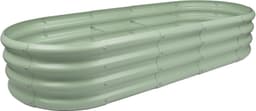
These kits are galvanised panels that bolt into a frame. The floor is the ground you stand them on. A missing base plate is the design. Bullets that mention a drainage hole mean that open base, not a sealed trough. Single large frames here are about 6.6–7.3 kg, and the heavier two-packs are about 10–16 kg before compost. A short screw count is a description problem under the Consumer Rights Act 2015, section 11. Use the returns route before you fill the bed.

Size, pack count, and honest litres

Match the title to the capacity line before you order bags. A 180 × 90 × 30 cm bed is 486 litres, and the Harbour Housewares listing states that figure. A 120 × 60 × 30 cm bed is 216 litres. A pack of two needs about twice that, even when the capacity line prints one bed. The KING BIRD soil bullet is 180 × 90 × 30 cm, about 486 litres, while 2,916 litres multiplies in the 180 cm trellis. A UK reviewer planned about nine 60-litre bags. If the litre line and the title disagree, believe the soil dimensions.

Height, width, and reach

Most kits kept here are 30 cm tall. The RHS uses about 30 cm for salads and strawberries, and 45 cm or more for most fruit bushes and small trees. One HEALSTOK pair is about 43 cm. On tarmac, the RHS schools sheet asks for at least 50 cm. None of the 30 cm kits meet that, and 43 cm still falls short. Crop detail is on the raised bed height for vegetables page. Stay under 1.5 m wide if you follow the RHS. A 90 cm bed works from both sides. A 120 cm round makes you lean.

Galvanising and thickness

Galvanised here means coated sheet pressed into panels, not a bed dipped to BS EN ISO 1461. The Galvanizers Association notes that continuously galvanised sheet sits outside that batch hot-dip scope. No listing shows a food-safe certificate, so we do not claim one. Thickness is printed once. ZORMY states 0.4 mm. Every other ASIN here is n/a on gauge. Silence is not a hidden 1 mm. A scratched coating is the weak point people flag near the sea.

Rules that still apply

A low open bed is not the shed example on the Planning Portal’s outbuildings page. Listed curtilage still belongs with the local authority. Rustington’s tenancy asks for written consent for raised beds. Brighton & Hove’s rules have been read as restricting metal goods that are not there for cropping. Rot and heat sit on metal vs wooden raised beds. HSE guidance for employers uses about 25 kg as a low-risk illustration for one lift. That is not a legal cap at home. The best galvanised raised bed page says which shape fits a first plot.

Common questions

Is galvanised steel safe for vegetables in the UK?
No source we used records a UK ban on galvanised beds for food crops, and none of these listings shows a food-safe certificate, so that claim stays off the page. The steel is coated sheet, which is different from a batch hot-dip fabrication. If your soil is very acidic, treat zinc and pH as a question for that plot. We did not test leaching, and you can refresh the compost you choose to put in the frame.
What does BS EN ISO 1461 mean on a garden bed listing?
ISO 1461 is the batch hot-dip standard for fabricated steel. The Galvanizers Association is clear that continuously galvanised sheet sits outside that scope, and pressed kits are normally made from sheet. A bullet that cites the number is not evidence of a thick dipped coating on that panel. Ask for the gauge in millimetres. If the answer is silence, record n/a and compare on size and reviews instead.
How do I check the real size before I order compost?
Multiply soil length, width, and depth in metres. A 180 × 90 × 30 cm bed is 486 litres. Then read the pack count, because two beds need two volumes even when the capacity line prints one. Ignore a litre figure that uses trellis height, and ignore parcel dimensions smaller than a panel. The comparison table is where those clashes sit side by side.
Do I need a base plate?
You do not, if the kit is an open-bottom bed on soil. Roots are meant to continue downwards and water is meant to leave. On paving, the wall height is the whole root zone, which is why 30 cm becomes a crop limit. Cardboard, where you are smothering grass, is a temporary weed layer. It is not a floor, and the fill guide covers when to use it.
Do allotments allow metal kits?
Some do, with written consent, and some restrict metal that is not used for growing. Rustington’s tenancy is one public example of a consent clause that names raised beds. Read your own agreement before the courier arrives. A wooden bed can face the same consent step. The material page is about rot and heat, and the tenancy is a separate yes or no.
Why do round and rectangle labels disagree?
Marketplaces reuse one template across ovals, rings, and rectangles, and the shape field often loses. Trust the centimetre line in the title, then the capacity maths. A round label on a 180 × 90 cm frame is usually a rounded rectangle. A 120 × 120 cm frame is the ring. If both stainless and galvanised appear, treat the material as unconfirmed until the panels arrive.

Related pages

Sources

Public UK sources from the research digest, last checked on 20 October 2026.

  1. RHS — How to make a raised bed (retrieved 20.10.2026)
  2. RHS — No-dig gardening (retrieved 20.10.2026)
  3. RHS — Creating raised beds (schools) (retrieved 20.10.2026)
  4. Which? — How to build raised garden beds (retrieved 20.10.2026)
  5. Thrive — How to build raised beds (PDF) (retrieved 20.10.2026)
  6. Galvanizers Association — EN ISO 1461 (retrieved 20.10.2026)
  7. legislation.gov.uk — Consumer Rights Act 2015, section 11 (retrieved 20.10.2026)
  8. Planning Portal — Outbuildings (retrieved 20.10.2026)