Independent comparisons. We may earn from shop links. More info

Insect mesh for raised beds

Updated: 21 October 2026

Insect mesh for raised beds is a hole-size decision before it is a brand decision. Carrot fly, cabbage whites and aphids are different sizes, and a micromesh title does not say which of them the cloth can stop. This page stays with millimetres. It is not a frost guide. The [raised bed cover comparison](/hub/raised-beds-greenhouses-and-compost/raised-bed-cover) has the prices. The [buying guide](/hub/raised-beds-greenhouses-and-compost/raised-bed-cover/sub/raised-bed-cover-buying-guide) is where fleece and pop-ups sit beside mesh, and [fleece versus insect mesh](/hub/raised-beds-greenhouses-and-compost/raised-bed-cover/sub/raised-bed-cover-fleece-vs-mesh) is why a 30 gsm sheet is the wrong aisle. Peter F., 20 October 2026. No lab count of insects. A qualifying purchase can earn a commission at no extra cost to you.

Insect mesh for raised beds is a hole-size decision before it is a brand decision. Carrot fly, cabbage whites and aphids are different sizes, and a micromesh title does not say which of them the cloth can stop.

Our top picks

On this page

RHS hole size bands

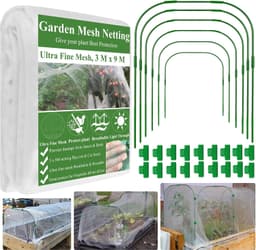
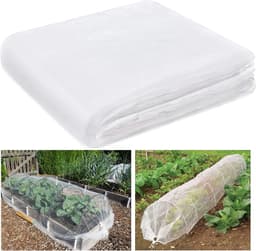
The Royal Horticultural Society distinguishes a fine insect mesh around 0.8 mm from a standard mesh around 1.3–1.4 mm. Fine mesh is aimed at smaller insects as well as larger ones. Standard mesh is aimed at cabbage whites, and it is a weaker bet for carrot fly, aphids and flea beetle. Bury the edge about 5 cm, and do not stretch the net. OAHAO states 0.8 mm on a 2.5 m × 10 m sheet. WYRJXYB states 0.8 mm × 1 mm on a 3 m × 9 m net with hoops.

Carrot fly and cabbage root fly

Carrot fly is small, the season is long, and a standard 1.3–1.4 mm mesh is the grade the Society treats as less suitable. A stated hole around 0.8 mm is what you can check before you pay. OAHAO’s reviews include people who covered carrots, and one report of carrot fly anyway. That failure fits an open edge. WYRJXYB’s kit adds hoops so the net is not lying on the foliage. Cabbage root fly is the same problem on brassica stems, and a net does not empty pupae already in the bed.
WYRJXYB WYRJXYB mesh and hoop kit

Testsieger

WYRJXYB WYRJXYB mesh and hoop kit
8.7/10about £22.99

Aphids and flea beetle

Aphids and flea beetle sit at the fine end, around 0.8 mm, not at a standard mesh that stops a white butterfly and lets a greenfly through. Haxnicks is a 120 × 100 × 50 cm cover at £19.99, described as ultra-fine micromesh, with 3.7 from 170 reviews. UK texts say it keeps cabbage whites and carrot fly off when sealed. The page still prints no millimetre, so you cannot place it on the 0.8 mm side from the listing alone. Repeated reviews say the pictured frame was not in the box. You can peg the net. You cannot cite it as a measured fine mesh.

Listing claims in this set

Read the bullet, not the adjective. OAHAO states 0.8 mm and says you can water through the sheet. The roll is 250 g, it tears at clumsy pegs, and reviewers doubt a multi-year life. WYRJXYB states 0.8 mm × 1 mm and hoops about 84 cm high. One review still found caterpillars after sealing, and the mesh tears if it is stretched. Pop-ups and the 30 gsm fleece listings state no millimetre hole. Bury OAHAO for the evidenced sheet. Keep WYRJXYB slack if you want hoops in the box.

Common questions

What mesh size stops carrot fly on a raised bed?
Use a fine mesh around 0.8 mm, the Royal Horticultural Society’s fine grade, and bury the edge about 5 cm so the fly cannot walk under. A standard mesh around 1.3–1.4 mm is a weaker choice for carrot fly. OAHAO states 0.8 mm and WYRJXYB states 0.8 mm × 1 mm. A micromesh title has not given you the number. One review still found fly under a 0.8 mm sheet, which is what a gap produces.
Is 0.8 mm the same as micromesh?
Only if the listing also prints the millimetre. Micromesh is a marketing word. Haxnicks uses it on a 120 × 100 × 50 cm cover and states no hole, while OAHAO states 0.8 mm. Reviews can say a micromesh kept whites off and still leave aphids and flea beetle unanswered. Prefer the number when the pest is small.
Will a standard 1.4 mm mesh stop cabbage whites?
A standard mesh around 1.3–1.4 mm is the grade aimed at larger insects such as cabbage whites, if the skirt is sealed and the cloth is not stretched. Fine 0.8 mm mesh also stops them and covers smaller insects, so a brassica bed that also worries you about aphids should take the finer cloth. Whites still appeared in one review of a fine kit after sealing, so the edge is the other half of the specification.
Do I need finer mesh for aphids and flea beetle?
Yes. Aphids and flea beetle sit around 0.8 mm, not at the 1.3–1.4 mm mesh that is enough for a large white butterfly. OAHAO’s stated 0.8 mm sheet is the loose option with the long review count. A pop-up that never prints a hole is not a flea-beetle cover because the title says ultra-fine. Haxnicks names aphids and still omits the millimetre.
Does fleece count as insect mesh if it is 30 gsm?
No. Gsm is weight, not hole size. FuBegi and CHEOAR are 30 gsm frost fleece. They are useful for about 2°C of light-frost shelter in the Society’s ordinary description, and they are the wrong specification for carrot fly. Keep them for the cold part of the season and switch to a stated fine mesh when insects are the reason the bed is covered. A fleece with hoops is still fleece.
How long can the mesh stay on the bed?
It can stay on while you water, which is the point of a net that passes rain, until the crop needs a bee or outgrows the frame. Take it off for strawberries and courgettes at flowering. Lift it when leaves press a 40 cm pop-up or a low hoop. Check pegs after wind so a tear at the base does not become a new entrance.

Related pages

Sources

Public UK sources named below. amazon.co.uk prices, stars and review counts on these listings were read on 20 October 2026. Page updated October 2026.

  1. RHS, Fleece and crop covers (retrieved 2026-10-20)
  2. RHS, Insect-proof mesh (retrieved 2026-10-20)
  3. RHS, Carrot fly (retrieved 2026-10-20)
  4. RHS, Cabbage root fly (retrieved 2026-10-20)
  5. RHS, Cloches (retrieved 2026-10-20)
  6. RHS, Warming soil for planting (retrieved 2026-10-20)
  7. Gardeners' World, how to use fleece (retrieved 2026-10-20)
  8. Consumer Rights Act 2015, section 22 (retrieved 2026-10-20)
  9. GOV.UK, accepting returns and giving refunds (retrieved 2026-10-20)