Independent comparisons. We may earn from shop links. More info

How to secure a raised bed cover

Updated: 21 October 2026

Wind on an exposed UK plot lifts a light sheet. Securing a raised bed cover is an edge job: spare fabric to bury or weigh, a support that holds the cloth off the leaves, and a check after the first gusty night. This page is the method, not a ranking. Listings sit on the [raised bed cover comparison](/hub/raised-beds-greenhouses-and-compost/raised-bed-cover). Choose the fabric with the [buying guide](/hub/raised-beds-greenhouses-and-compost/raised-bed-cover/sub/raised-bed-cover-buying-guide), and use [insect mesh for raised beds](/hub/raised-beds-greenhouses-and-compost/raised-bed-cover/sub/raised-bed-cover-insect-mesh) if the hole size is still unclear. Peter F., 20 October 2026. No lab trial. A qualifying purchase can earn a commission at no extra cost to you.

Wind on an exposed UK plot lifts a light sheet. Securing a raised bed cover is an edge job: spare fabric to bury or weigh, a support that holds the cloth off the leaves, and a check after the first gusty night.

Our top picks

On this page

Bury or weigh the edges

Insect mesh only works when the skirt meets the soil. The Royal Horticultural Society’s figure is about 5 cm of burial. A sheet listed at 250 g, the OAHAO weight in this capture, will not pin itself. Lay spare on every side, then cover it with soil, a batten, or pegs that do not punch a tear. On a timber bed the spare often goes down the outside face, because you cannot bury inside a full bed without smothering the crop. Short pegs walk out of loose allotment soil, and pegs forced through fine mesh start a run. One UK review found holes at the base within days.

Hoops and a slack drape

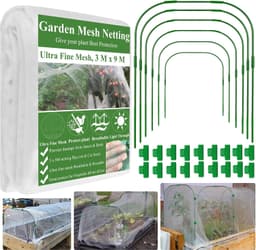
Crops that need headroom want hoops or a sewn wire, and the cloth wants to sit slack. The Society’s warning is not to stretch insect mesh. Tension turns a small hole into a slot. Reviews of a mesh-and-hoop kit say the net tears when it is pulled tight, and that clips need a look after wind. Build the arch first, drape the fabric, then fix the clips or the skirt. If a connector pops out while you bend a fibreglass rod, reseat it before you tension anything. A cover around 40 cm tall will rub a seedling within a fortnight. When leaves press the mesh, add a higher hoop or remove the tent.
WYRJXYB WYRJXYB mesh and hoop kit

Testsieger

WYRJXYB WYRJXYB mesh and hoop kit
8.7/10about £22.99

Ventilate fleece and any plastic panel

Fleece still needs weighed edges, and it also needs opening. The Royal Horticultural Society treats it as about 2°C of shelter, not a sealed winter room. The 30 gsm listings say to roll it back on mild days and dry it before you store it. Left down on a sunny March afternoon, it holds moisture on seedlings. Mesh can stay on while you water. A plastic face, where a listing mentions one, usually cannot.

Take covers off for pollination

A cover that keeps out carrot fly also keeps out bees. Leave mesh or fleece on leaf crops you cut before they flower. Take it off at flowering for strawberries, courgettes, and anything else that needs an insect to set fruit. The timing is the flower, not a calendar date. Put the cover back when flowering is done if a pigeon or a white butterfly is still the threat, and reseal the skirt. Caterpillars have turned up after a bed was thought sealed, which usually means a gap or a stretched hole.

Common questions

How deep should I bury a raised bed mesh?
About 5 cm is the Royal Horticultural Society figure for insect-proof mesh, which is enough soil or weight to stop the skirt flapping. On a timber bed you often cannot bury inside the box, so carry the spare down the outside and weigh it with a batten. The point is continuous contact, not a trench for its own sake. A peg every metre with a gap between them is not a seal, and carrot fly will use that gap.
Can I stretch the mesh so it looks tidy?
No. Stretching widens the holes and starts tears at pegs and clips. The Society says not to stretch insect mesh, and kit reviews in this capture describe tears when the net is pulled tight over hoops. A slack drape that is buried at the edge keeps insects out better than a drum-tight sheet with slots in it. If the bed looks messy, add a hoop so the cloth is not lying on the leaves, rather than pulling the corners harder.
How do I stop fleece going mouldy on the bed?
Roll it back on mild days and let it dry before you store it, which is what the 30 gsm listings already say. Fleece holds about 2°C in the Society’s ordinary description, and it also holds damp if you leave it sealed in sun. Dry the clips as well. A fleece is not a plastic cloche you leave shut for a fortnight.
When do I remove the cover for bees?
When the flowers that need a pollinator are open. Strawberries and courgettes are the clear cases. A mesh or fleece that stays on through that week keeps the bee out with the pest. Leaf crops you harvest young can stay covered. After fruit has set, you can put the cover back if birds or later caterpillars are still a problem, and you should bury the edge again rather than draping it loosely.
What if the pegs will not hold in my soil?
Stop making more holes in the mesh. Use a continuous weight: a timber batten, stones in a sock, or soil on a spare skirt outside the bed. Short pegs walk out of light allotment soil overnight, and a fine net tears around the hole they leave. Pop-up stakes have the same limit. If the bed sits on a membrane, on a balcony, or on paving, weights beat stakes. Do not pierce a roof waterproofing layer to anchor a seedling tent.
The cover arrived without the frame in the photo. What now?
Fit it as a sheet if the listing never promised a frame. Several UK reviews of one shaped micromesh say only the net arrived. Bury or weigh that net, or set it on hoops you already own. If the parts list included hoops or a wire and they are missing, the Consumer Rights Act 2015 short-term right to reject is the route.

Related pages

Sources

Public UK sources named below. amazon.co.uk prices, stars and review counts on these listings were read on 20 October 2026. Page updated October 2026.

  1. RHS, Fleece and crop covers (retrieved 2026-10-20)
  2. RHS, Insect-proof mesh (retrieved 2026-10-20)
  3. RHS, Carrot fly (retrieved 2026-10-20)
  4. RHS, Cabbage root fly (retrieved 2026-10-20)
  5. RHS, Cloches (retrieved 2026-10-20)
  6. RHS, Warming soil for planting (retrieved 2026-10-20)
  7. Gardeners' World, how to use fleece (retrieved 2026-10-20)
  8. Consumer Rights Act 2015, section 22 (retrieved 2026-10-20)
  9. GOV.UK, accepting returns and giving refunds (retrieved 2026-10-20)