Independent comparisons. We may earn from shop links. More info

Food waste caddy or compost bin

Updated: 21 October 2026

You are looking at a metal tin on amazon.co.uk while the council is also talking about a food waste caddy, and the two words are not the same bin. A food waste caddy or compost bin question is really two destinations. The council stream is collected and often allows cooked food and meat. A home compost heap is yours, and Recycle Now keeps cooked food, meat, and fish off it. The metal kitchen caddy in the [metal compost bin comparison](/hub/raised-beds-greenhouses-and-compost/metal-compost-bin) is only the indoor holder that feeds one of those destinations. It does not change the rules. The notes below are from GOV.UK and public council and charity pages, not from a product test. A qualifying purchase can earn a commission at no extra cost to you.

You are looking at a metal tin on amazon.co.uk while the council is also talking about a food waste caddy, and the two words are not the same bin. A food waste caddy or compost bin question is really two destinations.

Our top picks

On this page

Two destinations for the same kitchen scraps

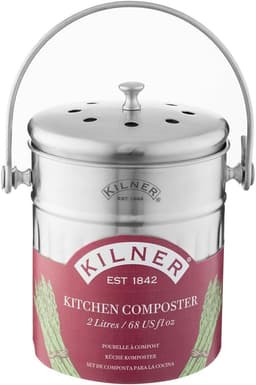
Name the destination before you name the tin. Destination one is the council food-waste service: a small kitchen caddy, often plastic and often supplied, emptied into a kerbside bin that goes for treatment such as anaerobic digestion. Destination two is home composting: an outdoor bin on soil, which Recycle Now describes as a mix of greens and browns, producing compost for the garden over months. WRAP’s home-composting guidance is in the same family. Garden waste and raw peelings, not the full contents of a dinner plate. A bought metal compost bin from this shortlist is neither of those outdoor containers. KitchenCraft, Kilner, Harbour, VeoHome, and the others hold about 2 to 5 litres on a worktop. You still walk the scraps somewhere. If you walk them to the council caddy, you follow the council yes-list. If you walk them to the heap, you follow the home-composting no-list. Using one indoor tin for both is fine only when you keep the two streams apart. A single bucket that mixes Sunday gravy with potato peelings cannot be tipped on the heap just because the bucket is labelled compost.

What council food caddies usually take

Council food caddies are built for the food people actually throw away, including food a heap should not see. Norwich City Council’s food-waste page allows cooked food and meat in the food caddy. That is a clear contrast with home composting lists. Other councils, in Devon and Durham patterns and elsewhere, send food waste to anaerobic digestion, ban packaging, and set their own liner rules. One council’s liner is not the nation’s liner. Some accept compostable bags, some want the caddy bare, some specify a brand of liner they supply. Read your own page before you copy Norwich. Scotland and Wales are not on England’s timetable, and a district still on a transition is not on the same week as a neighbour. The metal tin you buy does not unlock a wider yes-list. If the council caddy takes meat, the meat can sit in your stainless tin for the walk across the kitchen. It still has to land in the council bin, not on the garden.

What a home compost bin takes

A home heap takes raw plant material and a balancing share of browns. Recycle Now’s setup advice excludes cooked food, meat, and fish. RHS guidance for school composting makes the same point about cooked food and dairy, and it flags rats. WRAP’s home-composting note is narrower than a council food caddy. Potato peelings, apple cores, coffee grounds, and crushed eggshells are the usual kitchen contribution. A roast chicken carcass is not. The outdoor bin should sit on bare soil, with a lid, so liquid can drain and animals have a harder time. That volume is the compost bin comparison, not a worktop tin. Test Valley and Norwich pest advice talk about a lidded bin and a mesh of about 15 mm under the base where rats are a risk. That mesh is a garden-bin fitting. It is not something you add to a 3 litre KitchenCraft tin. If rats are already in the heap, remove the food that attracts them and use a pest controller. An illness you think is linked to rats belongs with NHS advice, not with a shopping page.

Where a bought metal caddy still fits

You can own a council caddy and still want a metal tin. The council caddy is often plain plastic, kept under the sink or in a cupboard, and sized for several days of all food waste. A metal tin is what you leave on the counter because it looks like a KitchenCraft or a Kilner and because you pass it while you chop. UK reviews on those listings talk about the look and about replacing a stained plastic box. That is a fair reason to spend about £13 to £30. It is not a second official caddy, and the council will not empty the duck-egg tin from your worktop. Litres and filters are on the metal compost bin buying guide. Use the metal tin as the daytime holder and empty it into the council caddy each evening, if the council bin is the destination. If you compost at home, empty only the peelings and grounds into the heap, and put meat and cooked leftovers into the council stream the same day. Two destinations, one pretty tin, no mixing at the tipping point. If the council has not given you a caddy yet, the metal tin still does not store meat for a week in a warm kitchen. It buys a day or two for peelings. Daily washing and fly control are on how to use a kitchen compost bin.

England’s collection changes from 2026

GOV.UK’s Simpler Recycling guidance says households in England are due weekly food-waste collection from 31 March 2026, with a kitchen caddy and an outdoor bin, while home composting is still encouraged for waste that suits a heap. The Environment Act 2021 commencement regulations 2024 allow later dates for named councils. From 2026 is not a promise that your district collects on 1 April. Ask the council for your start date, what the issued caddy looks like, and which liners they accept. This duty does not make a bought metal bin compulsory, and it does not cancel home composting. GOV.UK still points people at composting suitable waste at home. It also does not apply as an England date in Scotland or Wales. Those nations run their own services. Northern Ireland is not covered by that England date either. If a headline says the UK is getting free weekly food caddies next spring, narrow it to England and then to your council’s transition.

Common questions

Will the council give me a caddy in 2026?
In England, GOV.UK says weekly food-waste collection should be in place from 31 March 2026, including a kitchen caddy, unless a named council has a later transition under the 2024 regulations. That is not a delivery date for your street. Ask your council. Scotland, Wales, and Northern Ireland are not on that England date. A metal tin you buy yourself is not the official caddy.
Can I put meat scraps in a metal compost bin?
You can hold them in the tin only if their next stop allows them. Norwich allows meat and cooked food in the council food caddy. Recycle Now does not allow meat or fish on a home heap. The metal does not sanitise the scraps or move them into the heap’s yes-list. If the council bin is not available today, do not store meat in a warm kitchen tin for days.
Do I still need a bought tin if I have a council caddy?
No. The issued caddy is enough for the collection. A bought metal tin is for the counter: looks, a filter, or a size you prefer between chops. You empty it into the council caddy. You do not need both, and you should not pay about £25 for Kilner stainless in the belief the council requires it.
Can I tip the council caddy onto my garden heap?
Only if everything in it would have been allowed on the heap anyway, which defeats the point of a mixed food caddy. Cooked food and meat that Norwich-style services accept must not go on a home heap. Keep peelings for the heap and let the council take the rest. Mixing them in one indoor tin and tipping the lot is how the no-list gets ignored.
What about tea bags and coffee grounds?
Coffee grounds are normal scraps for a home heap and are widely accepted as food waste. Tea bags depend on the bag. Plastic mesh is a problem some councils and some compost guides exclude. The metal caddy can store either. Acceptance is on your council page or on Recycle Now’s home-composting exclusions, not on the product title.

Related pages

Sources

Public UK sources from the research digest, last checked on 19 October 2026.

  1. GOV.UK — Simpler recycling: household recycling in England (retrieved 19.10.2026)
  2. legislation.gov.uk — Environment Act 2021 commencement regulations 2024, regulation 6 (retrieved 19.10.2026)
  3. WRAP — Home composting (retrieved 19.10.2026)
  4. Recycle Now — How to set up home composting (retrieved 19.10.2026)
  5. RHS — Composting for schools (retrieved 19.10.2026)
  6. RHS — Rats in the garden (retrieved 19.10.2026)
  7. Test Valley Borough Council — Rats and compost (retrieved 19.10.2026)
  8. Norwich City Council — Food waste caddy (retrieved 19.10.2026)