Independent comparisons. We may earn from shop links. More info

How to anchor a walk in greenhouse

Updated: October 2026

The box is in the hall, the forecast has a gusty afternoon, and the cover is a light PE or PVC tent rather than a glazed house on a steel base. Anchoring is what keeps it in the garden. This is how to anchor a walk in greenhouse after you have already chosen the shape: site it, get the frame true, tie it down, then run the door so the plants are not cooked. The twelve listings in the [Gardebruk greenhouse comparison](/hub/raised-beds-greenhouses-and-compost/gardebruk-greenhouse) are other brands, not Gardebruk, and the same rope and zip faults show up across them. Peter F. checked the review notes and the RHS ventilation guidance on 20 October 2026. Pegs were not load-tested. A qualifying purchase can earn a commission at no extra cost to you.

The box is in the hall, the forecast has a gusty afternoon, and the cover is a light PE or PVC tent rather than a glazed house on a steel base. Anchoring is what keeps it in the garden.

Our top picks

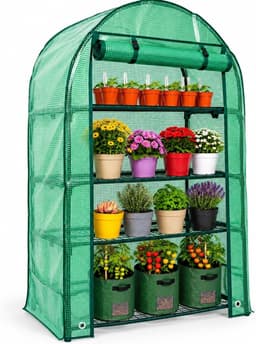
DIVCHI DIVCHI Shelf growhouse

Best overall

DIVCHI DIVCHI Shelf growhouse
9.2/10about £33.29
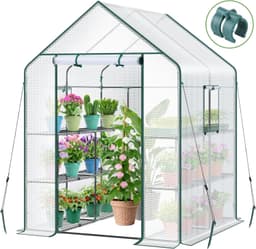
Ohuhu Ohuhu 12-shelf growhouse

Best value

Ohuhu Ohuhu 12-shelf growhouse
8.8/10about £69.99
Ohuhu Ohuhu Tomato house

Alternative

Ohuhu Ohuhu Tomato house
8.8/10about £49.99
On this page

Before you erect

Pick a sheltered spot out of the main funnel between houses, on ground you have checked with a spirit level. A frame that twists on a slope pulls the zip and lifts a corner. For a tall cover, two people are the sensible crew: one holds a hoop while the other seats a joint. A no-tools line on an Ohuhu or VOUNOT listing means the poles push together. It does not mean one person can sheet a 180 cm house in a rising wind. Wait for a dry, still morning. A second person is enough for a normal PE cover. It is not a promise you can finish it in a squall.

Anchoring on soil and paving

On soil, pegs go in as deep as the stake allows, not just through the turf. The Ohuhu tomato listing says to drive the stakes in as far as you can, and to add ropes if the site is exposed. The Taylor & Brown and the twelve-shelf Ohuhu include ground pegs and wind ropes. The wide VOUNOT includes four ropes and four ground anchors. The small VOUNOT tomato house includes four ropes, stakes and nylon ties. Use all of them. A single peg at the door is how a corner starts to hop. Guy ropes want a low angle out to a second stake or a fence post, not a short line straight down the leg. Review notes across this set say the supplied ropes perish or snap. Check them after the first windy week and again mid-season, and replace a brittle line before the next gale rather than waiting for the cover to go. Alex Grows Food’s storm-proofing notes make the same point in plain terms: weak pegs and weak ropes are what you upgrade, and you do it before the weather, not after the tent is in the neighbour’s tree. On paving, pegs do not bite. Weight the skirt. Pots, water containers or slabs on the extended hem hold the cloth down. The Ohuhu gothic has a hem you can fill with sand, soil or bottles, which is the listing’s own answer to a patio. The DIVCHI does not list pegs or ropes at all, so a patio install is your weights plus a line to a railing if you have one. Bricks on the skirt help against lift. They do not replace a guy if the frame is tall. Do not drill a listed wall or a rented fence without permission. A permanent concrete base, or mains power for a heater, is the point to call a professional.
DIVCHI DIVCHI Shelf growhouse

Testsieger

DIVCHI DIVCHI Shelf growhouse
9.2/10about £33.29

Wind orientation

Point the narrow face, or a corner, into the prevailing wind, not the full door elevation. A 215 cm VOUNOT side is a larger sail than the 143 cm end. An open roll-up door acts as a scoop. If you ventilate on a breezy day, open the leeward side or a mesh window first, and keep the windward zip partly closed so the cover is not a bag. Tie the door ribbons so a gust cannot unzip the panel into a flag. The JUNGLE STONE listing includes ribbons for that reason. After a storm, walk the pegs before you congratulate the star rating. UK texts praise houses that stayed up when they were tied down, and the same notes record panels blowing out. Survival in one review is we guyed it, not a cloth with a wind class. A star on the product page is not that test.

Daily door and vent routine

The RHS says you open the door and the vents on sunny days, and that a small house relies on the door when the roof-vent area is too small. That describes every zip tent here. A March sun on a shut 135 g/m² cover will overheat seedlings long before you notice from the kitchen. Open the door while you are around. Close it before you leave if the evening is cold, and crack a mesh window if the listing has one, such as the two side windows on the twelve-shelf Ohuhu or the gothic. Poor airflow shows up as mould. The heyfurni UK notes include fungus when the house stays shut. Shelf tents pack trays tightly, so a closed zip is worse there than in an empty tomato sleeve. Do not invent a temperature lift. Open the door, feel the air, and water in the morning so leaves dry. If you are growing fruiting tomatoes, the crop fit is on the tomato greenhouse page. The door habit is the same.

Limits of a zip cover

Zips leave the track in the UK samples for almost every cloth house here, from the 814-review Ohuhu tomato sleeve to the 1,635-review wide VOUNOT. If the slider jumps, ease the cloth so the teeth meet, and stop forcing it. A safety pin or a clip can hold a door for a week. It is not a repair that brings the original seal back. When the track is split along the hem, retire the cover. Buying another identical tent without changing the pegs repeats the failure. Ropes are a wearing part. Plan to replace them in a season if they stiffen in the sun. Water through the cover appears in the defect notes for the Taylor & Brown, the wide VOUNOT, the heyfurni and the small VOUNOT. A wet shelf is a seam or a door left open in rain, not a reason to seal every vent. This page does not cover polycarbonate glazing, anchor plates on the HAPPYGRILL, or a concrete base. Those are a different build. If the tent is already in the next garden, the next purchase is a shape and a hold-down you can actually use. Prices and kits change. The order of work does not: site, frame, cover, tie-down, then the door every bright day.

Common questions

How do I peg a greenhouse on paving?
You do not. Pegs need soil. On slabs, weight the skirt with pots, bottles, or the fillable hem on the Ohuhu gothic, and run a guy to a railing or a freestanding weight you are allowed to use. Bricks on the cloth stop flutter. They do not hold a tall frame on their own in a gale.
Do I need guy ropes as well as pegs?
Yes on an exposed site. Pegs at the feet stop the frame walking. Ropes stop it racking and lifting. The Taylor & Brown, the twelve-shelf Ohuhu, and both the VOUNOT tomato house and the wide house list ropes in the kit. Fit them low and tight, and replace them when they go brittle. The reviews say that is the part that snaps.
Should I leave the door open on a sunny day?
Yes while you are there to manage it. The RHS treats the door as the vent on a small house that lacks roof-vent area. A shut zip cooks plants and, on a shelf tent, shows up as mould in UK reviews. Close or reduce the opening if the wind is on the door, because an open panel is a sail.
Which way should the door face the wind?
Keep the full door elevation out of the prevailing wind. Present the narrow end or a corner to the gust, and ventilate on the lee side first. A 2 m wide face, as on the VOUNOT at 215 cm, catches more air than the 143 cm end. Tie the door so it cannot unroll itself.
Will bricks on the skirt work instead of pegs?
On paving, weight on the skirt is the right idea, and bricks can be part of it. They are not a full substitute for guys on a tall house, and they do nothing for a foot that can still hop if the cloth is not held all round. On soil, use the stakes the listing supplied, then add weight if the site is exposed.

Related pages

Sources

Public UK sources and amazon.co.uk listings, last checked on 20 October 2026.

  1. Planning Portal, Outbuildings (retrieved 20 October 2026)
  2. RHS, Choosing greenhouses (retrieved 20 October 2026)
  3. Consumer Rights Act 2015, section 11 (retrieved 20 October 2026)
  4. Growsave, Alternative greenhouse materials (retrieved 20 October 2026)
  5. Gardebruk foil, amazon.co.uk B08BS4JBDL (retrieved 20 October 2026)
  6. Gardebruk 6 × 6, amazon.co.uk B00TU0I3N2 (retrieved 20 October 2026)
  7. Gardebruk 6 × 8, amazon.co.uk B07B9VTWTV (retrieved 20 October 2026)
  8. Gardebruk 6 × 12, amazon.co.uk B0DYF15VHB (retrieved 20 October 2026)