Independent comparisons. We may earn from shop links. More info

Walk in greenhouse buying guide

Updated: October 2026

You have a UK patio or a narrow side return, and a tab of large walk-in covers between about £23 and £70, plus polycarbonate houses that jump past £700. The category name says Gardebruk, but none of the twelve amazon.co.uk listings in the [Gardebruk greenhouse comparison](/hub/raised-beds-greenhouses-and-compost/gardebruk-greenhouse) is a Gardebruk model. This walk in greenhouse buying guide is the order of decisions: the job, the cover, how you hold it down, how it breathes, then whether the UK review sample is large enough to trust. Peter F. checked those listings, the RHS greenhouse notes and the Planning Portal on 20 October 2026. There was no lab wind test. A qualifying purchase can earn a commission at no extra cost to you.

You have a UK patio or a narrow side return, and a tab of large walk-in covers between about £23 and £70, plus polycarbonate houses that jump past £700.

Our top picks

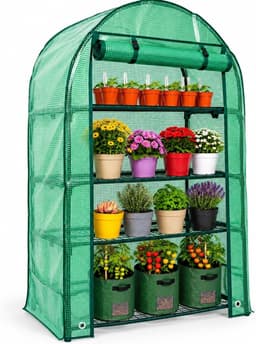
DIVCHI DIVCHI Shelf growhouse

Best overall

DIVCHI DIVCHI Shelf growhouse
9.2/10about £33.29
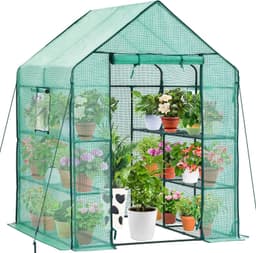
Ohuhu Ohuhu 12-shelf growhouse

Best value

Ohuhu Ohuhu 12-shelf growhouse
8.8/10about £69.99
On this page

What you are buying

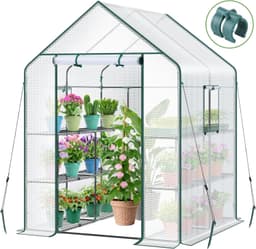
A walk-in in this search is four objects. A shelf growhouse is a cupboard of trays, 45 to 75 cm deep, such as the DIVCHI at 105 × 45 × 160 cm. A square cloth cover is something you can stand in, such as the Taylor & Brown at 143 × 143 × 195 cm or the VOUNOT at 143 × 215 × 195 cm. Polycarbonate here means the HAPPYGRILL, the Pipleo and the Ruby 3, not the £50 tents. If you wanted a 6 × 8 ft house and you buy 73 cm of depth, you have bought a propagator. Glazing is on the plastic greenhouse versus polycarbonate page, and what you do after the box arrives is the anchoring guide. Gardebruk’s own pages, checked on 20 October 2026 and not among these twelve listings, sit apart: foil around £49.99, polycarbonate about £208 to £370.

Cover and stated weight

Decide the cover before the stars. Polyethylene and PVC zip cloth is the £23 to £70 band. Twin-wall polycarbonate is the hundreds. Two listings disagree with themselves. Taylor & Brown’s bullets describe a 130 g/m² green PE cover, and the technical table says PVC. The Ohuhu twelve-shelf house is titled as plastic and tabled as PVC. Consumer Rights Act 2015 section 11 says goods must match the description. Grams per square metre is a printed cloth weight, not a wind class. VOUNOT states 135 g/m². The Ohuhu tomato sleeve states 130 g/m². DIVCHI’s item weight of 200 g is a listing conflict: a metal four-tier frame does not pack at 200 g. Packed weights of about 3 to 9 kg are the normal range, from the 2.7 kg VOUNOT sleeve to the 9 kg Ohuhu twelve-shelf.
DIVCHI DIVCHI Shelf growhouse

Testsieger

DIVCHI DIVCHI Shelf growhouse
9.2/10about £33.29

Footprint and shelves

Measure the ground, then the aisle, then the shelf gap. At 45 cm the DIVCHI holds trays and you cannot turn. At 73 to 77 cm, the heyfurni or the Ohuhu tomato house, you still reach in. A square near 143 to 180 cm, Taylor & Brown or the Ohuhu gothic at 180 × 180 × 200 cm, is where you can stand and pass a tray. The VOUNOT at 143 × 215 cm is the widest cloth floor in the mid band. Shelves change the crop. The twelve-shelf Ohuhu and the JUNGLE STONE, which lists ten shelves, are for pots. The heyfurni states about 40 cm between shelves, awkward for a cordon. The wide VOUNOT rates four shelves at 10 kg, and the twelve-shelf Ohuhu states 10 kg. For bags, use the tomato greenhouse page.

Ventilation and heat

The RHS says roof vents should be about 15 to 20 per cent of the floor, and that side vents alone are not enough on a small house. Almost every zip tent here fails that on paper. You get a roll-up door and a mesh window or two. The Ohuhu gothic lists two side windows and two doors, not a roof vent. The DIVCHI lists four vents on a 105 × 45 cm floor, a screened panel, not a ridge vent for a 6 × 8. The polycarbonate listings name roof vents: two on the Ruby 3 and the HAPPYGRILL, four on the Pipleo.

Planning and the description

A seasonal tent is not the same planning question as a polycarbonate house on a base. Where householder permitted development applies, the Planning Portal says stay off the land in front of the principal elevation, stay single storey, keep eaves to 2.5 m, and keep overall height to 4 m on a dual pitch or 3 m otherwise. Within 2 m of a boundary the overall limit is 2.5 m. At least half the garden stays uncovered. Listed buildings and flats are tighter. An allotment follows that site’s rules. Call a professional for a listed building, a concrete base, or mains power. Before you order, note the job, your tape measure, the cover words on the title and the table, and whether a house under £70 has a British review count in the hundreds.

Common questions

Do I need planning permission for a greenhouse in a house garden?
Often a householder greenhouse can be permitted development if it stays off the front garden, stays single storey, and keeps to the Planning Portal height limits: eaves 2.5 m, overall 4 m for a dual pitch or 3 m otherwise, and 2.5 m overall within 2 m of a boundary. Half the garden must remain uncovered. Listed buildings, conservation areas and flats are tighter, and a flat can need a full application. Check the live Planning Portal page for your case rather than treating a pegged tent and a glazed house as the same structure.
What cover should I choose: PE, PVC, or polycarbonate?
Choose PE or PVC zip cloth when you want a seasonal cover under about £70 and you will peg it down. Choose polycarbonate when you want a framed house you leave up, and expect to pay from a few hundred pounds. In these listings the polycarbonate houses start at £723.86. Read the title and the technical table together. Taylor & Brown and the twelve-shelf Ohuhu do not use the same cover word in both places.
How big a footprint do I need to stand and turn?
A square around 143 to 180 cm, such as the Taylor & Brown or the Ohuhu gothic, is the point where you can stand inside with a tray. At 45 cm deep, as on the DIVCHI, you reach in. At 50 to 77 cm, as on the tomato sleeves and the heyfurni, you work from the door. Measure your slabs before you trust the word large in a title.
Is a shelf growhouse the same as a walk-in greenhouse?
Only in the title. A shelf growhouse is 45 to 75 cm deep. A walk-in you can turn in is nearer 143 cm square, such as the VOUNOT at 143 × 215 cm. A 40 cm shelf gap is the wrong tool for a cordon tomato.
What does 135 g/m² mean on the listing?
It is the stated weight of the polyethylene cloth, here on the VOUNOT walk-in and the VOUNOT tomato house. It is not a wind rating and not a promise the cover lasts a set number of years. A 130 or 135 g/m² cloth still needs stakes or a weighted skirt. The DIVCHI line of 200 g is the packed-weight field mis-stating a metal frame, not a cover weight you should copy.

Related pages

Sources

Public UK sources and amazon.co.uk listings, last checked on 20 October 2026.

  1. Planning Portal, Outbuildings (retrieved 20 October 2026)
  2. RHS, Choosing greenhouses (retrieved 20 October 2026)
  3. Consumer Rights Act 2015, section 11 (retrieved 20 October 2026)
  4. Growsave, Alternative greenhouse materials (retrieved 20 October 2026)
  5. Gardebruk foil, amazon.co.uk B08BS4JBDL (retrieved 20 October 2026)
  6. Gardebruk 6 × 6, amazon.co.uk B00TU0I3N2 (retrieved 20 October 2026)
  7. Gardebruk 6 × 8, amazon.co.uk B07B9VTWTV (retrieved 20 October 2026)
  8. Gardebruk 6 × 12, amazon.co.uk B0DYF15VHB (retrieved 20 October 2026)