Independent comparisons. We may earn from shop links. More info

What size carbon filter for a grow tent

Updated: October 2026

You have a tape measure and a tent that the box calls medium, and that word will not tell you whether the flange should be 100 mm or 150 mm. What size carbon filter for a grow tent comes from the internal volume, then from an airflow target, then from a duct diameter you can actually buy in this comparison. The brand table is on the [carbon filter grow tent comparison](/hub/raised-beds-greenhouses-and-compost/carbon-filter-grow-tent). Figures below are retailer rules of thumb from Greens Horticulture, Hydroponics UK, The Growers Shop and the Roots2Riches calculator. They are not a lab test of any ASIN. Prices are GBP from the October 2026 amazon.co.uk scrape. A purchase through the comparison links can earn a commission at no extra cost to you.

You have a tape measure and a tent that the box calls medium, and that word will not tell you whether the flange should be 100 mm or 150 mm.

Our top picks

On this page

Measure the tent in metres

Measure length, width and height inside the fabric, in metres, and multiply. A 60 × 60 × 140 cm propagation tent is 0.6 × 0.6 × 1.4, about 0.5 m³. A 120 × 120 × 200 cm tent is 1.2 × 1.2 × 2.0, about 2.9 m³. A long 240 cm tent jumps again. Ignore the marketing size on the tent carton if it disagrees with the tape. Foot labels such as 2×2 or 4×4 are search language. The arithmetic that UK shops publish is metric. People buy a 4 inch filter because it is about £28 and then discover the tent is 2.9 m³. The filter is not defective. The volume was never done. Lamp heat and a long duct run are why the next step adds an allowance.

Turn volume into an airflow target

The repeated UK method is one air change per minute. Multiply cubic metres by 60 to get cubic metres per hour. The 0.5 m³ cupboard is about 30 m³/h. The 2.9 m³ tent is about 174 m³/h. Then add roughly 25 to 35 per cent for the carbon bed and the duct. Greens Horticulture describes that uplift. Roots2Riches also shortens the result if the duct run is long or kinked, which you should treat as a further reason to keep flex short, not as a number we measured. Using 30 per cent as a middle figure, the small tent wants about 40 m³/h after the allowance, and the 120 cm tent wants about 220 m³/h. Hydroponics UK then says to pick a fan at or above that target and a filter rated at or above the fan. Listings often print CFM. A rule of thumb is 1 CFM ≈ 1.7 m³/h. The 210 CFM and 410 CFM bullets are listing claims. They do not prove odour removal.

Choose 100 mm, 150 mm or 200 mm

UK guides cluster diameters by tent scale, and you should still check your own sum. Around 60 × 60 cm, 100 mm is often cited, with heat from the lamp mattering as much as smell. Around 100 × 100 cm, pages often move toward 125 or 150 mm. At 120 × 120 cm, 150 mm is the common citation, which is why a cheap 100 mm filter is the usual mistake on that footprint. Long or walk-in tents are where 200 mm appears. The Growers Shop notes that 100 mm runs out of headroom quickly and that 150 mm is the more forgiving mid size. This comparison only offers those three classes. There is no 125 mm row. If your sum sits between 100 mm comfort and 150 mm comfort, buy 150 mm rather than a reducer. A reducer joins the sizes and adds the resistance you just added 30 per cent to escape. Body length is a separate number. HG Power and Hon&Guan titles that read Ø100 mm × 200 mm are 100 mm flanges with a 200 mm body, not 8 inch duct.

Which rows match the diameter you just chose

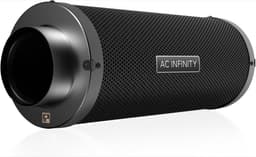
If the sum stays on 100 mm, the comparison’s 4 inch filters are the AC Infinity top pick at about £47.99 (210 CFM), Mars Hydro at about £27.92 (210 CFM), Hon&Guan at about £29.99 (267 CFM) and HG Power at about £29.99 with no CFM captured. The refillable AC Infinity shell is also 100 mm, at about £82.99, without a CFM bullet in the scrape. None of those becomes a 120 cm solution because the stars are high. If the sum lands on 150 mm, use the AC Infinity best value filter at about £65.99 (410 CFM), Mars Hydro’s 6 inch at about £40.38 (410 CFM), or HG Power’s 6 inch at about £33.99 with no stated CFM. The two kits are 150 mm as well: VIVOSUN G6 at about £169.99 (388 CFM) and AC Infinity CLOUDLINE LITE at about £189 (352 CFM). Buy a kit only when you still need the fan. The kit page makes that split. If the sum lands on 200 mm, the only matching filter here is the AC Infinity XL at about £119, and you still need a 200 mm fan that this set does not include.

Mistakes that show up after the tent is full

The expensive mistake is a 100 mm filter on a 120 cm tent because the top pick sits on the 4 inch AC Infinity. That place is inside a mixed-diameter table. Your volume overrules it. The second mistake is choosing a filter CFM below the fan you already run flat out. Air then crosses a thin bed too quickly, which is the faint-odour theme in AC Infinity reviews when people compare beds with Phresh. The third is a long crushed duct that quietly deletes the allowance you added. The fourth is planning hangers from a bad mass figure: the 200 mm listing prints 454 g, which is not a real weight for that cylinder. If the tent is already planted and the smell is escaping, resizing the duct is a rebuild, not a sleeve wash.

Common questions

What size carbon filter for a 60 cm tent?
A 60 × 60 × 140 cm tent is about 0.5 m³, about 30 m³/h before the allowance and about 40 m³/h after a 30 per cent uplift. UK guides often start that scale on 100 mm duct. Match a 100 mm fan and one of the 4 inch filters in the comparison, and still check lamp heat if the cupboard is sealed.
What size fits a 120 × 120 × 200 cm tent?
That tent is about 2.9 m³, about 174 m³/h at one air change per minute, and about 220 m³/h after a 30 per cent allowance for filter and duct. UK guides commonly specify 150 mm for that footprint. In this set that is the AC Infinity, Mars Hydro or HG Power 6 inch filters, or a 150 mm kit if you need the fan too.
Is a 100 mm filter enough for a 4×4 tent?
A 4×4 foot tent is about 120 × 120 cm. UK duct guides generally leave 100 mm behind at that size and cite 150 mm. A 100 mm filter can be excellent on a small tent and still be the wrong part here. Do the volume sum if your height differs from 200 cm.
When do I need a 200 mm carbon filter?
Use 200 mm when the tent is a long or walk-in volume and the fan you need is already in that class. This comparison has one 200 mm filter, the AC Infinity XL at about £119, with no CFM on the captured bullets. It does not include the matching fan.
Should the filter’s airflow be higher than the fan’s?
Yes, as a retailer rule of thumb. Hydroponics UK says the filter should be rated at or above the fan so contact time in the carbon stays adequate. If you only have a CFM bullet, convert roughly with 1 CFM ≈ 1.7 m³/h and treat both numbers as listing claims.
Do lamp watts change the size?
Heat can force a higher fan speed, which is why the allowance exists and why a borderline tent should step up a duct size. The published method still starts from volume. Watts are not a substitute for measuring the tent, and this page does not assign a watt-to-millimetre table.

Related pages

Sources

Public UK sources for sizing, licensing and electrical safety, last checked on 20 October 2026. Amazon.co.uk listing lines are the price and review source for the eleven ASINs. No laboratory odour test was run.

  1. Greens Horticulture — grow tent fan and carbon filter size (retrieved 20.10.2026)
  2. Hydroponics UK — carbon filter sizing guide (retrieved 20.10.2026)
  3. The Growers Shop — grow room ducting size guide (retrieved 20.10.2026)
  4. Roots2Riches — extraction fan calculator (retrieved 20.10.2026)
  5. Misuse of Drugs Act 1971, section 6 (retrieved 20.10.2026)
  6. GOV.UK — cannabis licensing factsheet (retrieved 20.10.2026)
  7. Electrical Equipment (Safety) Regulations 2016, regulation 35 (retrieved 20.10.2026)
  8. London Fire Brigade — cables, fuses and leads (retrieved 20.10.2026)