Independent comparisons. We may earn from shop links. More info

Cut resistant gloves vs chainsaw gloves

Updated: 17 October 2026

You may already own gloves marked EN 388 4X42C, 4X42D or ANSI A9 and wonder whether high cut resistance makes them suitable for occasional chainsaw work. It does not. Cut resistant gloves vs chainsaw gloves is a comparison of different hazards and different standards. None of the twelve products in the [cut protection gloves comparison](/hub/protective-clothing/cut-protection-gloves) names a chainsaw-glove standard in its captured technical information. If the tool is a chainsaw, leave these kitchen and handling gloves out of the kit and choose equipment intended for chainsaw users.

You may already own gloves marked EN 388 4X42C, 4X42D or ANSI A9 and wonder whether high cut resistance makes them suitable for occasional chainsaw work. It does not.

Our top picks

On this page

Two different cutting hazards

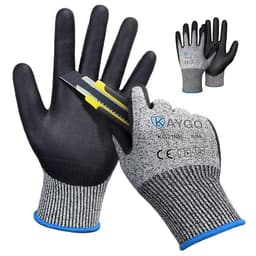
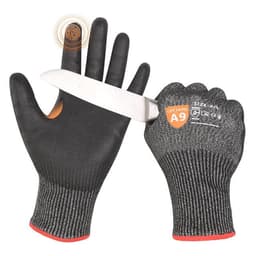
A knife, a sheet edge or a mandoline presents a slicing edge. EN 388 reports abrasion, blade cutting, tear and puncture. Codes such as 4X42C and 4X42D can distinguish handling gloves. They do not describe a powered saw chain. ANSI A9 does not become a chainsaw mark either. KAYGO’s 4X42C, the 4X42D wording on Donfri and AovYoo, the flintronic Class 5 bullets and Donfri QGA9’s ANSI A9 claim are ordinary mechanical-risk language. None is BS EN 381-7 or BS EN ISO 11393-4. A KAYGO review mentions chainsaw use. One customer cannot certify a listing for another hazard.

What HSE and BSI name for chainsaw gloves

Where a risk assessment requires chainsaw-protective gloves, HSE says they should meet BS EN 381-7, on and off the ground. That page also recognises thorns, cold and wet. It does not support substituting EN 388 gloves. HSE publication INDG317 states that no PPE provides 100 per cent protection against a hand-held chainsaw. A compliant glove sits with training, technique, maintenance and the rest of the kit. It is not permission to place a hand near a moving chain. The HSE page retrieved for this comparison still names BS EN 381-7. BSI identifies BS EN ISO 11393-4:2019 as the current British Standard and says it supersedes BS EN 381-7:1999. Level 5, 4X42D or A9 does not answer the question. Ask the supplier where the evidence is unclear.

What this comparison does not include

The twelve listings are food knits, coated handling gloves, one mesh glove and a ten-pair pack. Marks include 4X42C, 4X42D, ANSI A4, ANSI A9 and bare level or class claims. None cites BS EN 381-7 or BS EN ISO 11393-4:2019. Occasional use does not turn a kitchen glove into chainsaw PPE. Footwear is the chainsaw boots comparison. Leg protection is chainsaw trousers. One compliant piece does not make the whole kit suitable. For food, carving or sheet material, stay with the EN 388 cut resistant gloves buying guide. Labelled PPE does not replace training or the saw instructions.

A clear decision

Choose an EN 388 glove from this comparison only when the mechanical risk matches the evidence on that listing. KAYGO prints 4X42C for coated handling. Several uncoated knits use food-grade wording for kitchen tasks. Fit, coating wear and puncture remain limits. Choose a chainsaw glove when the risk assessment calls for one, and check BS EN 381-7 on the HSE page or BS EN ISO 11393-4:2019, which supersedes the 1999 standard. If neither appears, do not fill the gap with EN 388, ANSI A9 or a review. Return to these twelve only when the powered chain is no longer the hazard.

Common questions

Can I wear an EN 388 glove while using a chainsaw?
Do not treat EN 388 alone as chainsaw protection. It reports mechanical-risk performance, while HSE and BSI identify chainsaw-specific glove standards. None of the twelve gloves in this comparison cites BS EN 381-7 or BS EN ISO 11393-4:2019.
What chainsaw glove standard does HSE name?
HSE’s public chainsaw PPE guidance names BS EN 381-7. The page retrieved for this comparison still uses that identifier. BSI states that BS EN ISO 11393-4:2019 is the current British Standard and supersedes BS EN 381-7:1999, so buyers may encounter both numbers.
Does EN 388 4X42C count as chainsaw protection?
No. 4X42C reports abrasion, coupe-test status, tear, puncture and ISO 13997 cut performance under EN 388. It does not represent the chainsaw-glove test. A product needs relevant chainsaw-standard evidence rather than a high ordinary cut code.
Does an ANSI A9 claim make a glove suitable?
No. ANSI A9 is a cut-resistance claim under a different scale, not a British chainsaw-glove standard. Donfri QGA9 does not print an EN 388 string or a chainsaw standard in the captured fields, so its A9 title cannot answer this use case.
What if a review says the glove was used with a chainsaw?
That is an individual account, not product certification. One KAYGO review mentions chainsaw use, but the listing prints EN 388 4X42C and no chainsaw standard. Select PPE from the documented requirement and the risk assessment, not a reviewer’s choice.
Is any glove 100 per cent protective against a chainsaw?
No. HSE’s INDG317 guidance states that no PPE ensures 100 per cent protection against a hand-held chainsaw. Gloves are one part of controls that also include training, safe working methods, equipment condition and the rest of the required protective kit.

Related pages

Sources

Public UK sources and the amazon.co.uk listings used for this comparison. Page updated 17 October 2026.

  1. HSE, PPE overview (retrieved 17 October 2026)
  2. HSE, glove selection (retrieved 17 October 2026)
  3. HSE, chainsaw PPE (retrieved 17 October 2026)
  4. uvex, EN 388 glove standards (retrieved 17 October 2026)
  5. GOV.UK, UKCA and CE product marking (retrieved 17 October 2026)
  6. Food Standards Agency, food contact materials (retrieved 17 October 2026)
  7. BSI, BS EN ISO 11393-4:2019 (retrieved 17 October 2026)
  8. amazon.co.uk listings for the twelve gloves in this set (retrieved 17 October 2026)