Independent comparisons. We may earn from shop links. More info

How to wear chainsaw trousers correctly

Updated: 17 October 2026

Knowing how to wear chainsaw trousers starts before the engine starts: the protective area must stay where it was designed to sit. Trousers that slide down, legs cut to the wrong length, and fibres stuck together by poor care can undermine that aim. Reviews across all four products in the [chainsaw trousers comparison](/hub/protective-clothing/chainsaw-trousers) recommend braces, but none lists them as included. Secure the trousers without distorting their fit, follow the care label and withdraw them after a chain strike.

Knowing how to wear chainsaw trousers starts before the engine starts: the protective area must stay where it was designed to sit.

Our top picks

On this page

Braces help keep the protection in position

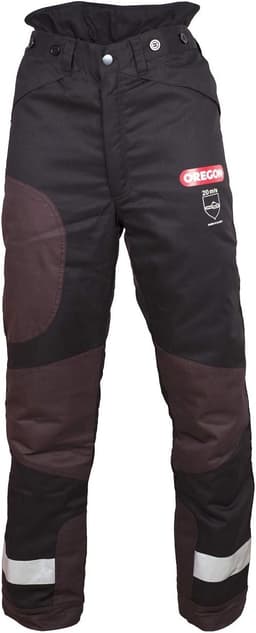
Chainsaw trousers should sit at the waist as you bend, walk and work. SIP says braces help keep the protective area in its designed position, whereas a belt can let the garment slide. Several Yukon reviews say a belt was not enough. Do not assume loops mean braces are supplied. Protect Pro lists two front suspender loops, one rear loop and five belt loops, yet the included line contains only the trousers. The other listings do not say braces are included. A deleted Oregon braces ASIN is an accessory, not leg protection. Adjust the braces so the waistband stays up without pulling the crotch or the legs out of shape. If the trousers still slide, the size or the brace arrangement is wrong. A Yukon+ review reports a front brace strap breaking, so check that hardware before work.

Do not cut a long protective leg

Several reviews report excessive leg length. One Yukon+ buyer describes legs more than a foot too long, and Yukon reviews also mention trousers being far too long. The tempting alteration is to cut the hem. SIP says cutting a protective garment reduces protection. Ordinary trouser tailoring rules do not automatically apply to a garment that contains a protective inlay. First confirm the waistband is held at the intended height, because slipping can make the legs look longer. If the garment is still too long, return it for the correct size. Protect Pro B0G5NK68PZ is a size M ASIN. The Yukon+ details show model suffix /S, although the title states no size. Rolling the hem is not a permanent fix, because excess cloth can move the protective area. For the listings themselves, see the best chainsaw trousers shortlist.

Wash only as far as the label allows

Care information is thin across this set, so there is no defensible universal wash temperature. Protect Pro says machine wash, but the available product block does not give a temperature. One shared Yukon review says the trousers washed successfully, should be line-dried and were not approved for tumble drying. Yukon+ supplies no care instruction in the captured details. Follow the sewn-in wash cycle and drying method rather than a setting from another Oregon model. SIP warns that incorrect washing can make the protective inlay stick together. Do not tumble-dry the Yukon because another garment can tolerate it, and do not read machine wash on Protect Pro as a temperature. If the label is missing, ask the maker for that model. The class and design guide explains the markings. Poor care can leave the inlay unlike the tested garment.

A chain strike ends that pair

After a moving chain touches the trousers, stop work and withdraw the garment. Kübler’s EN ISO 11393-2 guidance says to take trousers out of service after a chain strike even when the outer fabric looks almost intact. The damage that matters may be in the protective fibres rather than obvious on the surface. Do not stitch through the protective pad. SIP warns against sewing through that area, and a neat repair cannot restore a tested construction. If you cannot tell whether the protective area was involved, stop using the pair and ask the maker. One Yukon+ reviewer reports bruising after a chain broke. A stopped chain does not mean there was no injury. The trousers versus chaps guide explains why an over-trouser should not be cared for as if it were the same garment. A qualifying purchase can earn a commission at no extra cost to you.

Common questions

Do I need braces if the trousers have belt loops?
Reviews across all four product sets recommend braces, and SIP says braces help hold the protective area in its designed position. Belt loops do not mean braces are included. Adjust any braces for a stable waistband without distorting the garment, then check the fit through normal working movements.
Can I shorten chainsaw trousers?
Do not cut the legs. SIP warns that cutting a protective garment reduces protection, and several reviews reporting long legs are not alteration instructions. Hold the waist at the correct height first. If the legs remain too long, exchange the trousers for a suitable size or obtain exact maker guidance.
Can I tumble-dry chainsaw trousers?
Only if the care label for that exact garment permits it. One Yukon review specifically says the pair was not tumble-dry approved and should be line-dried. Protect Pro says machine wash but gives no drying instruction in the captured listing, so machine wash must not be read as tumble-dry permission.
What does Protect Pro say about washing?
The Protect Pro product details say machine wash, with no temperature in the available listing. Follow the sewn-in care label for the actual cycle and drying method. This ASIN also lists size M, model 695601-M and a 1.79 kg weight.
What should I do after a chain touches the trousers?
Stop work and withdraw the trousers, even if the outer cloth looks almost undamaged. Do not sew through the protective pad. The inlay may have done its job or suffered hidden damage, so replace the pair or seek manufacturer assessment rather than putting it back into service.
Does a stopped chain mean I cannot be injured?
No. A reviewer’s bruising after a broken-chain incident illustrates that protection has limits. No PPE offers complete protection. Correct trousers must be combined with an appropriate saw, other PPE, maintenance, training and safe technique.

Related pages

Sources

Public UK sources and the amazon.co.uk listings used for this comparison, captured on 15 October 2026.

  1. HSE, chainsaw PPE (retrieved 15 October 2026)
  2. HSE, working with chainsaws (retrieved 15 October 2026)
  3. HSE INDG317, chainsaws at work (retrieved 15 October 2026)
  4. PPE at Work Regulations 1992 (retrieved 15 October 2026)
  5. Arbortec, chainsaw PPE standards (retrieved 15 October 2026)
  6. SIP, EN ISO 11393 designs (retrieved 15 October 2026)
  7. Tudor, Oregon Yukon Type A shop page (retrieved 15 October 2026)
  8. Forest and Arb, chainsaw trouser types (retrieved 15 October 2026)