Independent comparisons. We may earn from shop links. More info

Chainsaw trousers Class 1 and Type A explained

Updated: 17 October 2026

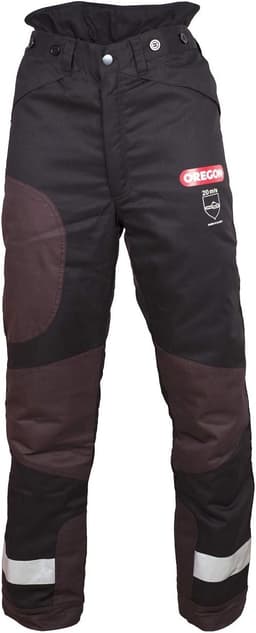
When a label says chainsaw trousers Class 1 Type A, it combines two different decisions. Class 1 is a test-speed category. Type A describes where the protective area sits. You need to match the first to the chain speed in the saw handbook and the second to the work position and likely exposure. In this four-product [chainsaw trousers comparison](/hub/protective-clothing/chainsaw-trousers), only Oregon Protect Pro states Class 1 at 20 m/s, and none of the kept listings states Type A or Type C. Do not let a familiar product name fill those blanks.

When a label says chainsaw trousers Class 1 Type A, it combines two different decisions. Class 1 is a test-speed category. Type A describes where the protective area sits.

Our top picks

On this page

Class is the test speed

The class ladder is straightforward. Class 1 corresponds to 20 m/s, Class 2 to 24 m/s and Class 3 to 28 m/s. These are test speeds, not a promise that injury is impossible. A class is also not the largest-looking number on a sales page, a customer star rating or a general quality grade. Start with the chainsaw handbook. Find the stated chain speed for that machine, then compare it with the garment marking. Arbortec warns that Class 1 is not enough when the saw is faster than 20 m/s. A comfortable pair does not become suitable for a faster chain because it fits well. Only Protect Pro B0G5NK68PZ states Class 1 at 20 m/s. The Yukon URLs and Yukon+ state no class, and their star lines cannot answer the speed question. Use the buying guide’s order of checks and ask for the sewn-in label.

Design is the protected area

Design letters describe coverage rather than chain speed. Type A is front protection. Type C is protection at the front and back. Read the letter alongside class. Do not use it instead of class. Type B is inconsistent in shop language. SIP identifies Type B with chaps. Another UK retailer describes trousers with an extra rear panel. If the garment buckles over ordinary trousers and is open at the back, the chainsaw trousers versus chaps page treats it as a different product type. None of these four product blocks prints Type A or Type C. One shared Yukon review says a garment described as Type C was actually Type A with front protection. That is a buyer’s warning, not an assignment of Type A to both Yukon URLs. Check the sewn-in design marking on the exact item.

What HSE says about ground work and climbing

HSE’s current chainsaw PPE page says Type C leg protection is preferable for work off the ground. It gives a qualified exception: where heat stress is a significant risk, a risk assessment may justify Type A. The exception is not a general shortcut for choosing lighter clothing. It depends on the risk assessment and the work conditions. HSE’s 2012 INDG317 leaflet recommends all-round protection for arborists working in trees and for occasional users such as those in agriculture. Keep that wording beside the current Type C preference and its heat-stress exception. For firewood or other ground work, ground alone does not settle the design. Consider where the chain could reach. For climbing, start from the current HSE Type C preference, subject only to the stated heat-stress condition. A design choice cannot make up for a class below the saw’s chain speed.

What these four listings actually print

Protect Pro states Class 1 at 20 m/s but gives no design letter. Its bullets print EN ISO 11392-2, while reviews refer to EN ISO 11393-2. Resolve that against the garment label. A qualifying purchase can earn a commission at no extra cost to you. HSE’s chainsaw PPE page still names BS EN 381-5. Arbortec says BS EN ISO 11393-2:2019 replaced BS EN 381-5:1995. That does not make every existing EN 381-5 garment illegal. Read the full marking and the current guidance. The two basic Yukon URLs share one product block and state no class, design or standard. Yukon+ has its own reviews and model 295453/S, with the same gaps. The best chainsaw trousers page favours Protect Pro only when the stated Class 1 matches the saw. It does not award an unstated design.

Common questions

What does Class 1 mean?
Class 1 corresponds to a 20 m/s chain-speed test category. It does not mean complete protection, nor does it cover a faster saw by default. Check the saw handbook for chain speed and the exact garment marking before deciding that Class 1 is appropriate.
When might I need Class 2 or Class 3?
Class 2 is identified with 24 m/s and Class 3 with 28 m/s. A faster saw can make Class 1 the wrong choice. Do not estimate from engine size or brand. Use the handbook’s chain-speed specification and obtain competent guidance where the task requires it.
Should I choose Type A or Type C for ground work?
Type A covers the front in the source description, while Type C covers front and back. Ground work alone does not settle every risk. Choose according to where the chain could reach, the task assessment and competent guidance, then verify the design on the garment label.
What does HSE prefer for work in a tree?
HSE’s current page prefers Type C off the ground. It says a risk assessment may justify Type A where heat stress is a significant risk. The older INDG317 leaflet recommends all-round protection for arborists in trees, so climbing should not be reduced to a casual comfort choice.
Is EN 381-5 now illegal?
The sources used here do not support that claim. HSE still names BS EN 381-5, while Arbortec says BS EN ISO 11393-2:2019 replaced the 1995 product standard. Read the exact garment marking and current guidance rather than treating replaced as an automatic legal ban.
Why are two standard numbers shown for Protect Pro?
The Amazon bullets print EN ISO 11392-2, while reviews use EN ISO 11393-2. The listing evidence contains both, so the discrepancy should remain visible. Check the sewn-in label or obtain confirmation from the seller before relying on either number.

Related pages

Sources

Public UK sources and the amazon.co.uk listings used for this comparison, captured on 15 October 2026.

  1. HSE, chainsaw PPE (retrieved 15 October 2026)
  2. HSE, working with chainsaws (retrieved 15 October 2026)
  3. HSE INDG317, chainsaws at work (retrieved 15 October 2026)
  4. PPE at Work Regulations 1992 (retrieved 15 October 2026)
  5. Arbortec, chainsaw PPE standards (retrieved 15 October 2026)
  6. SIP, EN ISO 11393 designs (retrieved 15 October 2026)
  7. Tudor, Oregon Yukon Type A shop page (retrieved 15 October 2026)
  8. Forest and Arb, chainsaw trouser types (retrieved 15 October 2026)