How to wear chainsaw gloves
How to wear chainsaw gloves starts with the pad. On several pairs in our [chainsaw gloves comparison](/hub/protective-clothing/chainsaw-gloves), it sits on the back of one glove only. Pull that glove onto the wrong hand and the hand on the front handle is ordinary leather. Once the pair has arrived, find the pad, check the controls, follow that listing's care line, and stop when the glove is no longer the one you bought. Peter F. compiled this on 19 October 2026 from those amazon.co.uk listings and HSE's leaflet INDG317. It is not a lab test. A qualifying amazon.co.uk purchase can earn a commission at no extra cost to you.
How to wear chainsaw gloves starts with the pad. On several pairs in our chainsaw gloves comparison, it sits on the back of one glove only.
How to wear chainsaw gloves starts with the pad. On several pairs in our chainsaw gloves comparison, it sits on the back of one glove only. Pull that glove onto the wrong hand and the hand on the front handle is ordinary leather. Once the pair has arrived, find the pad, check the controls, follow that listing's care line, and stop when the glove is no longer the one you bought. Peter F. compiled this on 19 October 2026 from those amazon.co.uk listings and HSE's leaflet INDG317. It is not a lab test. A qualifying amazon.co.uk purchase can earn a commission at no extra cost to you.
Our top picks
| Badge | Product | Where the pad sits | Care line on the listing | Fit note from reviews | Note | Price | Offer |
|---|---|---|---|---|---|---|---|
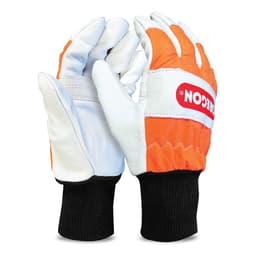
| Best overall |  Oregon Oregon class 0 left-hand gloves | Left hand only, class 0 | Wipe clean; do not wash in water | Size L, also labelled 10 | 9.1 | about £15.75 | View offer |
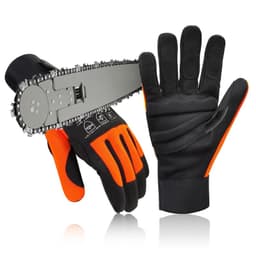
| Alternative |  Intra-FIT Intra-FIT class 1 both-hands gloves | Both hands, design A type 1 | Hand wash | Size L; one review says size down | 7.7 | about £33.99 | View offer |
| Best value |  Intra-FIT Intra-FIT class 1 left-hand gloves | Left hand, design A type 2 | Hand wash | Size XL; one review ran large | 7.5 | about £22.99 | View offer |

On this page
Find the pad before you start the saw
Fit so you can still use the saw
Wash only what that listing allows
Stop when the glove is no longer the glove you bought
Common questions
Which glove do you put on the front-handle hand?
What if you are left-handed?
How tight should the cuff be?
Can you machine-wash this set?
What do you do if a seam opens?
Why might size L feel huge on one brand and tight on another?
When do you stop using the pair?
Related pages
Sources
Public UK sources for the glove standard, the class speeds, and the PPE duty. Listing prices, stars, and review counts are the amazon.co.uk figures in this set. Retrieved 19 October 2026.
- HSE — Chainsaw PPE (retrieved 19 October 2026)
- HSE — INDG317 Personal protective equipment at work (retrieved 19 October 2026)
- The Personal Protective Equipment at Work Regulations 1992 (retrieved 19 October 2026)
- HSENI — Chainsaw safety (retrieved 19 October 2026)
- Stihl GB — Cut-protection classes (retrieved 19 October 2026)
- ISO 11393-4:2018 — Protective gloves for chainsaw users (retrieved 19 October 2026)
- Arbortec — Safety standards for chainsaw PPE (retrieved 19 October 2026)
- Husqvarna UK — Functional gloves with saw protection (retrieved 19 October 2026)