Steel toe chainsaw boots: why a toe cap is not enough

Steel toes are tested for impact, not chainsaw cuts. Learn how BS EN ISO 17249 differs from EN ISO 20345 and what to check before buying boots in the UK.
On this page

You already own sturdy site boots, the toes are capped with steel, and a chainsaw job is waiting. It is an understandable shortcut to think that the hardest-looking boots in the shed will do. Steel toe chainsaw boots are not defined by the toe cap. The distinction is between ordinary safety footwear tested under EN ISO 20345 and chainsaw-resistant footwear marked to BS EN ISO 17249. Before you start the saw, check for the chainsaw standard and class rather than trusting the words steel toe, S3 or metatarsal.
In short
A steel toe protects against a different hazard from a moving saw chain. It can be a useful feature within a chainsaw boot, but only a BS EN ISO 17249 marking and a stated chainsaw class show that the footwear is intended to provide chainsaw cut protection. Protection is never absolute, so the marking is a starting point for choosing the correct boot, not permission to relax your working technique.
What a steel toe is tested for
The familiar steel toe belongs to safety footwear. EN ISO 20345 includes protective toe caps, and the commonly quoted performance figure is resistance to a 200-joule impact. That matters when an object can fall onto your toes or when the front of your foot may be crushed. It is a meaningful protection feature, but it answers an impact question rather than a chainsaw-cut question.
Product listings compress several features into a short title. Safety boot, steel cap, S3 and metatarsal all sound progressively more protective. They do not form a ladder that ends at chainsaw resistance. S3 is an EN ISO 20345 safety-footwear code, and the metatarsal code M concerns another part of the foot. Neither code means the boot has passed the chainsaw-footwear requirements. EN ISO 20345 is not evidence of chainsaw cut protection, even when the boot feels heavy, has a high ankle and costs more than basic work footwear.
Why the steel cap still has a role
Saying that a steel toe is the wrong test does not mean it does nothing. STIHL explains that steel caps can help block a chain as part of a purpose-made cut-protection boot. The important words are as part of: a cap can work alongside the boot's other protective construction, but it does not replace it. A genuine chainsaw boot may therefore state both chainsaw protection and a steel toe without contradiction.
The SAFETOE boot in our comparison is a useful example because its title states both Class 1 chainsaw protection and a steel toe. It is the top pick in that set when you want those two claims written together. Class 1 tells you the chainsaw test level; the steel toe is an additional safety feature. The toe cap does not raise the chain class, and a cap on its own would not justify calling an ordinary site boot chainsaw-resistant.
What a chainsaw boot adds
For chainsaw footwear, the standard to find is BS EN ISO 17249. The classes are linked to chain speeds used in the test: Class 1 is 20 m/s, Class 2 is 24 m/s and Class 3 is 28 m/s. Check that the boot is marked to that standard before you compare classes. Aggressive tread, a tall cuff or a thick leather upper cannot fill a missing marking.
The class is not a promise that the chain cannot injure you. STIHL is explicit that protective equipment cannot provide absolute protection. A class records a test level under defined conditions. A real contact can differ in angle, duration, chain condition and the part of the boot struck. You still need controlled technique, the rest of the appropriate PPE and a boot suited to the work.
A buying decision should begin with the standard and class, then move to fit, construction and other features. The chainsaw boots comparison keeps that product type in view. It does not remove the need to inspect the exact boot's label when it arrives.
Why the wrong boots appear
Search results are not a standards check. Results for chainsaw boots included Rock Fall RF540 and RF710 footwear, a Bawalon steel-cap boot, Amblers FS998 and SAFEYEAR S3 boots. Those products were left out of the chainsaw-boot set because the available material identified ordinary safety-footwear features rather than the chainsaw standard. That does not make them poor site boots. A search can match steel, safety, work or boot and still miss the distinction you need.
The same problem occurs when a shortened listing drops the decisive detail. You may see an S3 code, a toe-cap claim and a rugged photograph, with no mention of BS EN ISO 17249. Do not infer the missing chainsaw claim. Treat it as unverified until the tongue label or reliable product documentation gives you the standard and class.
Price is not a reliable shortcut either. An expensive metatarsal boot can be designed for a demanding workplace hazard without being designed for chainsaw contact. A cheaper title can use the word chainsaw loosely without presenting the marking you need. The practical filter is documentary: exact standard, exact class, and a match to the exact model and size you are buying.
Gaiters are not the easy workaround
Chainsaw gaiters can look like a neat way to keep your existing steel-toe boots. HSE guidance treats them as a conditional option: gaiters are suitable only on even ground where there is little risk of tripping or snagging. British woodland, brash, roots, slopes and uneven garden ground can quickly move you outside that limited situation.
Gaiters plus steel toes is not a universal equation. The gaiter does not turn an EN ISO 20345 marking into BS EN ISO 17249, and the steel cap does not remove the ground and snag conditions. If the job does not clearly fit those limits, purpose-made chainsaw boots are the direct route to the footwear standard. If it does fit, you still follow the gaiter guidance and wear chainsaw PPE as a set.
For a first kit, work out the whole clothing system before buying one impressive-looking item. The guide to what to wear when using a chainsaw explains why the kit is a set of standards. Footwear is one part of that system, and no boot makes protection absolute.
How to read the label and listing
Start with the tongue label or the manufacturer's documentation for the exact product. Look for BS EN ISO 17249 and a chainsaw-protection class. EN ISO 20345, SB, S3, a 200-joule toe claim or the metatarsal code M tells you about safety footwear, not chainsaw cut protection. If a marketplace title and the physical label disagree, use the label on the boot.
Separate the chainsaw class from additional features. A listing that says Class 1 and steel toe is making two different claims. Class 1 corresponds to the 20 m/s test level. The toe cap does not upgrade it to the 24 m/s Class 2 level. Similar model names and near-identical photographs are not enough to carry a claim across.
Reject vague substitutes. Chainsaw style, forestry look, heavy duty, cut resistant and professional do not state the standard or class. Product imagery cannot prove what the material has been tested to do. If the seller's information leaves the key marking uncertain, choose a listing that makes it verifiable.
A quick decision before you start
If your current boots show EN ISO 20345 or S3 but no BS EN ISO 17249 marking, treat them as ordinary safety boots for this decision. Do not assume that a steel cap or a metatarsal guard closes the gap. Check purpose-made options, confirm the class, and only then consider fit and the extra workplace features you also need.
If the boot does show BS EN ISO 17249, read the class rather than stopping at the standard number. Class 1, 2 and 3 refer to 20, 24 and 28 m/s test levels respectively. Certification describes tested protection, not immunity from a running chain. The chainsaw boots buying guide sets out the markings to verify before you buy.
Common questions
Are steel-toe boots enough for using a chainsaw?
What is the difference between EN ISO 20345 and BS EN ISO 17249?
Does an S3 marking mean that boots resist a chainsaw?
Will a metatarsal guard protect against a chainsaw?
Does a steel toe make a Class 1 chainsaw boot a higher class?
Can I add chainsaw gaiters to my ordinary site boots?
Where can I compare actual chainsaw boots?

Peter F. is the editor for DIY & tools at productscompared.co.uk. Comparisons in this category are checked against amazon.co.uk listings, review evidence and public UK sources.
Related articles

Chainsaw PPE: wear this kit before you start the saw
Chainsaw PPE is a set of standards, not one pair of boots. A site toe cap leaves a hole in the HSE kit.

Chainsaw protection class: what the numbers mean
A chainsaw protection class is a chain-speed test category, not a general safety rating. Match it to your saw.
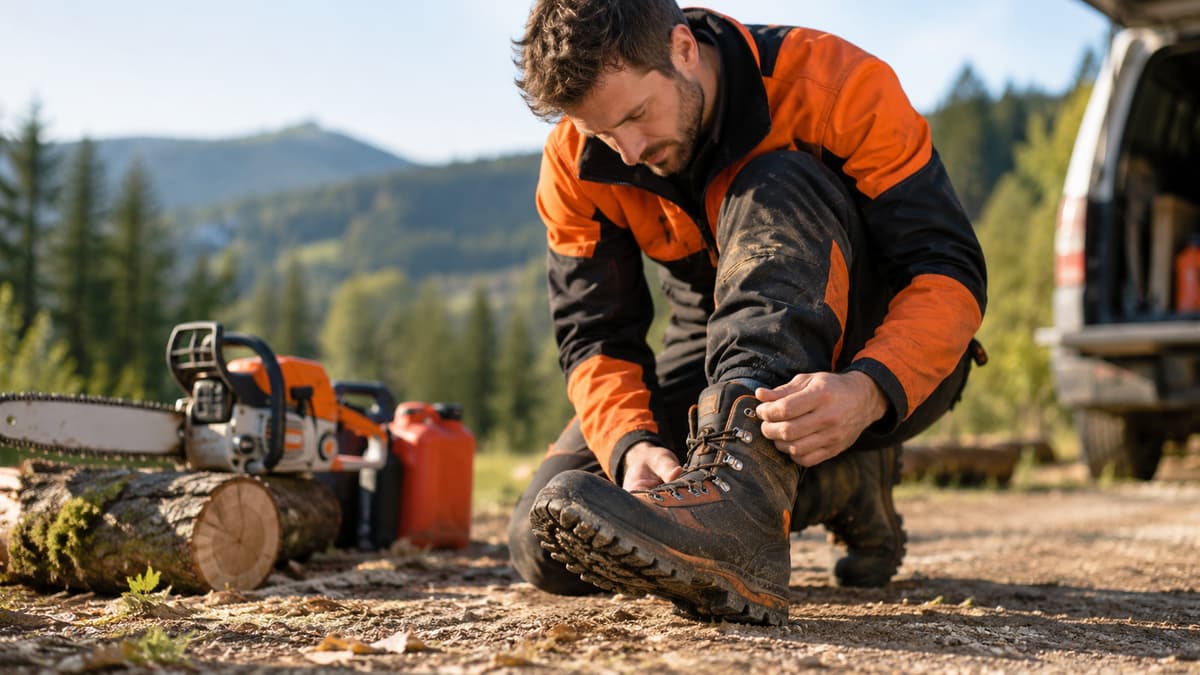
Check chainsaw boots before you start the saw
A pair can look clean yet have a lace hook pulling away, a heel splitting or a sole separating from the upper.