Check chainsaw boots before you start the saw
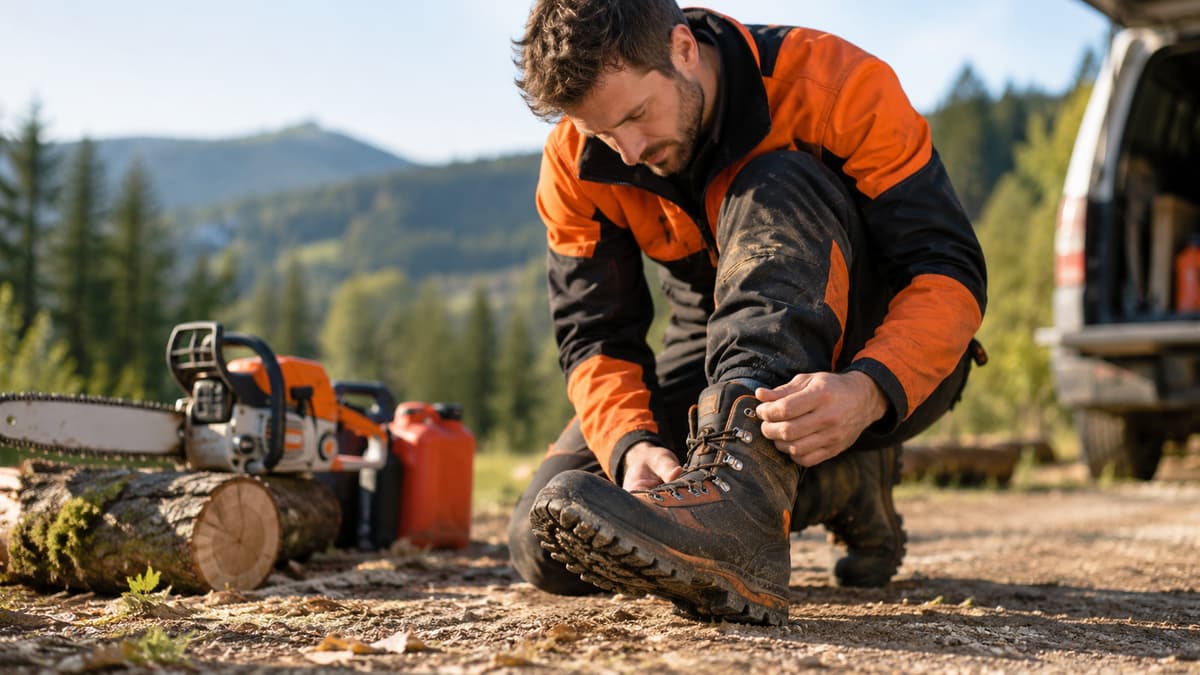
Check chainsaw boots for a readable class mark, damaged hooks, loose soles, poor fit and missing insoles before you start any cutting job on site in the UK.
On this page

You have the saw ready, the fuel or battery sorted and only one last job before cutting: check your chainsaw boots. A pair can look clean from standing height yet have a lace hook starting to pull away, a heel beginning to split or a sole separating from the upper. A deliberate inspection takes you past the general appearance and asks whether the pair you are about to wear can still be identified, fastened and walked in securely.
In short
Before you start, read the boot's protection mark and inspect the tongue, fastening, upper, heel, sole bond and insole. Put both boots on, secure them properly and make sure your trousers cover the tops. If a fault compromises the structure, fit or fastening, do not start the saw. Chainsaw protection is not absolute, so a clean surface or a familiar pair is not a substitute for this check.
Read the mark you are relying on
Begin with the label on the boot itself. Confirm that this pair is the protective footwear you think it is, and that the class can still be read. Do not substitute a remembered description, an old order or the fact that the boots have always lived with your chainsaw kit. The check concerns this pair, today.
Read both boots. Confirm the stated class and look for a missing or illegible label. The researched set includes a pair that arrived in the wrong size, so the box is not enough. Reading a class does not prove the boot will prevent every injury, and it does not turn a look-over into a cut test. If the mark is unclear, stop. Appearance cannot recover it.
Check a new pair as seriously as an old one
New boots belong in the same routine. One review reported mouse damage to leather boots in the box, and another buyer received the wrong size. Take both out, compare them, inspect the uppers and soles, and try them on before the first cutting job. A new pair can fail on supply damage or fit even though it has never touched the ground.
Check the tongue, laces and hooks
The protective area includes the vamp and instep, so check that the tongue lies where it should and that the boot closes as designed. Look for displacement, folding or cuts. Then run a finger along the laces and every eyelet or hook. Reviews include hooks that caught and came off, and hooks that snapped when the lace was jerked. A hook can be cracked while the leather around it still looks presentable. Check each fitting gently. Do not yank it hard enough to create damage.
Lace the boots normally. The fastening should secure the boot without forcing a damaged part or leaving a wide gap over the tongue. Frayed laces or a hook pulling away are not cosmetic when they stop a secure fit. Do not improvise a field repair to get one cutting session from the pair.
Treat one failed hook as a fault
One loose hook is still a fault. The fastening must secure the whole boot, and one failure can change how the tongue sits or how firmly your foot is held. If a hook moves, cracks, catches or separates, stop using the pair for chainsaw work. For work-issued footwear, report it rather than changing the lacing pattern. A tidy upper does not cancel a broken fastening.
Inspect the sole, heel and insole
Turn each boot over before you put it on. Look around the full join between sole and upper, not only the toe. The research includes a Sarawak sole starting to come away, so a boot can look fine from above while the bond underneath is failing. Check the heel from the rear and both sides. Reviews also include a heel split and a pair that fell apart after six to seven months. Those reports are failure types, not a replacement calendar. Decide on the condition you find, not the date on a receipt.
Look inside. Confirm the insole is present and seated. Some rubber-boot reviews described pairs supplied without an insole, with wearers adding their own, which can leave the boot looser than expected. Clear loose mud only enough to see the construction. Do not treat a wipe-down as proof the boot is sound, and do not probe damage so that you make it worse. If you find an opening, split or separation and cannot tell its effect, stop.
Distinguish surface wear from structural warning signs
A light scuff is not an open seam, a split heel or a separating sole. Look closely enough to tell them apart, including whether the mark opens when the boot flexes. This is a hands-on pre-start check, not a laboratory assessment. If you cannot tell, set the pair aside before you use it around a running chain.
Check the fit and trouser overlap
Put on the socks and insoles you will use, fasten both boots and walk on the ground where you are about to work. Your heel should not lift, your foot should not slide and the fastening should not depend on a broken hook. A fit that feels merely roomy while you stand still may become unstable as you walk.
The size on the box is not the check. A rubber Yukon was described as running large, with some wearers going down one or two sizes and adding an insole. One reviewer called an oversized fit unsafe. A Sarawak review reported a pair arriving half a size smaller than ordered. These are review signals, not universal sizing rules. How the models differ is set out in chainsaw boots sizing.
Once the boots are secure, check your trousers. They should sit over the tops, not tucked inside, and the overlap should stay when you bend and take a few steps. If the boots are too loose, too small or impossible to fasten, do not plan to fix that once cutting has started. The chainsaw boots wearing guide covers the setup. If you cannot walk securely in it, you are not ready to start the saw.
If anything fails, do not start
Take the boots out of use if you cannot read the mark you rely on, secure the fastening, trust the sole and heel, or walk safely. Never put a running saw against a boot to test protection, and do not treat the cutting job itself as the test.
If the boots are supplied for work, report the fault through the workplace procedure. HSE guidance calls for faults to be reported. Say which boot is affected, where the problem is and what happened when you tried to fasten or walk. Who must provide that kit is covered in chainsaw boots and UK law.
For your own pair, resolve the defect before the next job. That may mean confirming the class, dealing with a supply error or replacing a pair whose construction has failed. There is no evidence-based month interval, so do not discard sound boots because a date has passed. The signs that a pair is finished are in when to replace chainsaw boots.
If you need another pair, use the chainsaw boots comparison. The top pick there is the SAFETOE Class 1 chainsaw boots, about £108.88, with Class 1 stated in the amazon.co.uk title. The listing is 4.3 from 135 reviews, and the same set records lace hooks that catch and come off. A listing does not replace the label on the pair that arrives. Protection is not absolute even when the check passes. A qualifying purchase on amazon.co.uk can earn us a commission at no extra cost to you. We did not cut-test these boots.
Use the same short sequence every time
Keep one order: mark, tongue, fastening, upper, heel, sole, insole, fit and trouser overlap. A fixed sequence stops you admiring a clean upper and forgetting to turn the boot over. Check a familiar pair and a new pair alike. Once a defect changes the identification, structure, fastening or secure fit, do not start with those boots.
Common questions
What should I check on chainsaw boots before cutting?
Does the tongue need to cover the instep?
How do I check the protection class?
Is a scuffed leather upper enough reason to replace the boots?
Can I use chainsaw boots with one loose lace hook?
Are chainsaw boots safe if they are too big?
Should I inspect brand-new chainsaw boots?
Who should I tell about a fault in work-issued boots?

Peter F. is the editor for DIY & tools at productscompared.co.uk. Comparisons in this category are checked against amazon.co.uk listings, review evidence and public UK sources.
Related articles

Replace chainsaw boots: the warning signs
Learn when to replace chainsaw boots, from peeling soles and broken hooks to chain contact, without relying on a made-up monthly service interval.

Chainsaw boots sizing: avoid the wrong fit
Chainsaw boots sizing varies by model. Learn why rubber Yukon boots run large, why leather differs, and how to judge insoles and review evidence.

Chainsaw boots legal requirement UK: who must comply
Learn when chainsaw boots are a workplace duty in the UK, who must provide them, and why the same legal rule does not automatically cover your garden.