How to use a wire saw
You have a cable or a short chain in your hand, the branch or the pipe is in reach, and the first pull is where these tools kink, jam or open at the crimp. This is how to use a wire saw without wrapping it around the wood and hauling it into your body. Overhead drop zones stay on [rope saw for high branches](/hub/power-saws/wire-saw/sub/wire-saw-high-branches). Which mechanism you should have bought is on the [wire saw comparison](/hub/power-saws/wire-saw). Products Compared used amazon.co.uk review notes stored on 16 October 2026 and public instructions. There was no timed cut. A qualifying purchase can earn a commission at no extra cost to you.
You have a cable or a short chain in your hand, the branch or the pipe is in reach, and the first pull is where these tools kink, jam or open at the crimp.
You have a cable or a short chain in your hand, the branch or the pipe is in reach, and the first pull is where these tools kink, jam or open at the crimp. This is how to use a wire saw without wrapping it around the wood and hauling it into your body. Overhead drop zones stay on rope saw for high branches. Which mechanism you should have bought is on the wire saw comparison. Products Compared used amazon.co.uk review notes stored on 16 October 2026 and public instructions. There was no timed cut. A qualifying purchase can earn a commission at no extra cost to you.
Our top picks
| Badge | Product | Grip | Failure in reviews | What to do | Note | Price | Offer |
|---|---|---|---|---|---|---|---|
| Best overall |  Skyocean Skyocean 36 inch pocket chain | Nylon paracord | Jams; teeth on one side | Light pressure, toothed face on the wood | 7.4 | about £17.99 | View offer |
| Best value |  Tweruna Tweruna 3-pack wire saw | Plastic; one review mentions rubber | Crimp opened on drainpipe | Drop it; do not grab the strand | 6.5 | about £5.29 | View offer |
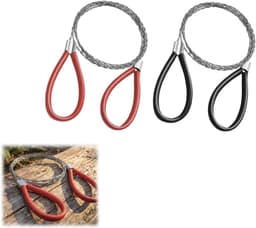
 Unbranded Red and black wire saw pair | 5 cm loops | Both reviews: fingers, not a hand | A stick or spoon handle through the rings | 5.4 | about £3.39 | View offer |


On this page
Set the tool up before you pull
The stroke that does not wrap the wire
When it jams, snaps, or only cuts one way
Where this method stops
Common questions
Do you wrap the wire around the branch?
How hard should you pull?
What if it only cuts one way?
What if the rings are too small?
How do you know the wire is getting too hot or kinked?
Should you wear gloves?
When do you stop and use another page, or stop altogether?
Related pages
Sources
Public UK sources and the amazon.co.uk listings for this set. Last checked on 16 October 2026.
- HSE, PUWER overview (retrieved 16.10.2026)
- legislation.gov.uk, PUWER 1998 (retrieved 16.10.2026)
- HSE, chainsaw operators (retrieved 16.10.2026)
- HSE, aerial tree work (retrieved 16.10.2026)
- Consumer Rights Act 2015, section 9 (retrieved 16.10.2026)
- Advnture, camping saw guide (retrieved 16.10.2026)
- Spyral Saw, wire saw instructions (retrieved 16.10.2026)
- KS Tools 123.0005 via Mister Worker (retrieved 16.10.2026)