Independent comparisons. We may earn from shop links. More info

Plunge saw vs circular saw

Updated: 22 October 2026

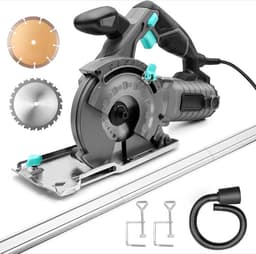
You already own a circular saw, and a plunge saw looks like the same machine with a rail in the photo. Plunge saw vs circular saw is a guard question before it is a price question. A circular saw starts at an edge and a lower guard swings out of the way. A plunge saw keeps the blade in an upper guard until you press it into the panel. Peter F. wrote this on 20 October 2026 from UK sources, not from a lab cut. Prices stay on the [plunge saw comparison](/hub/power-saws/plunge-saw). Products Compared may earn a commission if you buy through an amazon.co.uk link, at no extra cost to you.

You already own a circular saw, and a plunge saw looks like the same machine with a rail in the photo. Plunge saw vs circular saw is a guard question before it is a price question.

Our top picks

Draper Draper 57341 plunge saw

Best value

Draper Draper 57341 plunge saw
7.0/10about £119.00
BlueMars BlueMars BM-TC3001

Rank 3

BlueMars BlueMars BM-TC3001
5.0/10about £67.99
On this page

The guard is the difference

BS EN 62841-2-5:2014 treats a plunge type saw as a circular saw with only an upper guard. The blade retracts into the housing. A conventional circular saw has a lower guard that swings as the shoe meets the timber. B&Q’s wording has called the tool a plunge saw with track, or a circular saw with guide rail, in one breath. The rail is shared language. The guard is not. Protrade makes the same split, and says the enclosed housing gives extraction a better chance, without a capture percentage. Kickback can still happen if the kerf closes or the saw twists. A sensor on one premium listing is a bullet, not a test. What to check on the carton is on the plunge saw buying guide.

When a circular saw is enough

A circular saw is enough when every cut starts at an edge and the finish can be ordinary. Framing timber, fence boards, and a rough breakdown of sheet you will trim later are that work. Clamp a straight batten, measure the offset from the blade to the shoe on scrap, and keep the shoe against the batten. The cut can be straight. It is still an edge start, and the show face is usually down so exit tear-out lands on the hidden side. You do not need a plunge saw to cross-cut a stud, or to rip a board that a skirting will cover. Straight enough for carcass timber is not the same as starting in the middle of a worktop.

When the plunge saw earns the price

Buy the plunge saw when the cut has to start in the panel, or when the show face has to stay clean against a splinter strip. A sink opening cannot start from the edge without a lead-in that ruins the top. A jigsaw still finishes the square. That job is on cut a worktop with a plunge saw. The price is not only the motor. A bare 18 V body still needs a rail and a pack, and two short rails may still be short of a 2,440 mm sheet. None of the four files prints the depth left once the rail is under the shoe.

A circular saw that accepts a rail

Track-compatible circular saws stay on the circular-saw side of this page. Evolution sells the R185CCSX with 64 mm at 0 degrees and 59 mm on the track, and a DIYnot reply says it will not do sink cut-outs. Those figures are not a row here. Eight files were removed because the blade did not retract into an upper guard. You can get a straight edge-started cut from that kind of saw. You cannot plunge a sink side with it if the lower guard has to swing.

Which to buy for the job in front of you

Choose the circular saw when the cut starts at an edge, the finish can be ordinary, and you already trust the batten. Choose the plunge saw when the cut starts in the panel or the show face has to stay clean on a splinter strip, and you have priced the rail and, on an 18 V saw, the battery. A cupboard back nobody will study does not justify the plunge kit. A worktop opening does not belong on the circular saw just because a track is clamped beside it. Face down remains the freehand circular habit. Face up remains the splinter-strip habit. The enclosed housing gives the hose a better chance, in Protrade’s wording, and it does not make the air safe.

Common questions

Is a track saw a plunge saw?
Only when the blade retracts into an upper guard. UK shops use track saw for a plunge saw and for a circular saw on a rail. BS EN 62841-2-5:2014 draws the line at the guard. If the lower guard swings and the cut must start at an edge, it is a circular saw on a track, whatever the heading says.
Can I get straight sheet cuts with a circular saw and a clamped straightedge?
Yes, for an edge-started cut. Measure the offset from the blade to the shoe on scrap, clamp the batten that far from the line, and keep the shoe against it. Support the sheet so the offcut cannot pinch. The line can be straight and the face can still chip, because there is no splinter strip on the show face. Straight is not the same as starting in the middle.
What can a plunge saw do that the straightedge cannot?
It can start in the panel, with the blade coming down from the housing, and it can run against a splinter strip trimmed to your blade’s kerf. A clamped batten cannot start a sink side without a lead-in from the edge. The corner of that opening is still a jigsaw job, because the blade is round.
Why was a circular saw with a track taken out of this comparison?
The plunge category kept saws whose blade retracts into an upper guard. Eight files failed that test and were not kept. Evolution’s R185CCSX is sold as a track-compatible circular saw, with a depth on the track and a depth off it. A DIYnot user says it will not do sink cut-outs. It belongs with circular saws.
Which face is up on each tool?
On a freehand circular saw, the show face is usually down, so exit tear-out is on the hidden side. On a plunge saw with a splinter strip, the show face is up, so the strip bears on the laminate. Using the circular habit on a rail with a strip puts the chip on the face you wanted to save.

Related pages

Sources

Public UK sources first, then the amazon.co.uk listings compared on this page. Prices and stars were taken on 20 October 2026.

  1. HSE: Wood dust (retrieved 20 October 2026)
  2. HSE: Cutting and sanding wood (retrieved 20 October 2026)
  3. HSE: Electrical systems (retrieved 20 October 2026)
  4. HSE: PUWER (retrieved 20 October 2026)
  5. IET: Electricity in the workplace FAQ (retrieved 20 October 2026)
  6. BSI: BS EN 62841-2-5:2014 (retrieved 20 October 2026)
  7. BuildWiz: Plunge saw (retrieved 20 October 2026)
  8. HSE: Electrical standards, BS 1363 (retrieved 20 October 2026)