Independent comparisons. We may earn from shop links. More info

Plunge saw buying guide

Updated: 22 October 2026

You are about to pay for a motor and assume the rail, the clamps, and a UK plug come with it. A plunge saw buying guide has to settle whether the blade retracts into an upper guard, how long the rail is, and how much depth is left once that rail sits under the shoe. BS EN 62841-2-5:2014 defines a plunge type saw as one with only an upper guard. Peter F. wrote this on 20 October 2026 from these listings. Prices sit on the [plunge saw comparison](/hub/power-saws/plunge-saw). Products Compared may earn a commission if you buy through an amazon.co.uk link, at no extra cost to you.

You are about to pay for a motor and assume the rail, the clamps, and a UK plug come with it.

Our top picks

Draper Draper 57341 plunge saw

Best value

Draper Draper 57341 plunge saw
7.0/10about £119.00
BlueMars BlueMars BM-TC3001

Rank 3

BlueMars BlueMars BM-TC3001
5.0/10about £67.99
On this page

What you are actually buying

A plunge saw keeps the blade inside the housing until you press it into the work, so you can start in the middle of a panel. A circular saw on a clamped straightedge can still be straight, and it still starts at an edge. If the listing only says track, read the plunge claim. That split is the point of plunge saw vs circular saw. The rail is a second purchase even when the photo shows one. ITS groups Festool-pattern brands together, puts Bosch with Mafell, and treats DeWalt as its own profile. Einhell sits in a solo group. One United Kingdom review said an Evolution track fitted an Einhell body. That is one person, not a chart.

Rail length and which rails do not mix

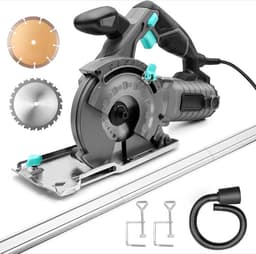
A standard UK sheet is 2,440 mm by 1,220 mm. BuildWiz’s rule of thumb is about 2.7 m for one pass down that sheet, plus about 100 mm of run-off at each end. The Draper’s two 700 mm pieces can join for a short cross-cut and still need moving for a full-length rip. The BlueMars lists three 400 mm pieces. The Einhell carton lists a parallel stop, not a guide rail.

Depth, power, and voltage

Listings usually print the maximum at 90 degrees with the shoe on the timber, not the depth left after the rail lifts the shoe. BuildWiz’s rule of thumb is about 56–60 mm on the scale for a 38 mm top. The same site also says the rail adds about 4–5 mm in one article and about 12–15 mm in another. Do not average them. None of these four files prints a with-rail depth. Corded 230 V with a BS 1363 plug is the domestic default. HSE says domestic 13 A plugs are not for site conditions, and the IET FAQ says 110 V is not compulsory. A bare 18 V body is cheaper only when you already own the packs. A laminate top is on cut a worktop with a plunge saw.

What the box must contain

Read the included-components line, then the bullets, and treat a disagreement as unresolved. The Festool title at about £890.19 says with guide rail while that line says bare tool. The Einhell at about £168.98 lists the saw, one carbide blade, a parallel stop, and an Allen key. UK reviews on the Draper repeat a missing connecting bar or clamps. That is a Consumer Rights Act 2015 issue if the goods are not as described. HSE sets hardwood dust at 3 mg/m³ and softwood at 5 mg/m³, and employers should use at least Class M. A GS mark is not UKCA.

Checklist before you add it to the basket

Five checks, before the star line gets a vote. The blade retracts into an upper guard. The rail covers the cut plus run-off, and you have noticed when a with-rail depth is absent. The voltage matches the room, or you already own the battery. The included-components line agrees with the title. If two of those fail, a higher star rating does not repair the carton. Which listing fits is on best plunge saw UK.

Common questions

Is a plunge saw the same thing as a track saw?
UK shops use both names for a saw on a guide rail. The guard is the difference. A plunge type saw, in BS EN 62841-2-5:2014, has only an upper guard and the blade stays in the housing until you press it down. A circular saw on a rail still has a swinging lower guard and still starts at an edge. Use track saw only after you have seen which guard you are buying.
How long a rail do I need for a worktop and for a full sheet?
BuildWiz’s rule of thumb is about 100 mm of run-off at each end. A 600 mm worktop cross-cut therefore wants at least about 800 mm of rail. A 2,440 mm sheet wants a rail near 2.7 m, or a join and a second position of the rail. Two 700 mm pieces can cover the short cut once they join. They do not cover the long edge of an 8×4 sheet in one pass.
Why is the depth on the box larger than the cut on the rail?
The printed maximum is usually the shoe flat on the timber. The rail lifts the shoe, so the same scale reading cuts less. BuildWiz’s rule of thumb is about 5–6 mm of blade past the underside, and about 56–60 mm on the scale for a 38 mm top with the rail on it. That is not a measurement of every saw. If the listing omits a with-rail depth, test it on scrap.
Should I buy corded or cordless if I already own 18 V batteries?
Buy the bare body when the listing names the pack system you already own and you already have a matching rail. You still add a charger if you lack one, and you still add the rail if the carton only lists a parallel stop. If you do not own the packs, a 230 V saw with a BS 1363 plug is the simpler domestic buy, provided the lead reaches the socket.
Is 110 V required on a UK site?
HSE describes 110 V centre-tapped to earth, or cordless tools, as site practice because domestic 13 A plugs are not for those conditions. The IET FAQ says 110 V is not compulsory. A household kitchen wants 230 V. Employers still have PUWER duties if the saw is work equipment. That is not a rule that every domestic socket must be 110 V.

Related pages

Sources

Public UK sources first, then the amazon.co.uk listings compared on this page. Prices and stars were taken on 20 October 2026.

  1. HSE: Wood dust (retrieved 20 October 2026)
  2. HSE: Cutting and sanding wood (retrieved 20 October 2026)
  3. HSE: Electrical systems (retrieved 20 October 2026)
  4. HSE: PUWER (retrieved 20 October 2026)
  5. IET: Electricity in the workplace FAQ (retrieved 20 October 2026)
  6. BSI: BS EN 62841-2-5:2014 (retrieved 20 October 2026)
  7. BuildWiz: Plunge saw (retrieved 20 October 2026)
  8. HSE: Electrical standards, BS 1363 (retrieved 20 October 2026)