Independent comparisons. We may earn from shop links. More info

How to use a plunge saw

Updated: 22 October 2026

You have the saw on the bench, and the first cut is the one that chips the face or fills the room. How to use a plunge saw is the ten minutes before the blade spins: the rail true, the splinter strip trimmed on scrap, the depth read on the scale that includes the rail, and the show face up. Peter F. wrote this on 20 October 2026 from UK guides and HSE dust pages. There was no workshop test. The [plunge saw comparison](/hub/power-saws/plunge-saw) holds the listings. Products Compared may earn a commission if you buy through an amazon.co.uk link, at no extra cost to you.

You have the saw on the bench, and the first cut is the one that chips the face or fills the room.

Our top picks

Draper Draper 57341 plunge saw

Best value

Draper Draper 57341 plunge saw
7.0/10about £119.00
BlueMars BlueMars BM-TC3001

Rank 3

BlueMars BlueMars BM-TC3001
5.0/10about £67.99
On this page

Set the saw on the rail before you cut

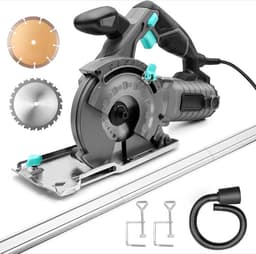
If the saw can rock sideways, the splinter strip cannot seal the kerf. ITS describes fitting a Festool-style saw with the cams so there is no side play. The habit you can copy is a shoe that slides without rattling. A BlueMars review says that saw clips under a narrow extrusion and that the track has to be bolted down. A Draper review says the saw sticks at the rail joint, and another says a track was not straight. Sight down the rail before you commit a finished face. What should be in the box is on the plunge saw buying guide.

Trim the splinter strip on scrap

The strip along the rail is meant to be cut by your blade, once, so it marks the kerf. Trim it on scrap, with the blade you will use, and with the saw already on the rail. About 5 mm deeper than the scrap is the ITS figure for one Festool setup. It is not stamped on every saw here. Re-trim after a blade change, because the kerf moves. Unplug a corded saw, or remove the battery, before you touch the spindle lock. Festool’s listing names FastFix and Einhell’s carton includes an Allen key. Neither is a reason to change a blade with the pack clicked in. If the viewing window or the strip is missing, you are not ready.

Depth and which face is up

One scale is the shoe on the timber. The other is the shoe on the rail. The number on the box is usually the first. BuildWiz’s rule of thumb is about 56–60 mm on the scale for a 38 mm top with the rail on it. None of the four listings prints a with-rail depth, so plunge on scrap of the same thickness first. Face up is the splinter-strip habit. Face down puts tear-out on the show face. Support the sheet so a sagging offcut cannot close the kerf. A laminate top is on cut a worktop with a plunge saw.

Dust, hearing, and a blade change

Connect a hose if you have an extractor. Protrade says an enclosed blade gives the port something to pull from, and it does not publish a capture percentage. HSE says power-tool cutting should use an M or H class unit. Employers examine local exhaust at least every 14 months. A householder does not take on that timetable. Hardwood dust is limited at 3 mg/m³ and softwood at 5 mg/m³ as an eight-hour average. Draper reviews repeat a port that split or arrived shattered. None of these listings prints a noise figure, so hearing protection is the sensible default indoors. If the hex key does not fit the arbor lock, stop.

When to stop

Stop if the upper guard will not close, if the housing arrived cracked, or if the rail is bent enough that the cut already varies. A missing link bar is not a prompt for a freehand pass. A structural cut, a first sink or hob opening, or repeated MDF with no extraction is the point to hand the job to someone who does it for a living. PUWER duties sit with an employer when the saw is work equipment. A burnt face on the first 300 mm of scrap is information. Change the setup on scrap, or send the tool back under the Consumer Rights Act 2015 if it is not as described.

Common questions

Do I trim the splinter strip on the worktop or on scrap?
Trim it on scrap, with the blade you will use, and with the saw already on the rail. The strip then shows the kerf. Trimming it on the finished top uses that seal on a piece you may not be able to replace. Re-trim after a blade change, because the kerf moves.
Which depth scale do I use once the rail is underneath?
Use the reading that includes the rail, not the bare maximum for the shoe on the timber. BuildWiz’s rule of thumb is about 5–6 mm of blade past the underside, and about 56–60 mm on the scale for a 38 mm top. The same publisher quotes more than one rail thickness. None of the listings here prints a with-rail depth. Prove the setting on scrap of the same thickness.
Show face up or down?
Show face up when a splinter strip bears on that face. The blade exits underneath, so breakout is away from the surface you will see. Face down is the usual freehand circular-saw habit, and it puts tear-out on the show face. Tape is an extra on brittle laminate, not a reason to flip the board.
How do I stop the saw rocking at the start of the cut?
Leave about 100 mm of rail, on BuildWiz’s rule of thumb, beyond the start so the shoe is fully on the track before the teeth touch. Take the side play out of the fit, and clamp the rail if the strips are slipping. Starting with half the shoe off the rail is how the first 50 mm wanders.
What should I connect to the dust port indoors?
Connect an extractor if you have one. HSE treats M or H class as the class for power-tool wood cutting. A domestic vacuum may catch chips and still leave fine dust. Use a mask if the cut is MDF or runs on. Employers have a 14-month examination duty for local exhaust. A householder does not, and the dust is still wood dust. A port is not a dust-free claim.

Related pages

Sources

Public UK sources first, then the amazon.co.uk listings compared on this page. Prices and stars were taken on 20 October 2026.

  1. HSE: Wood dust (retrieved 20 October 2026)
  2. HSE: Cutting and sanding wood (retrieved 20 October 2026)
  3. HSE: Electrical systems (retrieved 20 October 2026)
  4. HSE: PUWER (retrieved 20 October 2026)
  5. IET: Electricity in the workplace FAQ (retrieved 20 October 2026)
  6. BSI: BS EN 62841-2-5:2014 (retrieved 20 October 2026)
  7. BuildWiz: Plunge saw (retrieved 20 October 2026)
  8. HSE: Electrical standards, BS 1363 (retrieved 20 October 2026)