Independent comparisons. We may earn from shop links. More info

Circular or reciprocating saw on Makita 18 V

Updated: 21 October 2026

You have one Makita 18 V pack, a sheet of ply to rip, and a pallet to break up. A circular or reciprocating saw on Makita 18 V is not a brand contest. The circular saw keeps a blade square to a line. The reciprocating saw pushes a short blade so you can plunge and steer. This page chooses between those shapes inside the [Makita cordless saw comparison](/hub/power-saws/makita-cordless-saw), from amazon.co.uk listings and Makita UK figures on 20 October 2026. Peter F. did not run a timed cut. A qualifying purchase can earn a commission at no extra cost to you.

You have one Makita 18 V pack, a sheet of ply to rip, and a pallet to break up. A circular or reciprocating saw on Makita 18 V is not a brand contest. The circular saw keeps a blade square to a line.

Our top picks

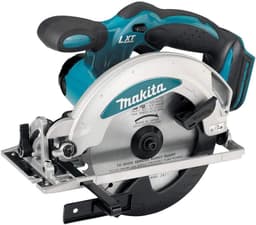
Makita Makita DSS610Z

Best overall

Makita Makita DSS610Z
9.6/10about £119.00
On this page

A straight line in a board is a circular saw

Choose a circular saw when the cut is straight and thinner than the blade can finish. The DSS610Z at £119.00 is an 18 V LXT bare body with a 165 mm blade. Makita UK states 57 mm at 90°. The HS301DZ at £99.95 is 12 V CXT, so an LXT pack does not fit. The £39.99 CISSIYOG is a 5 inch-class body and does not publish that depth table. Box lines are on the buying guide.

Pallets, pipe and branches are a reciprocating saw

Choose a reciprocating saw when the cut starts in the middle or meets a nail. Both recip bodies here expect your Makita 18 V pack. The OHAISFELA at £59.99, 4.4 from 16 reviews, states a 20 mm stroke and four blades. A UK review says the label reads 3,000 strokes per minute, not 3,500. The Builrand at £48.99 does not state a stroke. Makita UK’s DJR187, not an ASIN here, publishes a stroke around 32 mm.
Makita Makita DSS610Z

Testsieger

Makita Makita DSS610Z
9.6/10about £119.00

What changes if you stay on the same pack

The same 18 V battery can run a DSS610Z and an OHAISFELA, and the cuts stay different. On the circular saw, let the offcut fall. On the recip saw, keep the shoe against the work. Makita UK lists 94 dB(A) for the DSS610, above the HSE 85 dB(A) action value, so hearing protection is the default. The CSE002 is a 15 cm pruning head, not either of these cuts. Setup is on the how to use page.

One recommendation, with the condition

For a straight cut within 57 mm at 90°, use the DSS610Z if you own LXT packs, or the £39.99 CISSIYOG only when the piece is thin. For a pallet, use the OHAISFELA for a stated 20 mm stroke, or the Builrand at £48.99 if the stroke can stay unstated. One pack does not make them the same tool. Skip the luolety at £57.99: a failed safety switch and a poor showing on 12 mm MDF. Structural timber is the DJR187 class, or a carpenter.

Common questions

Can one Makita 18 V battery run both saws?
Yes, if both tools are built for that 18 V pack. The DSS610Z is. The OHAISFELA and the Builrand name BL1820 to BL1860 codes and ship no battery of their own. The HS301DZ will not take that pack, because it is 12 V CXT. Sharing a battery does not share the cut. You still choose the circular body for a straight line and the recip body for a plunge or a curve.
Is a circular saw faster for breaking up a pallet?
It can look faster until the blade meets a nail or the shape pinches the disc. A circular saw wants a straight, supported line. Pallet slats are short, nailed and awkward, which is why the reciprocating saw fits better, even though each stroke is only 20 mm on the OHAISFELA bullets. A metal-capable recip blade survives the nails better than a fine circular wood blade.
How do I know the board is too thick for the circular saw?
Measure it and compare it with a published depth. Makita UK allows 57 mm at 90° on the DSS610 and 25.5 mm at 90° on the HS301D. A compatible claim of 33–55 mm, as on the luolety listing, is already contradicted by a UK review that struggled with 12 mm MDF. If the board is thicker than the figure you trust, plan a second pass or a different saw. Leaning harder is how motors smell hot.
The recip listing says 3,500 strokes per minute. Should I believe it?
Quote it as the bullet, not as a test. On the OHAISFELA a UK review says the label reads 3,000. The Builrand bullets say four settings up to 3,500, and nothing here confirms the label. You have no Makita UK speed sheet for these bodies. Keep the speed low enough that the blade tracks, and stop if the housing gets hot. Sixteen reviews cannot settle the argument.
Should I buy the mini chainsaw instead of a recip for the garden?
Only for light softwood branches. The CSE002 has the review volume, at 4.5 from 393, and UK text about branches. A reciprocating saw with a pruning blade can take small limbs and then move on to a pallet. The mini chainsaw cannot become a circular saw, and a 15 cm bar is the wrong tool for thick limbs. For mixed garden waste and household timber, the recip body covers more of the afternoon.
When is neither saw the right purchase?
When the timber is structural, when you cannot see services in a wall, or when you need published vibration for paid work. The DSS610Z has the depth sheet and the large review sample. The recip copies have short UK write-ups and, on the Builrand, no stroke figure. Past that point, ask a carpenter, or read Makita’s DJR187 and DHS680 pages, which sit outside the eleven ASINs compared here.

Related pages

Sources

Public UK sources and the amazon.co.uk listings in this comparison. Prices, stars and review counts are the stored listing figures for 20 October 2026. There was no lab cut.

  1. Makita UK, DSS610 (retrieved 20 October 2026)
  2. Makita UK, HS301D (retrieved 20 October 2026)
  3. Makita UK, DHS680 (retrieved 20 October 2026)
  4. Makita UK, DJR187 (retrieved 20 October 2026)
  5. HSE, wood dust (retrieved 20 October 2026)
  6. HSE, noise duties for employers (retrieved 20 October 2026)
  7. HSE, hand-arm vibration (retrieved 20 October 2026)
  8. Consumer Rights Act 2015 (retrieved 20 October 2026)
  9. amazon.co.uk, Makita DSS610Z (retrieved 20 October 2026)