Independent comparisons. We may earn from shop links. More info

How to use a fret saw

Updated: 21 October 2026

The blade is wandering, or it snapped on the first corner, and the frame is still in your hand. That is usually tension, tooth direction, or a cut that started in the middle of the sheet with no hole. This guide on how to use a fret saw covers the pin-end coping frames and the wing-nut fret frames sold together on amazon.co.uk, using UK how-to sources and the review notes on the sets in our [fret saw set comparison](/hub/power-saws/fret-saw-set). Peter F. did not film a lab cut. A qualifying purchase can earn a commission at no extra cost to you. By the end you should be able to fit the blade your frame actually takes, pull the cut, and stop before a fine blade meets thick timber. Prices and the full skirting sequence live on other pages.

The blade is wandering, or it snapped on the first corner, and the frame is still in your hand. That is usually tension, tooth direction, or a cut that started in the middle of the sheet with no hole.

Our top picks

On this page

Fit the blade your frame actually takes

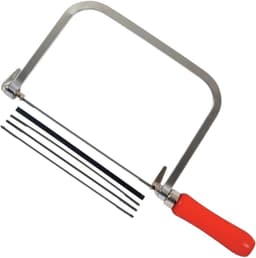
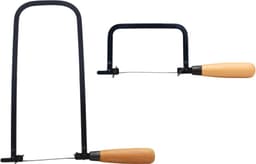
Look at the ends before you copy a video. A coping saw uses pin-end blades. The Bloke Cave’s UK sequence is to unwind the handle until the frame relaxes, hook the pins into the slots, and wind the handle until the blade is tight. Teeth face the handle, because the saw cuts on the pull. If you leave the pins half seated, the blade jumps out on the first stroke and the frame springs back toward your hand. A fret saw such as the Eclipse pair uses plain ends in hardened serrated clamps, closed with wing nuts. One UK review says those blades change without a separate tool. You still slacken both clamps, seat the blade straight, and tighten until it cannot slip. Do not hook a pin-end coping blade into those clamps, and do not feed a plain fret blade into pin slots. Pebaro’s UK listing does not describe the holder in the bullets. If your kit matches the maker’s fretwork frame, expect clamps and a spanner rather than coping pins. Avit’s listing is the coping pattern: wing adjusters rotate the blade through 360°, so you can turn the teeth without twisting your wrist around a moulding. That rotation is not a substitute for tension. A blade that spins in the holders is loose, not adjustable. Fit one blade, then tug it with a finger before you approach the wood. Tooth count and the spare pack belong on the fret saw set buying guide, once the ends match.

Tension and tooth direction

Homebuilding’s coping-saw advice is a firm blade with a little flex left, not a wire you have wound until it might shatter. On a pin-end saw you add that tension with the handle. On wing-nut clamps you add it by tightening. If the frame has no way to add tension, stop. SULIVES reviews describe a missing lock and a blade that comes out. An XMDROU review says there is no tension screw even though the bullets mention a knob. An Eclipse review says one set could not be tensioned and felt flimsy. Those are the tool, not a heavier stroke. Teeth toward the handle is the usual UK instruction, from The Bloke Cave, BuildWiz and Homebuilding. You cut on the pull. Pushing loads the thin blade in compression and it wanders or snaps at the corner. One Avit review found the blade fitted upside down on arrival and treated that as packing. Flip it before you blame the timber. If you turn the blade in the frame for a vertical cut on skirting, the teeth still point so that you pull them through the work. A piercing blade at 32 TPI, as on the Eclipse piercing saw, follows the same pull. It is finer, so the little flex is smaller and the snap comes sooner. Do not tension it harder to make it cut 18 mm board.

Support the work and follow the line

Wonkee Donkee’s holding note is both hands toward the handle, with you standing so the line is in front of you rather than across your body. Clamp the board to the bench, or support a thin sheet on a board with a V notch, so the blade can drop through. Pebaro lists a stand for that kind of support, and UK reviews describe the set on very thin wood. If you hold a plywood offcut in one hand and saw with the other, the sheet chatters and the blade grabs. Mark the line on the face you can see. Start at an edge with a light pull, let the teeth engage, and steer with the frame rather than by bending the blade. A coping throat near 125 mm, the BuildWiz figure for a typical skirting saw, means you turn the work or you turn the blade in the pins when the frame hits the bench. The Eclipse fret bow is stated at 285 mm, so the frame stays clear of a wider sheet. That reach does not make the 16 TPI blade happy in thick stock. Keep the offcut supported as it comes free. A falling piece twists the blade at the last millimetre. For a moulding, the coping saw for skirting page has the mitre and the back-cut. Do not try to learn that joint in the middle of a tension lesson.

Interior cuts start with a hole

A shape that does not meet the edge cannot be started by pushing the blade through the face. Homebuilding’s method is to drill a pilot hole in the waste, undo one end of the blade, thread the blade through the hole, and tension it again. Then you saw to the line. Pebaro’s listing names a drill for pre-drilling the interiors of a fretsaw template. No diameter is given in the UK file, so match the bit to the blade you will thread. The hole sits in the waste, inside the line, with room to turn. On a pin-end coping saw you release the handle end, pass the blade through, and hook it again. On wing-nut clamps you slacken one clamp, pass the plain end through, and reseat it square. If you drill on the line itself you have already scarred the finished edge. If the hole is smaller than the blade’s end fitting, you will bend the blade trying to force it. A shallow coping saw can do a small hole near an edge, and it becomes awkward once the throat hits the sheet. Fine blades snap when the wood is too thick or the turn is too tight. Eclipse reviews say exactly that about photos of a 2x4. Fit a fresh blade only if the next cut is in the thin material the saw is for.

When to stop and change tool

Stop if the lock is missing, the screws walk open, or the blade will not stay straight under a finger tug. Pebaro has a UK review of screws that keep opening. Forcing that frame sprains the cut and your grip. Stop if you are about to enter structural timber, a joist, or anything that is holding the house up. These sets are for mouldings, thin sheet, plastic and thin metal. A 32 TPI piercing blade is not a substitute for a handsaw in a 50 mm batten. Stop and call a joiner for ornate plaster cornice, which a coping blade will shatter, and for a whole house of prefinished board if you have never scribed a corner. A long day on MDF is wood dust. HSE workplace limits are 3 mg/m³ for hardwood and 5 mg/m³ for softwood over eight hours. The FFP3 guidance on the HSE cutting page is written for power tools. A few hand cuts are not that job. Occupational MDF work still needs extraction and a suitable mask, which none of these sets includes. The fret saw vs coping saw page is the fork if the frame you own cannot reach the line you have drawn.

Common questions

Which way should the teeth face?
Toward the handle, so the saw cuts when you pull. That is the usual UK instruction in The Bloke Cave, BuildWiz and Homebuilding. If a blade arrives upside down, as one Avit reviewer found, turn it before you cut. Pushing a thin blade makes it wander and snap on corners. The same direction applies when you rotate the blade in a 360° coping frame for a vertical moulding.
How tight should the blade be?
Firm, with a little flex left when you press it sideways. Homebuilding warns against winding a coping blade until it is rigid. On wing-nut clamps, tight enough that the ends do not slip, then stop. If the frame has no tension adjustment, or the lock is missing, do not compensate by pulling harder. A blade that falls out, as UK reviews describe on the SULIVES set, is a faulty set, not a loose technique.
How do I change a pin-end blade?
Unwind the handle so the frame relaxes, unhook both pins, and fit the new blade with the teeth toward the handle. Seat the pins fully, then wind until the blade is firm and still has a little flex. The Bloke Cave walks through that on a coping saw. It does not apply to plain-end clamps. Tug the blade before you put it on the work, and keep your other hand off the line of the frame as it springs.
How do I change a blade held by wing nuts?
Slacken the wing nuts on the serrated clamps, lift the plain-end blade out, and seat the new one straight, teeth toward the handle. Tighten both nuts so the blade cannot creep. Eclipse reviews describe that change without a separate tool. Do not use a pin-end coping blade in those clamps. If a spanner came with a Pebaro-style kit, use it on that kit’s nuts rather than on pliers that round them off.
How do I cut a shape that does not meet the edge?
Drill a pilot hole in the waste, release one end of the blade, thread it through, and tension it again. Homebuilding describes that sequence, and Pebaro lists a drill for interior template holes without stating a diameter. Keep the hole off the finished line. Support the sheet on a notched board or on the stand in the kit. A shallow coping frame will hit the board once the cut moves away from the edge.
Why does the blade snap on a corner?
Usually you pushed instead of pulled, the blade was over-tight or twisted, or the stock is too thick for a fine blade. Eclipse reviews say the fine blades will not do the 2x4 in the photos. A sharp turn with the frame jammed against the bench also snaps the blade at the holder. Ease the turn, check the teeth face the handle, and change to a coarser wood blade only if the frame accepts it.
Can I use the same steps on a piercing saw?
The pull stroke, the light tension and the pilot hole are the same. The scale is not. The Eclipse piercing saw is about 8 cm deep in one UK review, with a 32 TPI blade for thin metal and delicate work. It is not a coping saw for skirting and not a saw for thick timber. Spares are not in that box, so a snap ends the job until you have a matching blade. Keep the work supported and the turns wide enough for that small frame.

Related pages

Sources

HSE, GOV.UK, legislation.gov.uk, BuildWiz, Homebuilding and Wonkee Donkee. Listing prices, stars and review counts are the amazon.co.uk figures for these seven ASINs. Shelf date 20 October 2026.

  1. HSE wood dust (retrieved 20 October 2026)
  2. HSE cutting and sanding wood (retrieved 20 October 2026)
  3. General Product Safety Regulations 2005 (retrieved 20 October 2026)
  4. Consumer Rights Act 2015 (retrieved 20 October 2026)
  5. Supply of Machinery (Safety) Regulations 2008 (retrieved 20 October 2026)
  6. BuildWiz coping saw (retrieved 20 October 2026)
  7. Homebuilding: what is a coping saw (retrieved 20 October 2026)
  8. Wonkee Donkee: coping, fret and piercing saws (retrieved 20 October 2026)