Independent comparisons. We may earn from shop links. More info

Fret saw set buying guide

Updated: 21 October 2026

You are about to order a saw for an internal corner of MDF skirting, or for a thin plywood shape, and the amazon.co.uk title says fret saw. That browse node mixes deep fretsaws, shallow coping saws and piercing saws, so the word in the title is a weak guide. This fret saw set buying guide uses seven listings priced from £7.25 to £23.39, with the star lines and UK review notes in those files. Peter F. did not run a lab cut. A qualifying purchase through our links can earn a commission at no extra cost to you. The shelf prices sit on the [fret saw set comparison](/hub/power-saws/fret-saw-set). What you need is the frame, the blade ends and the tooth count that match the job.

You are about to order a saw for an internal corner of MDF skirting, or for a thin plywood shape, and the amazon.co.uk title says fret saw.

Our top picks

On this page

Three frames sold under one name

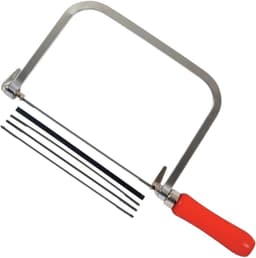
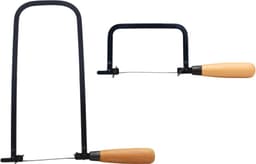
A coping saw is a shallow U-frame with a pin-end blade. Second-fix work uses it to follow a profile on skirting, architrave and cornice after a mitre has opened on a wall that is not square. BuildWiz, a UK tool guide, puts a typical coping throat near 125 mm, which reaches across a moulding and does not reach the middle of a wide board. XMDROU is listed at 30 × 11 cm, SULIVES at about 30 × 12 cm, and MIPIACE as a 290 mm U-frame. A fret saw is a deeper bow with a thinner plain-end blade. Wonkee Donkee describes it as the frame for patterns that sit away from the edge of thin sheet. Eclipse states a 285 mm bow, more than twice the short side of those coping frames. Pebaro WPB705 is sold as a fretsaw set with a stand. The UK page does not state a throat, so do not invent one from a catalogue drawing. A piercing saw is smaller again, with a finer blade, for thin metal, jewellery and tight model work. Eclipse includes one with a 32 TPI blade, and a UK reviewer put that throat at about 8 cm. It is a third tool, not a compact coping saw. If you are still choosing, the fret saw vs coping saw page stays on that fork.

Throat, blade ends and tension

Pin-end coping blades hook into slots, and you tension them by winding the handle. Plain-end fret blades sit in clamps, often under wing nuts, as on the Eclipse pair. Those patterns do not interchange. A high-street pin-end pack will not seat in a plain-end clamp, and a plain fret blade will not hook into pin holders. If the listing never says which ends you are buying, a spare pack is a guess. Tension is what the UK reviews argue about. On SULIVES, two UK reviews say the blade-locking end was missing and the blade keeps coming out. On XMDROU, the bullets mention a tension knob, and one UK review says there is no tension screw and the blade is a drop-in. Eclipse uses hardened serrated clamps. One review still says there was no way to tension the blade. Avit states wing adjusters that rotate the blade through 360°, which is how a coping saw turns the teeth to follow a moulding. Homebuilding’s note is to wind until the blade is firm and still has a little flex. If the lock is absent when the parcel arrives, that is the set, not your wrist. A blade that leaves the frame mid-cut is a return.

Tooth count for wood, MDF and thin metal

BuildWiz’s rule of thumb, which is not a British Standard, is about 14–15 teeth per inch for softwood and about 18–20 TPI for MDF and tight mouldings. A coarse blade tears the painted face of MDF skirting. A very fine blade is slow in pine and snaps if you force it through thick stock. Avit prints the mix: two 16 TPI wood blades, one 20 TPI wood blade, one 24 TPI metal blade and one 28 TPI metal blade. A UK review mentions 18 mm MDF skirting, which sits near that wood band. Eclipse fits 16 TPI on the deep fret saw and 32 TPI on the piercing saw. The 32 TPI blade is for thin metal, not for the flat of a skirting board. MIPIACE lists two blades each of 4, 6, 8 and 10 TPI. Those figures are coarse next to the 18–20 band for MDF, and they are not jeweller’s blade-size numbers. Hilka, XMDROU, SULIVES and Pebaro do not state a TPI. Pebaro’s blade-length field says 3 cm, which does not describe a usable fretsaw blade. If your skirting is MDF, look for a stated figure around 16–20 TPI. The cut itself is on the coping saw for skirting page.

What should be in the box

A set here means a frame plus spare blades, or a second frame you will actually use. Spares only help when the ends match. Eclipse includes one blade on each saw and no spare pack, so the first snap ends the afternoon unless you already own matching blades. At £23.39 that is easy to miss. Pebaro lists 12 items, a stand, and a drill for pre-drilling interiors, at £15.87. The UK bullets do not count the blades. The maker’s 2025 catalogue item 705P describes a frame, a wooden table, a clamp, blades, a wing-nut spanner, a fretwork drill and directions. That catalogue is not the amazon.co.uk bullet list, so check the bag against the listing you paid for. Avit at £13.84 is one coping frame and five stated blades. Hilka at £9.32 says a set with blades and does not tabulate the count. XMDROU at £7.59 is one frame and four blades. SULIVES at £7.25 lists five blades. MIPIACE at £10.99 lists eight blades, while the included-components field says no. BuildWiz also quotes merchant coping saws around £8–£16. Those figures are that guide’s shop prices, not the shelf prices of these ASINs. You do not need a second frame to scribe one corner.

When the listing is not enough

These are hand tools. They are not machinery under the Supply of Machinery (Safety) Regulations 2008, and none of these listings describes a UK 13 A plug. Avit’s power-source field says corded electric, and Hilka’s speed field says 4,500 rpm. The bullets describe hand saws. Treat those rows as listing noise. The General Product Safety Regulations 2005 are the Great Britain baseline for consumer goods. If a set arrives incomplete, the Consumer Rights Act 2015 covers goods that are not as described. A Hilka reviewer counted four blades and none fitted, and wrote that Hilka replaced the set. That is a return, not a lesson in how hard to push. A long session in MDF or hardwood is wood dust. HSE workplace limits are 3 mg/m³ for hardwood and 5 mg/m³ for softwood as an eight-hour average, and mixtures use the hardwood limit. A few coping cuts at home are not the power-tool job on the HSE cutting page. No British Standard number is printed on these listings. Named picks are on the best fret saw set page.

Common questions

Is a fret saw set the same as a coping saw set?
No. On amazon.co.uk the Fret Saws browse node mixes them. A coping set is a shallow U-frame with pin-end blades for mouldings. A fret set is a deeper bow with plain-end blades for patterns in thin sheet. A piercing saw is smaller still, for thin metal. Read the throat and the blade ends. The title alone does not tell you which family you will unpack.
What throat do I need for skirting?
BuildWiz puts a typical coping throat near 125 mm, which clears skirting and architrave. The cheaper frames here are about 11–12 cm on the short side, or 290 mm along the MIPIACE U-frame. The Eclipse fret saw states a 285 mm bow, which is more reach than a moulding needs. Pebaro does not state a throat on the UK listing, so that kit is not a throat you can compare from the page.
What TPI should I look for on MDF?
Use BuildWiz’s rule of thumb: about 18–20 TPI for MDF and tight mouldings, and about 14–15 TPI for softwood. It is a guide, not a standard we measured. Avit prints 16 and 20 TPI wood blades. MIPIACE’s 4, 6, 8 and 10 TPI blades are coarse for painted MDF. Hilka, XMDROU, SULIVES and Pebaro do not state a TPI, so you cannot check them from the specification table.
Will spare coping blades from the high street fit every set?
Only if the ends match the frame. Pin-end coping blades do not fit plain-end clamps, and plain-end fret blades do not hook into pin holders. Eclipse spares have to match its wing-nut clamps, and that box does not include a spare pack. A pin-end pack suits a coping frame such as the Avit. Check the listing before you add a blade pack of about £5.
What if the blade lock is missing?
Stop, and treat it as the product. Two UK reviews of the SULIVES set say the locking end was missing and the blade comes out. A Hilka review found a loose end fitting and four blades, and the brand replaced that set. The Consumer Rights Act 2015 covers goods that are not as described. A frame that cannot tension a blade will twist the cut, and forcing it is not a technique.
Are these mains tools with a UK plug?
No. They are hand saws. No listing here describes a BS 1363 plug or a 230 V lead. Avit’s power-source field says corded electric and Hilka’s speed field says 4,500 rpm, but the bullets do not describe a motor. Ignore those rows. Judge the frame, the blades and the UK reviews, and keep the saw as a hand tool on the bench.

Related pages

Sources

HSE, GOV.UK, legislation.gov.uk, BuildWiz, Homebuilding and Wonkee Donkee. Listing prices, stars and review counts are the amazon.co.uk figures for these seven ASINs. Shelf date 20 October 2026.

  1. HSE wood dust (retrieved 20 October 2026)
  2. HSE cutting and sanding wood (retrieved 20 October 2026)
  3. General Product Safety Regulations 2005 (retrieved 20 October 2026)
  4. Consumer Rights Act 2015 (retrieved 20 October 2026)
  5. Supply of Machinery (Safety) Regulations 2008 (retrieved 20 October 2026)
  6. BuildWiz coping saw (retrieved 20 October 2026)
  7. Homebuilding: what is a coping saw (retrieved 20 October 2026)
  8. Wonkee Donkee: coping, fret and piercing saws (retrieved 20 October 2026)