Independent comparisons. We may earn from shop links. More info

How to use a jewellers saw

Updated: 21 October 2026

Your first plain-ended blade snapped on the second stroke, or the wing nut undid itself before you finished a corner, and you are unsure whether the fault is tension, tooth direction, or a clamp that was never fit for purpose. Using a jeweller's piercing saw starts with fitting the wire, checking tension with a ping, and only then worrying about stroke speed. Which kits reviewers said slipped is on the [frame saw comparison](/hub/power-saws/frame-saw). Peter F. mapped those listings against UK bench guidance. There was no lab test. A qualifying purchase can earn a commission at no extra cost to you.

Your first plain-ended blade snapped on the second stroke, or the wing nut undid itself before you finished a corner, and you are unsure whether the fault is tension, tooth direction, or a clamp that was never fit for purpose.

Our top picks

Eclipse Eclipse 70-CP1R

Best overall

Eclipse Eclipse 70-CP1R
9.0/10about £10.89
Eclipse Eclipse PS51

Best value

Eclipse Eclipse PS51
8.4/10about £11.99
On this page

Fit a jeweller's blade

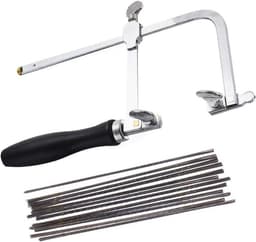
Cooksongold's bench method is the spine to follow. Seat the frame comfortably, set the teeth to point toward the handle so the cut happens on the down stroke, and clamp the far end of the wire first. Flex the frame slightly toward you, clamp the near end, and increase tension until the blade makes a short ping when you pluck it. Teeth should feel rigid, not loose like a string. Do not tighten wing nuts with pliers. Overtightening strips soft screws and cracks cheap clamps. On adjustable frames in this set, thumbscrews or wing screws claim a range from about 2 cm to 14 cm on some listings. The Eclipse PS51 is fixed: you fit a full-length plain-ended blade only. Reviewers sometimes report a supplied blade that was short or missing, which is a packing check before you tension. If the listing shipped oiled blades, wipe oil off a handful of wires so your grip and the clamp are not slippery. Internal cuts need a drilled hole larger than the kerf. Thread the blade through, reclamp, and retension. You cannot start a pierced window from the edge alone. Drill size sits with grade choice on jeweller's saw blade size.

Turn a coping blade

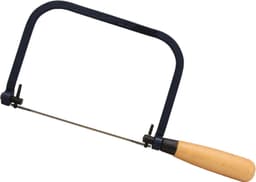
If you are using the Eclipse 70-CP1R or the generic coping set, you are not clamping plain wires. Coping blades are pinned at both ends and hook into rotating holders. The Eclipse listing says the blade can sit at any angle to the frame, which is how you keep cutting along a skirting profile when the bow would otherwise foul the wall. Loosen the pins, rotate to the angle you need, and retension until the blade tracks without twist. Wing-screw tension on a jeweller's frame is unrelated to coping pin rotation. Buyers who ordered the wrong family from a frame saw search often try to force a plain wire into pinned holders. Stop and confirm the blade ends before you tension harder. The family check is coping saw vs jeweller's saw.
Eclipse Eclipse 70-CP1R

Testsieger

Eclipse Eclipse 70-CP1R
9.0/10about £10.89

When it snaps or slips

Snapping on the first stroke usually means slack tension or teeth pointing the wrong way. Re-fit with teeth toward the handle and ping the wire again. Snapping in thin sheet can mean a grade too coarse for the thickness. The three-teeth-in-metal check is a rule of thumb on the blade-size page, not a reason to blame the frame first. If the wing nut or thumb screw loosens mid-cut, the blade skews and snaps even with the right grade. UK review text on SKYPRO and some generic kits repeats clamps that slip or refuse to grip. One note on the TS-JS144, ASIN B0FQ2QNBKS, mentions the top grip loosening until blades snapped. That pattern is a frame fault. Stop. Do not work around a clamp that will not hold. At work, HSE maintenance guidance says not to use damaged equipment. At home the same practical rule applies, and the Consumer Rights Act 2015 covers a tool that cannot tension a new blade straight. A cracked frame or a bent bow is not fixed with more tension. Return it. A short supplied blade on the PS51 is a packing issue. Fit a known full-length replacement before you judge the bow.

Where you stop

These hand frames suit fine work on a supported bench pin, trim boards you can hold safely, and practice stock. They are not the tool for load-bearing timber, concealed structural cuts, or high-value jewellery repairs where hallmarking and stone setting need a professional bench. Call a joiner when the job carries structural load, and a jeweller when the piece is insured or set with stones you cannot risk. At work, PUWER 1998 treats a hand tool as work equipment: suitable, maintained, and used by people who have been shown how. Learn on scrap sheet or offcuts until the ping and the stroke feel consistent, and only then move to good material. For coping mouldings you may never need the jeweller's sequence beyond knowing not to use it on pinned blades.

Common questions

Which way do the teeth face?
Toward the handle on a jeweller's frame, so the cut happens on the down stroke. Reverse them and the wire will grab or snap.
How do I know the tension is enough?
Pluck the blade lightly. A clear ping means usable tension. A dull flop means a slack fit or a slipping clamp.
Can I reuse a snapped blade?
On an adjustable frame, sometimes, if the stub is long enough to clamp straight and the screws hold. On the fixed Eclipse PS51, fit a new full-length wire.
Why does the wing nut undo?
Soft threads, overtightening with tools, or a clamp that cannot hold side load. If it repeats on a new blade, return the frame.
How do I turn a coping blade along the frame?
Loosen the pinned holders on a coping saw such as the Eclipse 70-CP1R, set the angle, and retension. That step is for coping saws. It is not done on jeweller's wing screws.
What if the supplied blade is too short?
Check the packing against the listing. Fit a standard plain-ended replacement of full length before you judge an Eclipse PS51 bow.
When is a snap my fault, and when is it the frame?
Wrong tension, wrong tooth direction or the wrong grade point to technique. A clamp that will not stay put, a bow that flexes sideways, or nuts that undo themselves point to the tool.

Related pages

Sources

Public UK sources and the amazon.co.uk listings compared on this page. Prices are the stored figures for this set.

  1. Cooksongold, a guide to sawing and piercing (retrieved 21 October 2026)
  2. Jewellers Academy, choosing a jeweller's saw (retrieved 21 October 2026)
  3. Common Woodworking, buying a coping saw (retrieved 21 October 2026)
  4. Workshop Heaven, jeweller and coping saws (retrieved 21 October 2026)
  5. HSE, PUWER overview (retrieved 21 October 2026)
  6. HSE, maintenance of work equipment (retrieved 21 October 2026)
  7. Consumer Rights Act 2015 (retrieved 21 October 2026)
  8. amazon.co.uk Best Sellers, Frame Saws (retrieved 21 October 2026)