Independent comparisons. We may earn from shop links. More info

Jewellers saw blade size

Updated: 22 October 2026

You opened a packet of plain-ended wires, or a mixed gross labelled 4/0 to 2, and the first stroke snagged the metal or wandered off line. Jewellers saw blade size is not the same scale as a coping saw's TPI, and the numbers run finer once you pass zero into /0 grades. This page shows how to pick a grade for ordinary sheet, how the three-tooth check works, and what to do when a 144-blade pack is not labelled. The rows are on the [frame saw comparison](/hub/power-saws/frame-saw). Peter F. compared those amazon.co.uk listings, with no lab test. A qualifying purchase can earn a commission at no extra cost to you.

You opened a packet of plain-ended wires, or a mixed gross labelled 4/0 to 2, and the first stroke snagged the metal or wandered off line.

Our top picks

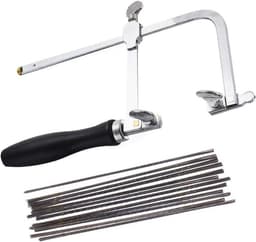
Generic Generic ADJ-SAW-144

Best overall

Generic Generic ADJ-SAW-144
8.8/10about £13.99
Eclipse Eclipse PS51

Best value

Eclipse Eclipse PS51
8.4/10about £11.99
SKYPRO SKYPRO 144-blade frame

Alternative

SKYPRO SKYPRO 144-blade frame
7.8/10about £13.99
On this page

How the numbers run

Piercing blades are sold by grade, not by millimetres on every wire. Whole numbers such as 2 or 3 are coarser. Sizes with /0 after them are finer: 2/0 is finer than 1/0, and 4/0 is finer still. Cooksongold's trade guide places grade 4 at roughly 1.0–1.3 mm with about 15 teeth per centimetre, and grade 8/0 for material up to about 0.4 mm. Coping saws are shopped by TPI, such as 14 or 18 for timber. The generic coping set here lists 14 TPI blades. Eclipse PS51 ships one 32 TPI wire, not a coping refill. A pinned blade with a hole at each end belongs on coping saw vs jeweller's saw. Kits in this set mostly bundle six grades from 4/0 through 2. SKYPRO lists 6/0 through 6, and UK reviews say those sizes are not marked.

A grade for ordinary sheet

For typical silver or brass sheet around 1 mm, start near 2/0 or 1/0 unless the metal is thinner or the pattern is exceptionally tight. Stocking those two grades covers most bench work. If the blade grabs, chatters, or snaps on the down stroke, the grade is often too coarse, so go finer. If the cut stalls and the kerf wanders, you may be too fine. Pepetools states a rule of thumb: aim for about three teeth in contact with the metal at once. That is not a British Standard. If only one tooth seems to bear, step coarser. If the teeth look crowded, step finer. Coarse blades on thin sheet snag like a file. Fine blades on thick stock snap because the wire flexes and binds. Support the sheet on a bench pin or over a slot. Grade choice assumes the metal is flat, not held in mid air.
Generic Generic ADJ-SAW-144

Testsieger

Generic Generic ADJ-SAW-144
8.8/10about £13.99

Piercing holes

Internal cuts start with a drilled hole larger than the kerf and large enough for the blade's depth to pass through when you thread the wire. Pepetools notes that the drill must clear the blade depth, not just the tooth width, because you feed the whole wire through the hole before you clamp and tension. Exact drill sizes belong with the pattern layout. The hole must exceed the blade width you chose. After threading, retension until the wire pings. A hole that is barely wider than the tooth may work once and then bind when the frame flexes. If you are snapping at the pierced corner, check tension and tooth direction on how to use a jeweller's saw before you blame the grade alone.

Coping TPI is not this chart

Coping blades for timber are counted in TPI, often mid-teens to about 18 for general woodwork in UK woodworking guides. Eclipse 70-CP1R is sold for wood with a pinned blade. The generic coping set lists five 14 TPI replacements. Those teeth are spaced for mouldings and softwood sections, not for 0.8 mm silver. Some listings allow a coping blade on soft metal in a pinch. Pierced jewellery wants plain-ended grades and a piercing frame. Do not convert 14 TPI into a /0 grade. The systems are unrelated. Woodworkers shopping TPI should leave this chart. Jewellers shopping 2/0 should not buy coping refills when a kit says 144 blades unless the ends are plain and the listing names /0 sizes.

Common questions

What does 2/0 mean compared with size 2?
Size 2 is coarser. 2/0 is finer and suited to thinner stock. The slash-zero sizes run finer as the number before the slash grows, so 4/0 is finer than 2/0. Whole numbers such as 2 or 3 sit at the coarse end of a piercing packet.
Which grade for ordinary silver sheet?
Start with 2/0 or 1/0 for sheet near 1 mm, following Cooksongold's medium-grade band. Move finer if the teeth snag. Move coarser if the cut stalls. You do not need every step down to 8/0 before the first job.
Why does a coarse blade grab thin metal?
Too few teeth support the thickness, so each tooth bites like a file. That feels like poor technique, and it is often the wrong grade. Step finer until more than one tooth meets the edge, then check tension if the wire still chatters.
What hole do I drill before piercing?
Drill larger than the kerf and large enough for the blade depth to pass through when threading. Tool makers treat that as a bench rule of thumb, not a British Standard. A hole that only clears the tooth can bind once the frame flexes.
Are the 144 blades labelled?
Often not clearly. UK reviews of the SKYPRO gross say the individual sizes are unmarked. Sort by tooth spacing if you can, or buy one marked packet of 2/0. A six-grade kit that names 4/0 through 2 is easier to sort than an unmarked spread.
Is 14 TPI a jeweller's grade?
No. That is coping-saw language for timber blades. Jeweller's kits in this set use /0-to-2 grades, or SKYPRO's 6/0-to-6 spread. A 32 TPI wire on the Eclipse PS51 is still a piercing blade, not a pinned coping refill.
How many grades do I actually need?
Most bench work runs on 2/0 and 1/0, with a finer grade for delicate work and a coarser one for thicker sheet. A six-size gross is plenty to learn. Speciality shops sell finer steps when you need them. You do not have to stock 8/0 on day one.

Related pages

Sources

Public UK sources and the amazon.co.uk listings compared on this page. Prices are the stored figures for this set.

  1. Cooksongold, a guide to sawing and piercing (retrieved 21 October 2026)
  2. Jewellers Academy, choosing a jeweller's saw (retrieved 21 October 2026)
  3. Common Woodworking, buying a coping saw (retrieved 21 October 2026)
  4. Workshop Heaven, jeweller and coping saws (retrieved 21 October 2026)
  5. HSE, PUWER overview (retrieved 21 October 2026)
  6. HSE, maintenance of work equipment (retrieved 21 October 2026)
  7. Consumer Rights Act 2015 (retrieved 21 October 2026)
  8. amazon.co.uk Best Sellers, Frame Saws (retrieved 21 October 2026)